GenAI in Marketing: The Growth Multiplier for AI-Ready CMOs
GenAI is rewriting the marketing playbook by delivering 30% better results, 60% lower costs, and limitless creative scale for AI-ready CMOs.
Modern marketing has entered a high-stakes era where audiences expect personalized content at the speed of social media, while budgets and teams are shrinking. Marketing leaders today must deliver more content, across more channels, for more diverse audiences, without compromising quality or brand integrity.
Generative AI (GenAI) has emerged as a transformative solution. By automating creative production, accelerating content testing, and enabling hyper-personalized campaigns, GenAI can boost campaign performance by up to 30% while reducing content creation costs by 40–60%.
Yet, this transformation isn’t plug-and-play. To unlock GenAI’s full potential, organizations must navigate new dimensions of governance, data privacy, and change management, ensuring that automation enhances (not replaces) strategic creativity.
Marketing executives are currently faced with the following challenges:
1. Demand for Volume of Content: The audience base is becoming more diverse, particularly with Gen Z and Millennials, which drives demand for customized, multichannel assets.
2. Growing Expenses for Acquiring Customers: Customer Acquisition Cost (CAC) keeps rising due to various factors impacting profitability and growth margins.
3. Personalization at Scale: Although old approaches are inefficient and expensive, given the availability, customers want a tailored experience at every touchpoint.
4. Time-to-Market Pressure: As AI and other increasingly advanced capabilities become available, campaign timeliness has decreased rapidly, going from weeks to days.
GenAI effectively tackles the above challenges by automating creative processes and facilitating large-scale personalization.
This guide explores how executives can integrate GenAI responsibly, optimize marketing efficiency, and drive measurable business outcomes through intelligent automation.
The Business Problem GenAI Addresses
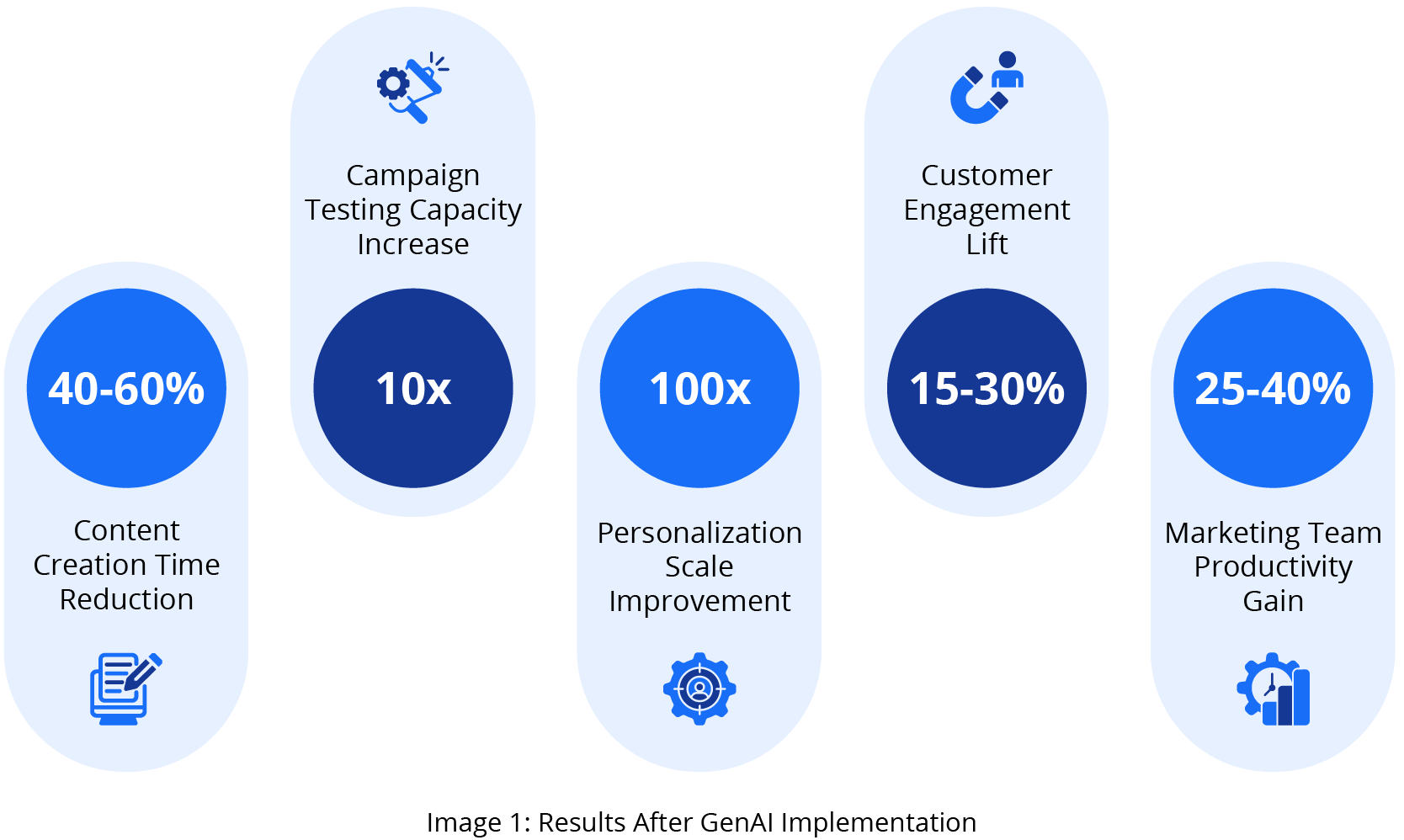
Content creation, testing, scaling, and personalization of campaigns, customer engagement management, and improving team productivity are a few of the key challenges that GenAI currently addresses when adopted across the marketing organization.
Research has shown that many companies have achieved impressive results, as summarized in Image 1.
The Business Case: What GenAI Delivers
Here are some use cases where GenAI can help in delivering actual results:
- Response Improvement: Up to a 40% increase in campaign response rates.
- Cost Savings: A reduction in deployment and production costs ranging from 25% to 35%.
- Reduced Cycle Time: Zalando trimmed production cycles from 6 to 8 weeks to 3 to 4 days using GenAI.
- Engagement Surge: IBM noted up to 26 times higher engagement with AI-generated content variations in pilot programs.
Real World Examples
The following examples elaborate on the success stories achieved by large MNCs globally:
- Coca-Cola - “Create Real Magic”
By allowing consumers to co-create over 120,000 branded variations, Coca-Cola reduced creative costs and achieved higher engagement rates. Beyond cost savings, the initiative provided unprecedented market testing data, which Coca-Cola’s marketing team used to refine larger campaign strategies. This is a clear example of GenAI turning customer creativity into actionable business intelligence. - Klarna - $10M in Savings
Klarna applied GenAI across marketing workflows (copywriting, imagery, and campaign assets), resulting in $10 million annual savings. More importantly, these freed resources allowed them to focus on strategic brand campaigns and accelerated their ability to test and iterate messaging in competitive fintech markets. - Zalando - Speed & Efficiency
Zalando cut campaign production cycles from 6 to 8 weeks to 3 to 4 days, reducing production costs by 90%. This speed-to-market advantage allowed Zalando to align campaigns more closely with seasonal fashion trends, translating operational savings directly into competitive differentiation in a fast-moving industry. - Netflix - Personalization Driving Retention
Netflix’s GenAI-powered personalization (thumbnails, recommendations) directly influences most of its viewing hours. The strategic outcome is reduced churn and increased customer lifetime value, showing that AI-driven personalization is not just about engagement but a core driver of revenue stability in subscription-based models.
Best Practices for Using GenAI in Marketing
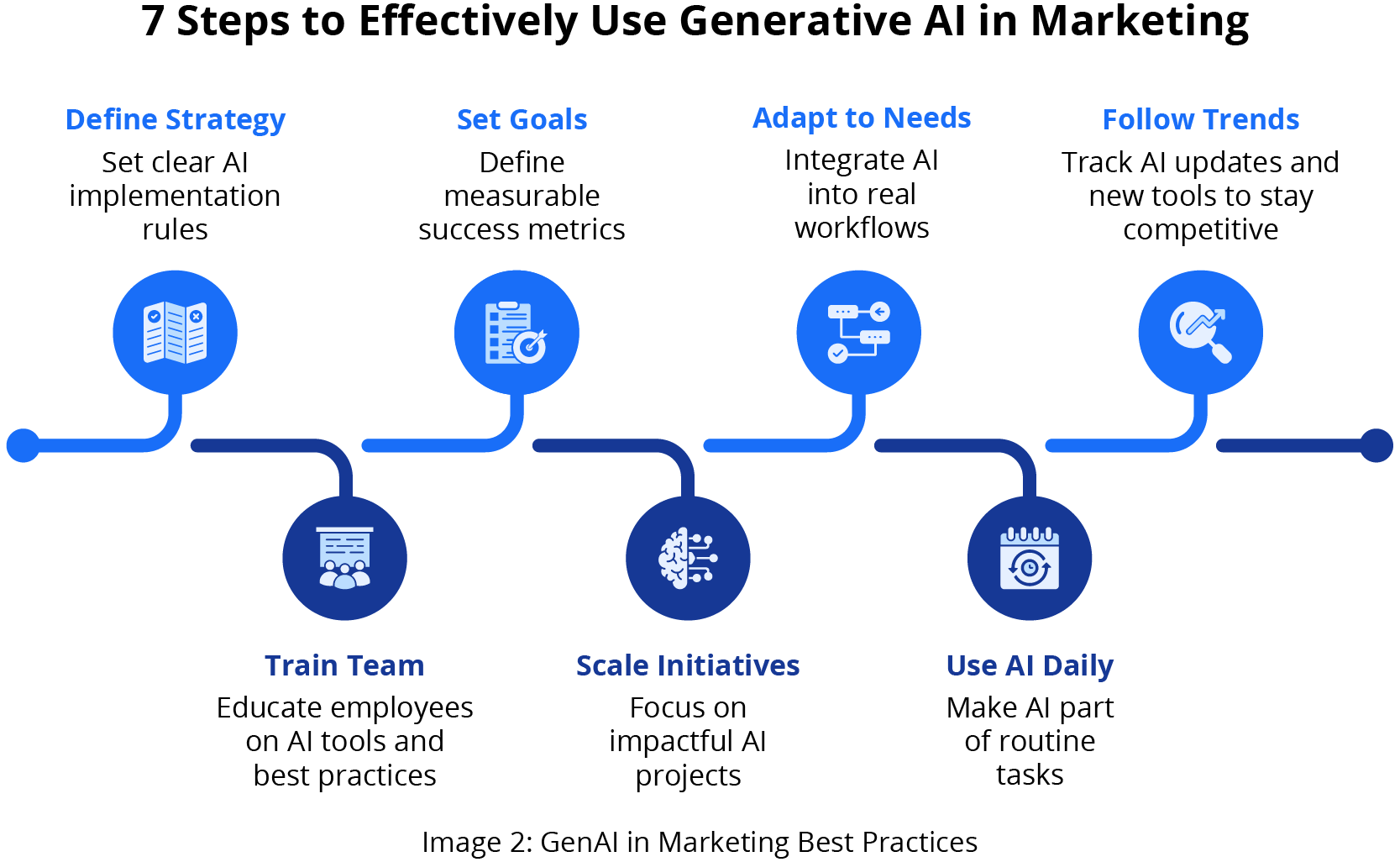
1. Keep Human Oversight: Use AI as a co-pilot, not a replacement
2. Protect Brand Voice: Train AI on your brand tone and messaging style
3. Prioritize Data Privacy: Ensure compliance with GDPR, CCPA, and other regulations
4. Balance Speed & Quality: Quick doesn’t mean careless; always review outputs
5. Experiment Relentlessly: Treat AI outputs as drafts; refine through testing
Phased Implementation Roadmap
After evaluating the strategic objectives, followed by technical and financial ones, it's time for organizations to adopt a phased implementation approach for GenAI applications to be infused into day-to-day activities within the organization. You should also define an effective change management plan to help employees and other stakeholders adopt the changes and understand why they are being made. This, in turn, improves employee satisfaction and increases the adoption rate.
Here is an ideal phase-wise approach to adopt:
Phase 1 (First 3 Months): Pilot
- Focus on low-risk, high-volume use cases (emails, ad variants)
- KPIs: response rate, cost per asset, production speed
Phase 2 (3 - 6 Months): Scale
- Expand to web and social personalization
- Integrate with CRM and CMS
Phase 3 (6 - 12 Months): Full Integration
- Develop end-to-end AI-assisted campaign workflows
- Implement governance, training, and change management strategies
Here are the key parameters in calculating the Return on Investment (ROI) for this initiative
1. Baseline: Map current spend on creative production + agencies
2. Pilot savings: Apply a 25–35% reduction to initial workflows
3. Revenue uplift: Multiply engagement lift (e.g., 20–40%) by average conversion/LTV.
4. TCO: Include licensing, integration, model training, and governance
5. ROI formula: (Incremental profit − TCO) ÷ TCO.
Risk Management & Governance
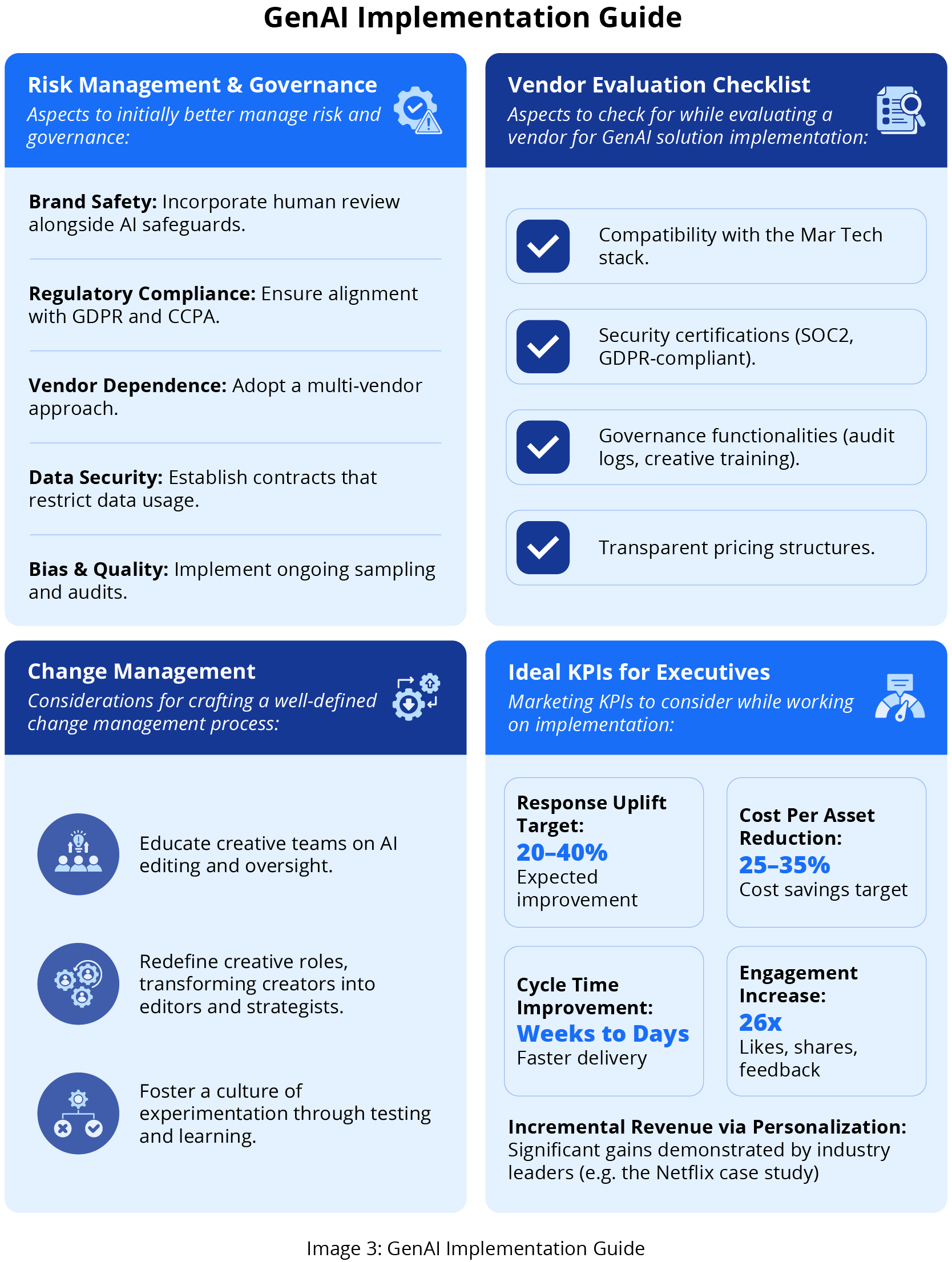
In parallel to the implementation, managing risk and establishing a thought-out governance plan are critical to the initiative's success. Especially since GenAI is a new technology to adopt globally, the risks and threats are yet to be uncovered in detail, unlike the typical cybersecurity challenges already known.
Vendor Evaluation Checklist
It is crucial to have a technology vendor who can understand the custom requirements and help implement them at scale with no known errors and impact on live systems. Typical vendors might not have experience dealing with artificial intelligence applications yet, and organizations must be extra cautious in assessing their capabilities and previous work before awarding a contract to such vendors.
Change Management
Implementation is beginning, and changing management is what it takes to keep the ball rolling. With effective change management policies and practices in place, organizations are set to experience the true benefit of GenAI applications.
Ideal KPIs for Executives
Measuring what's been done and analyzing how to scale it with the given tools and technology is critical for a marketing campaign to be successful.
Conclusion
This is a time when every organization worldwide is carefully scrutinizing Artificial Intelligence and its applications. It is also time to take action and adopt the early-stage AI applications and successfully integrate them into their regular business and marketing operations to achieve a sustainable competitive advantage.
Specifically, by adopting GenAI applications, marketers can achieve the best results through superior personalization, reduced operational costs, and accelerated time-to-market. The success of GenAI lies in how quickly and strategically organizations can implement it while managing associated risks with the help of a technology vendor.
References:
- McKinsey: How Generative AI Can Boost Consumer Marketing
- McKinsey: The Economic Potential of Generative AI
- Reuters: Klarna using GenAI to cut marketing costs by $10M annually
- Reuters: Zalando uses AI to speed up campaigns, cut costs
- Axios: IBM tests Adobe’s Firefly for personalized marketing
- Coca-Cola: Create Real Magic campaign
- Litslink: How Netflix Uses AI for Personalization