Optimizing Customer Experience via Customer Journey Orchestration
Journey orchestration has become a strategic MarTech imperative, eliminating data silos and enabling one-to-one engagement. Learn how premium e-tailers have seen churn reduction and loyalty boosts.
In the rapidly changing world of business today, personalized service will set you apart from your competition and contribute to your company's financial well-being. Customer Journey Orchestration (CJO) has become the cornerstone of a modern, strategic MarTech mandate to break down silos and facilitate personalized 1:1 customer engagement.
The global market will be worth $86.8 billion by 2034, and business leaders not investing in journey orchestration put themselves at risk of being left behind by leaner, customer-obsessed competitors.
What is Customer Journey Orchestration and Why Does It matter?
Customer Journey Orchestration is a cohesive, consistent delivery of a personalized experience as a result of collecting customer interactions across touchpoints. It harnesses real-time data and customer behavior insights to ensure that the right message, offer, or action is delivered at the right time through automation platforms that create seamless omnichannel customer journeys across every touchpoint.
The Business Case: Driving Revenue by Orchestrating Experiences
There are strong financial reasons to support the case for Customer Journey Orchestration. The market is growing at a 23.41% CAGR (Kings Research), and businesses that take this approach are seeing revenue growth of 10-20% and cost reductions of 15-25% (Source: PwC). And these aren't small gains - they are big things that dramatically impact the business and financial returns of shareholders directly. When evaluating marketing automation ROI, these journey orchestration implementations consistently deliver measurable returns.
Consider these documented results:
- Advanced marketing automation for e-commerce delivered remarkable results, with one company experiencing a 341% increase in conversions. The company also enjoyed 67% fewer cart abandonments and 215% growth in Customer Lifetime Value (Single Grain).
- A global manufacturer of appliances saw add-to-cart conversions rise by 22%, and an overall conversion rate increase by 106% (Medallia).
- Brands driving these types of omnichannel customer journeys see higher overall revenue (89%) vs. non-omnichannel brands (Renasence).
The effect on business goes beyond direct revenue numbers. Event-driven campaigns can drive click-through rates 112% higher, while recommendation engines driven by AI boost upsell by up to 30% (Marketing Sherpa).
These enhancements equal competitor advantages, which enable businesses to:
- Charge premium prices: Mature Journey Orchestration vendors benefit from an average 10-15% higher average order value, as customers receive the most relevant offers at exactly the time they open their wallets, which can translate to an increased willingness to pay a premium price (involve.me).
- Capture market share: Quick, contextually appropriate responses to customer queries and complaints help you seem nimble, taking customers from slowpoke or unresponsive competitors. Firms report their market share is rising 15% faster than others' (eduMe).
- Faster product adoption: Next-best-action recommendations are automated to direct users down onboarding and upsell flows, leading to quicker new features and service adoption.
The Integration Partner Imperative
The business case is apparently a no-brainer; achieving it, though, will rely heavily on selecting the best systems integration partner. Technology is an important part, but journey orchestration involves having the right technology and laying a foundation that allows for true personalization at scale.
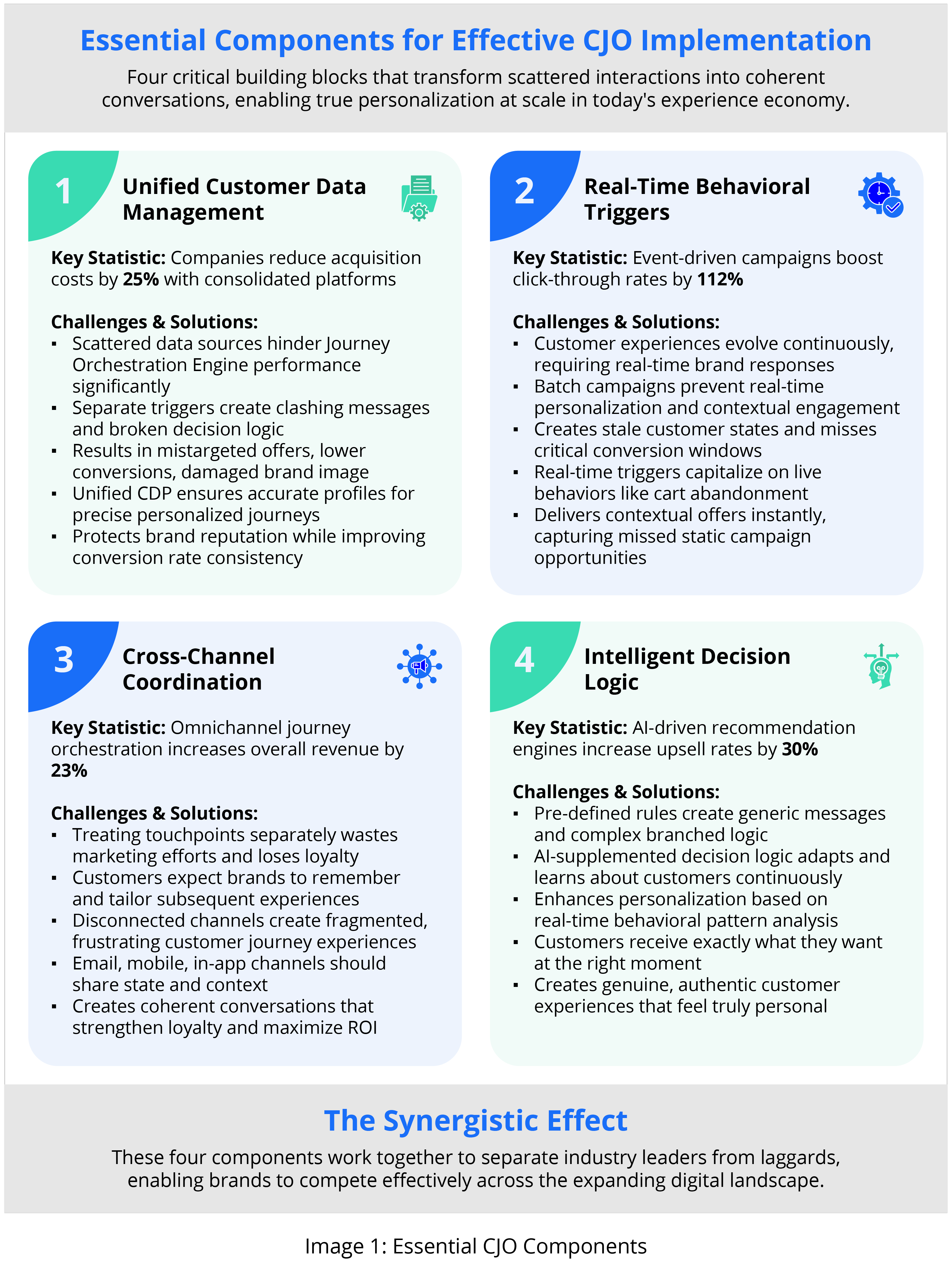
Four essential building blocks work in unison to make journey orchestration effective:
- Unified Customer Data Management
- Real-Time Behavioral Triggers
- Cross-Channel Coordination
- Intelligent Decision Logic
A good integration partner maximizes marketing automation ROI through deep expertise in wiring up these systems for your specific business needs. When your Journey Orchestration Engine has to pull in customer data from disparate sources instead of a single, centralized Customer Data Platform (CDP), you end up with an identity resolution nightmare.
A McKinsey report states that organizations focused on a single, unified data platform see 25% lower acquisition costs. Your integration partner is key to establishing that good foundation so that your journey orchestration effort realizes its promise and doesn't leave you with additional technical debt.
Risks of Inadequate Integration
Effective CJO is a journey: one that teems with technical difficulties and risks tripping, or even compromising, the best-laid business plans when they are not supported by the right technology infrastructure and organizational structures.
Data Latency and Synchronization
Slow data syncing from other systems creates out-of-date customer profiles, limited personalization, and poorly timed triggers. Organizations require low-latency pipelines driven by event streaming technology to keep everything fresh—that’s a lot of investment in data engineering and integration skills. Without that foundation, campaigns are slow and irrelevant, squandering opportunities and irritating customers.
Workflow Complexity and Scalability
A journey with nested decision trees generates huge processing amounts resulting in potential bottlenecks and slow performance. This requires investment from top architects and steady state tuning so as not to break the journey on high load. Firms face broken interactions and negative customer experiences that tarnish the business brand if they don't.
Real-Time Event Processing Constraints
Real-time processing is particularly critical for marketing automation for e-commerce, where split-second decisions can mean the difference between conversion and cart abandonment. At a minimum, infrastructure needs to ensure that responding to events in a sub-second time frame and quick API responses for the firing script do not defer or drop triggers altogether. Event brokers, message queues, and elastic cloud clusters are required for organizations to process streams in real time. Neglecting this investment can mean customers who don't receive well-timed nudges, abandoned potential sales, and systems that feel obsolete.
The Advantage of Experienced Partners
Experienced integration partners minimize these risks by providing proven methodologies and technical skills behind your journey orchestration effort. By supporting organizations to overcome implementation barriers through:
- A Staggered Approach: Solutions providers know that straightforward, outcome-oriented mandates are key to helping companies navigate complexity, keep momentum going, and deploy resources efficiently. Rushed, overengineered deployment typically results in stymied adoption and diluted organizational impact.
- Cross-team collaboration: Knowledgeable partners help create alignment among marketing, IT, and analytics teams. They also make it easy to establish a data governance framework, including role-based access controls and granular permissions that prevent misuse while enabling compliance with regulations such as GDPR.
- Active monitoring: Active monitoring and feedback arms can assist in early problem detection. This feedback loop keeps journey orchestration in lockstep with customer requirements, providing continued business value.
Final Thoughts
Modern customer journey orchestration revolutionizes traditional marketing by moving beyond static campaign messaging. It does this through intelligent, data-driven customer engagement solutions designed to produce measurable value and impact on the business. By becoming proficient at the building blocks of unified customer data, real-time behavioral triggers, cross-channel coordination, and intelligent decision logic, your company will deliver seamless experiences – which will improve consumer satisfaction, loyalty, and generate significant revenue.
Although CJO implementation issues may necessitate some level of technical proficiency, the business advantages can be impressive. A good integration partner will help you build a strategic approach to orchestration that would include iterative deployments and performance monitoring in real time throughout the life of the campaign or program.
What You Learn in this White Paper
Customer Journey Orchestration transforms scattered customer interactions into cohesive, personalized experiences across all touchpoints using real-time data and AI-driven automation. This comprehensive guide explains the four essential components: unified customer data management, real-time behavioral triggers, cross-channel coordination, and intelligent decision logic.
Companies implementing CJO report 10-20% revenue growth and 15-25% cost reductions. This white paper covers leading platforms, industry use cases, implementation challenges, and future trends toward autonomous customer engagement. With the market projected to reach $86.8 billion by 2034, CJO represents a competitive necessity for delivering exceptional customer experiences and sustainable business growth.
Here’s what you will learn after reading this white paper:
Core Concepts
- Definition and significance of Customer Journey Orchestration (CJO) in MarTech
- Four essential components for effective CJO implementation
- Key metrics to track when implementing journey orchestration
- Resource allocation and potential technical challenges
Implementation Knowledge
- Leading platforms and their unique advantages (Adobe, Salesforce, Braze, etc.)
- Industry-specific use cases across fintech and beauty/personal care sectors
- Market differentiation opportunities through personalized experiences
- Implementation best practices and cautionary considerations
Strategic Insights
- Future trends in AI-driven predictive personalization
- ROI expectations and performance benchmarks
- Cross-channel coordination strategies
- Data governance and technical infrastructure requirements
Download the white paper today to start your journey to business success. You can also contact our experts directly at www.gspann.com/contact-us.