
For as long as enterprises have run on dashboards, the number came from a report a person built, checked, and put their name on. You trusted the BI report because a human stood behind it. Now an AI agent answers the question directly, in plain language, and skips all of that.
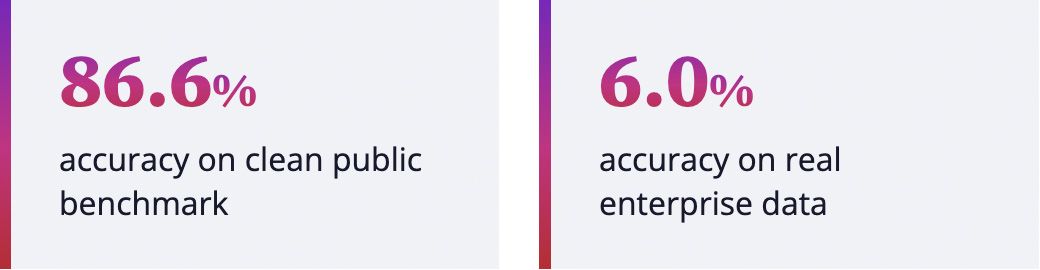
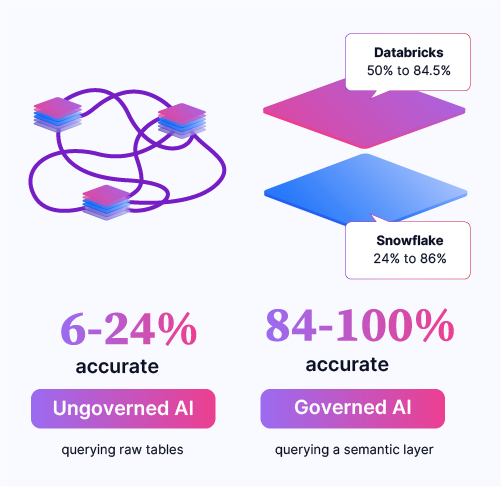
In June 2026, Databricks and Snowflake both launched semantic context layers to make AI answers trustworthy. They did so for a reason. On real enterprise data, the best AI agents answer correctly as little as 6% of the time, and the wrong answers look exactly like the right ones.
Here are the questions every business leader is asking about that gap, answered:
Why Does Our New AI Copilot Give a Different Number than the Dashboard?
Because nobody ever agreed on what the number means. The same metric gets computed different ways across BI tools, and self-service publishing spawns new conflicting definitions faster than governance can catch them.
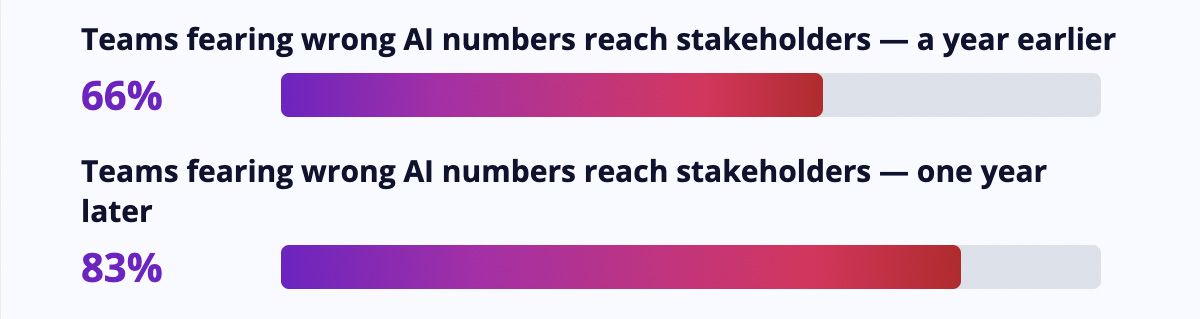
Gartner calls inconsistency across sources the single hardest data quality problem enterprises face. In dbt Labs’ 2026 survey, the share of teams naming trust in data a top priority jumped from 66% to 83% in a single year, and 71% now worry about wrong or hallucinated numbers reaching stakeholders. [1] [2]
Aren’t the Latest AI Models Accurate Enough to Trust with Our Data?
Not on your data. On industry benchmarks, top models score 86.6% on clean public datasets but as little as 6.0% on real enterprise databases, where hundreds of tables and ambiguous column names live.
The best specialized agent frameworks solve just 17 to 21% of real enterprise questions. The benchmark demo and your warehouse are different worlds. [3] [4]
Is This Just Hallucination? Won’t Someone Catch it?
It is worse than hallucination, and that is the trap. The AI is not inventing facts. It is pulling real numbers from real tables with the wrong filter or the wrong period. The result looks clean, sourced, and correct, which is exactly why it sails past review and into your board deck. [5] [6]
What is Confidently Wrong Data Actually Costing Us?
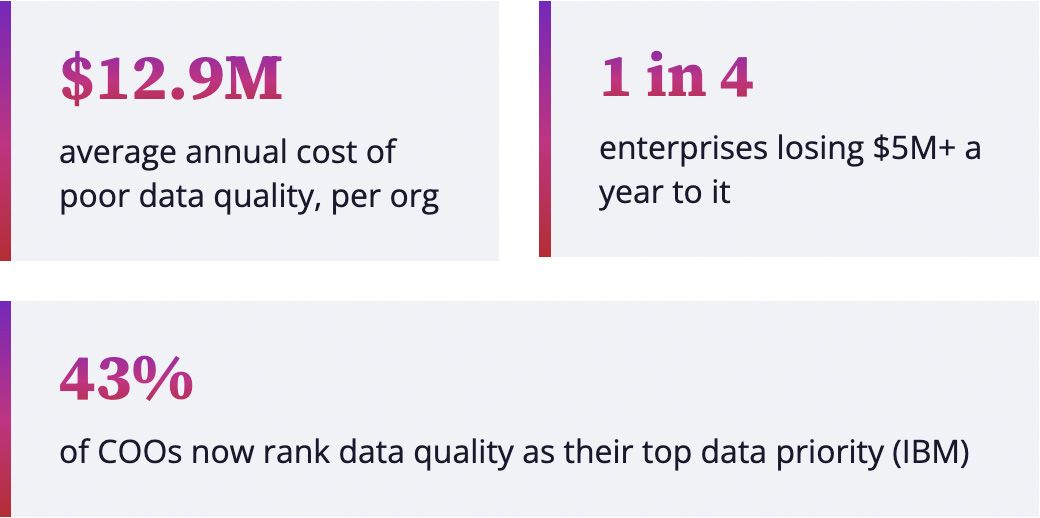
Gartner’s 2020 research put the average cost of poor data quality at $12.9 million a year per organization, a figure that predates today’s AI wave and has likely grown since.
IBM found 43% of COOs now rank data quality as their top data priority, one in four enterprises lose more than $5 million a year to it, and 7% lose more than $25 million. [7] [8]
How Would We Even Know When the AI is Wrong?
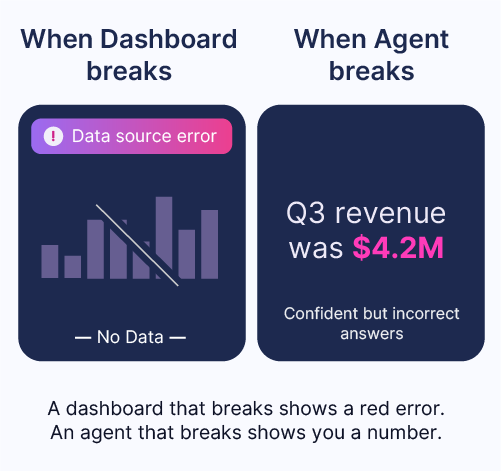
Usually, you would not. A bad answer and a good answer look identical: same confidence, same clean figure, same trusted-looking source.
A dashboard that breaks shows a red error. An agent that breaks shows you a number. The danger was never that the AI is wrong. It is that being wrong and being right look the same. [9]
Won’t a Bigger, Smarter Model Just Fix This?
No, because it is not a model problem. At Build 2026, Microsoft bet the enterprise AI race is won on data context, not model power, and analysts now frame stalled agents as a runtime and context problem, not a reasoning one.
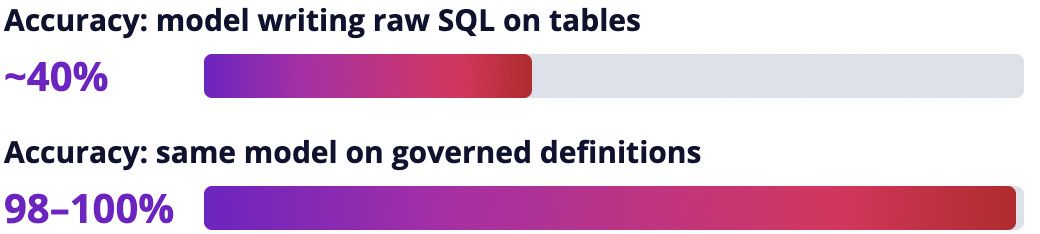
The proof: the same models that fail on raw tables jump to 98 to 100% accuracy when they query governed definitions instead. The model was never the bottleneck. [10] [11]
So What Actually Fixes it?
Governing the meaning of your data through a governed semantic layer, so the AI answers from certified metrics instead of guessing at raw tables. Do that and the failure mode flips: an ungoverned query fails silently with a plausible wrong number, while a governed one fails loudly with an error. [12]
The Data Vendors Say They Have Solved This. Have They?
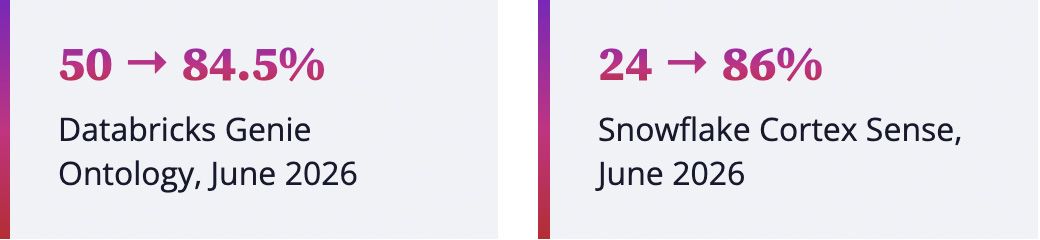
Inside their own walls, mostly. In June 2026 Databricks launched Genie Ontology and reported answer accuracy rising from 50% to 84.5%. Snowflake shipped Cortex Sense and reported 86% versus 24% for a generic model.
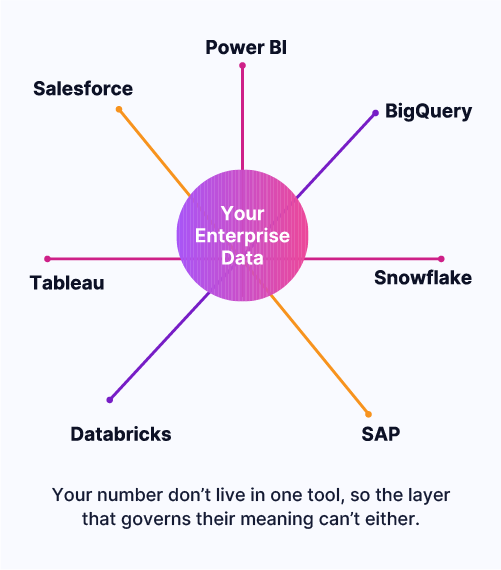
The catch: those gains are governed to one platform, and almost no enterprise runs on just one. Your numbers live in Power BI, BigQuery, SAP, and six other places that do not share a definition. [13] [14]
We Are Standardizing on MCP. Doesn’t That Connect Our Agents to Our Data Safely?
Model Context Protocol (MCP), an emerging open standard that lets AI agents plug into enterprise systems and data sources, connects agents to data. It does not make them agree on what the data means.
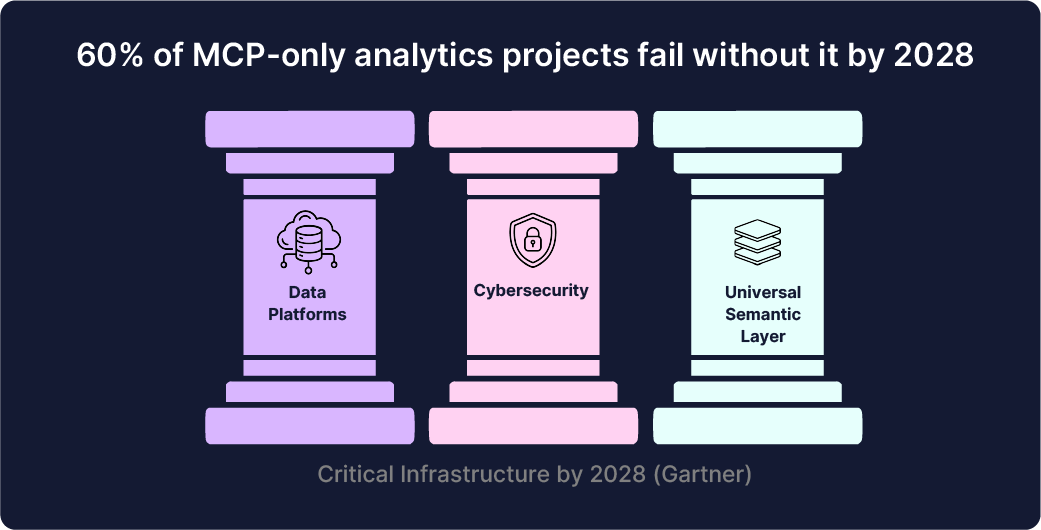
Gartner predicts that by 2028, 60% of agentic analytics projects relying only on MCP will fail, precisely because they lack a consistent semantic layer underneath. A universal plug is not a shared dictionary. [15] [16]

Is This a Data-Team Problem or a Board Problem?
Board. Gartner now says universal semantic layers will be treated as critical infrastructure by 2030, on the same level as data platforms and cybersecurity, with budget it calls non-negotiable.
When the thing that decides whether your AI can be trusted becomes a named budget line, it stops being a data-team chore. It becomes an executive one.
For organizations under the EU AI Act, the case is sharper still. The Act's transparency and record-keeping obligations make auditable, traceable AI answers a compliance requirement, and a governed semantic layer is what supplies the lineage behind them. [17] [18]
This Sounds Like Boiling the Ocean. Where Do We Start?
You do not govern everything. You start with the handful of KPIs that reach the board and one decision domain that matters, then expand from there.
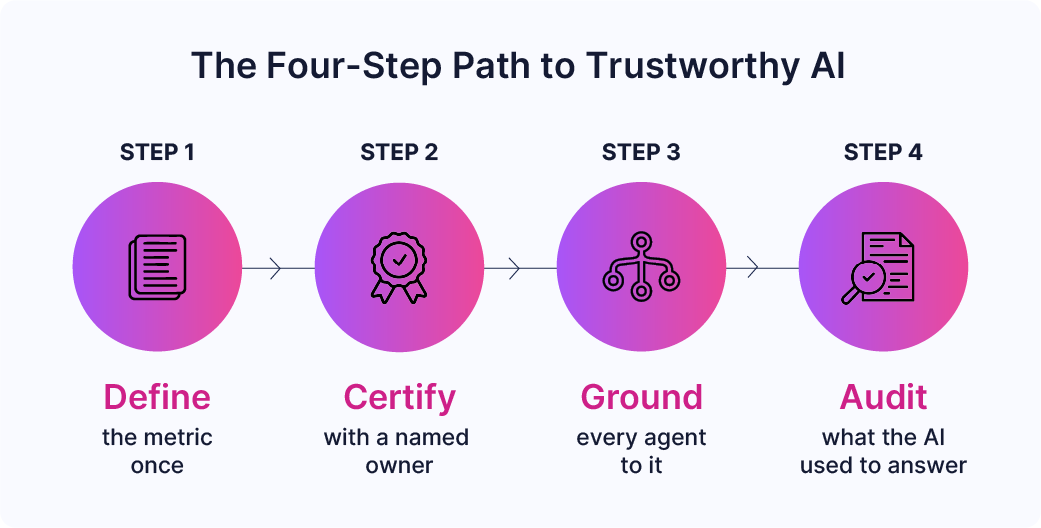
The sequence is simple: Define the metric once, Certify it with a named owner, Ground every agent to it, and keep an Audit trail of what the AI used to answer.
Forbes’ technology council said it plainly this year: agentic AI will not scale without enterprise context.
This takes real work up front: cataloging metric definitions, aligning business owners, and integrating tools across platforms. The payoff is an AI whose answers can be trusted. The alternative is one whose answers cannot. [19]
What Does Getting it Right Actually Look Like?
One governed answer, everywhere.
Picture a global skincare brand whose sales numbers were computed one way in Power BI and another in BigQuery, so its dashboards and its new AI assistant quietly disagreed.
The fix was not a new model. It was reconciling those definitions into a single governed layer, built on open tooling like OpenMetadata so the layer stayed portable across platforms rather than tied to one vendor, so every agent answered from certified metrics rather than raw-table guesses.
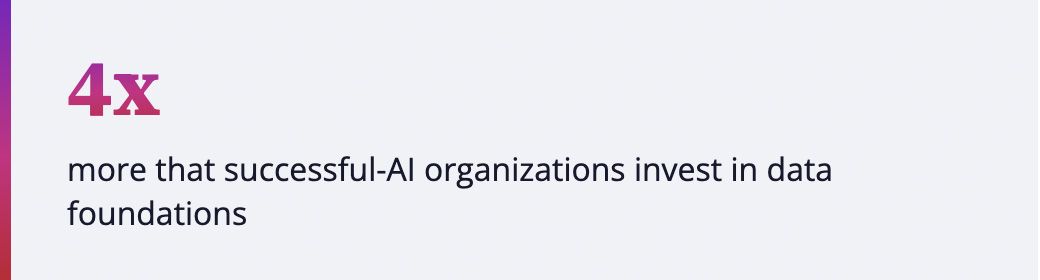
Gartner found the organizations that get this right invest up to four times more in exactly this data foundation. [20]
If We Fix the Context, What Actually Changes?
The AI stops being a confident stranger and becomes something you can audit. The silent wrong turns into a loud error you can see and correct before it reaches anyone. You are not buying a smarter model. You are finally giving the model something to be smart about. [21]
GSPANN's Take
Most companies will meet the accuracy problem by shopping for a better model. That is the wrong aisle. The distance between a 6% answer and an 84% answer was never intelligence. It was whether the AI stood on a definition the business had actually agreed on.
GSPANN calls the discipline that closes that gap data context engineering, and treats it as its own practice rather than a feature of any one platform. Vendors solve context inside their own walls. Data context engineering solves it across all of them, because your numbers do not live in one tool, so the layer that governs their meaning cannot either.
Data context engineering is a concrete body of work, not a slogan. It means cataloging and reconciling every conflicting metric definition across BI tools into one certified source, certifying each metric with a named business owner who is accountable for it, building platform-agnostic semantic models that sit above Power BI, BigQuery, SAP, and the rest, and tracking lineage so every answer an agent gives can be traced back to the definition it used.
The sequence GSPANN runs is simple to say and hard to fake. Define the metric once, certify it with an owner, ground every agent to it, and audit what the AI used to answer. Get that layer right and the silent wrong becomes a loud, catchable error. That is the difference between an AI you demo and an AI you trust in front of your board.
Here is the uncomfortable part. Your AI is already answering questions today, and the screenshots in your last board deck looked exactly as clean as the ones that were right. The work ahead is not making the AI sound more sure. It is making sure that when it speaks, it is reading from a number your company actually agreed on. Confidence was never the problem. Agreement is.
Knowing which of your AI's answers you can trust today is the first step, and data context engineering is how GSPANN gets there with data and analytics leaders: map the handful of metrics that reach your board, then govern the definitions behind them.
All References
Ref 1: https://bluepes.com/blog/multiple-versions-of-truth-kpi-misalignment
Ref 2: https://www.perceptive-analytics.com/why-enterprises-struggle-with-inconsistent-kpis-across-teams/
Ref 3: https://www.kaelio.com/blog/how-accurate-are-ai-data-analyst-tools
Ref 4: https://promethium.ai/guides/building-ai-agents-that-dont-hallucinate-enterprise-data/
Ref 5: https://promethium.ai/guides/building-ai-agents-that-dont-hallucinate-enterprise-data/
Ref 6: https://www.kaelio.com/blog/how-accurate-are-ai-data-analyst-tools
Ref 7: https://www.ibm.com/think/insights/cost-of-poor-data-quality
Ref 8: https://www.revefi.com/blog/business-operations-poor-data-quality-cost
Ref 9: https://docs.getdbt.com/blog/semantic-layer-vs-text-to-sql-2026
Ref 10: https://thenewstack.io/microsoft-build-2026-data-fabric-horizondb-ai-agents/
Ref 12: https://docs.getdbt.com/blog/semantic-layer-vs-text-to-sql-2026
Ref 13: https://atlan.com/know/ai-agent/databricks/genie-ontology/
Ref 14: https://atlan.com/know/snowflake/summit-2026-announcements/
Ref 16: https://atlan.com/know/gartner-context-graphs/
Ref 21: https://docs.getdbt.com/blog/semantic-layer-vs-text-to-sql-2026