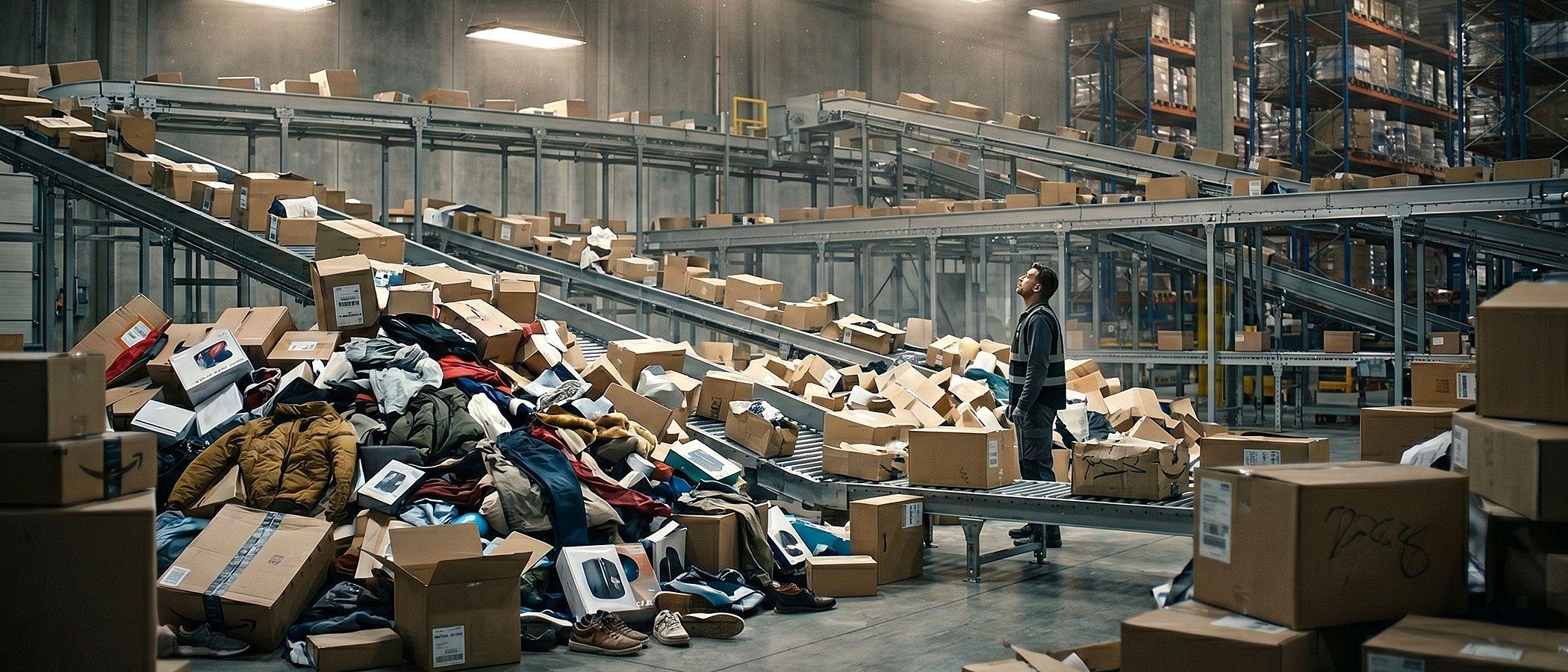

Returns are retail's quiet profit killer. Virtual try-on gets the headlines, but it only fixes one reason people send things back.
Here is what really drives returns, what actually reduces them, and what the early adopters already know.
$849.9 Billion in Returns, and the Online Problem is Getting Worse
- $849.9 billion in merchandise came back in 2025, or 15.8% of all US retail sales (NRF)
- Online return rate is 19.3%, nearly 1 in 5 items shipped comes back
- Gen Z shoppers averaged nearly 8 online returns per person last year (NRF)
- 9% of all returns are fraudulent (NRF); Appriss Retail and Deloitte put the 2024 dollar impact at $103 billion
Returns are not slowing down. They are accelerating, especially online, and fraud is compounding the damage.[1] & [2]

Returns Trigger a Second $200 Billion Problem, and Retailers Recover Only Half the Value
US retailers spend an estimated $200 billion annually recovering value from returns, yet recover only about 50% of a product's worth via resale, liquidation, or parts (McKinsey)
Over half of supply chain executives call dispositioning their top returns challenge (McKinsey)
1 in 4 transactions includes a "bracketed" item (consumer behavior of purchasing multiple versions of the same product with the intention of keeping only one and returning the rest.), and nearly three-quarters of sellers say this is rising (McKinsey/NRF)[3]

Why Returns Actually Happen: Five Root Causes
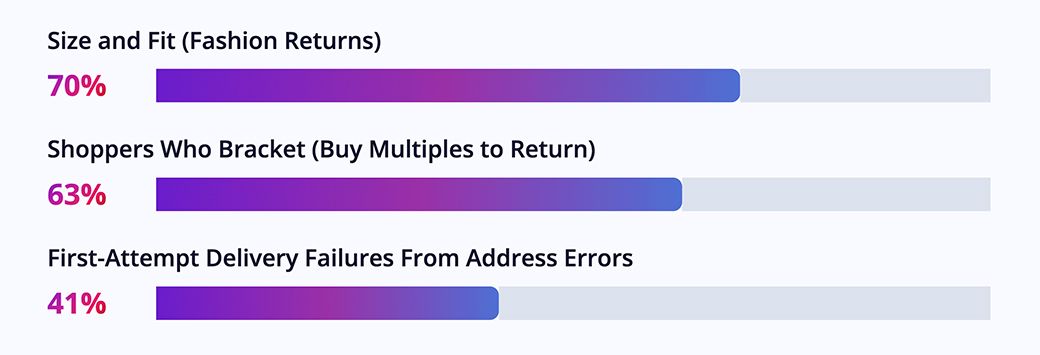
Size and fit: largest cause of fashion returns, roughly 70% of the category (McKinsey)
“Not as described”: products that do not match photos and copy (ReturnPrime)
Quality and defects: items arriving damaged or inconsistent
Bracketing: 63% of US shoppers admit to buying multiples planning to return some (ReturnPrime); 45% say “bending the truth” is acceptable (NRF)
Incorrect delivery address: up to 41% of first-attempt delivery failures trace to address errors (Digital Commerce 360). Missed packages become returns, RTO, or escalations.[4], [5], [6] & [7]
Product Data and Content Enrichment Attacks “Not as Described” Returns
What the product page says is what the shopper gets:
- “Not as described” returns happen when the product page doesn't match what arrives — wrong dimensions, missing attributes, or imagery that misleads shoppers
- AI-generated product content cuts manual content effort by 70%
- ContentHubGPT uses generative AI and real-time trending keywords to turn raw product data into SEO and GEO ready descriptions in a fraction of the time, keeping every product page accurate, on-brand, and discoverable in both search results and AI shopping assistants
- Accurate product data is the first line of defense against mismatch returns.[8], [9] & [10]
AI Sizing and Virtual Try-on Attack Fit Returns Helping Shoppers See the Right Fit Before They Buy
- Size and fit is the single largest cause of fashion returns, roughly 70% of the category (McKinsey)
- Virtual try-on uses generative AI and body modeling so shoppers see fit before they buy; AI sizing engines recommend the right size from past purchases, garment data, and fit reviews
- True Fit reports return-rate reductions of up to 40% from AI-powered fit tools

AI-Driven Address Normalization Attacks Delivery Returns
Fixing the hidden driver of Returns to Origin before parcels leave the warehouse:
- Up to 41% of first-attempt delivery failures trace to address errors, and missed packages become returns, Returns to Origin (RTO), or customer service escalations (Digital Commerce 360)
- T5-based transformer models standardize fragmented address inputs into postal-authority format before the package ships
- GSPANN has an AI and Machine Learning-based address normalization blueprint and deploys this for omnichannel retailers
- Clean the address before the parcel moves. It is the cheapest return to prevent.[15] & [16]
AI Fraud Detection Attacks the $103 Billion Fraud Leak
Stopping refund abuse without breaking the customer experience:
- 9% of all returns are fraudulent, and Appriss Retail and Deloitte put the 2024 dollar impact at $103 billion
- AI models score every return request in real time using customer history, transaction patterns, and product signals to flag suspicious activity before a refund is issued
- 85% of retailers now deploy AI for return fraud scoring (NRF), enabling tiered policies where trusted customers keep frictionless returns and flagged customers face stricter terms
The goal is not to punish legitimate returns. It is to make fraud unprofitable while keeping the experience seamless.[17], [18] & [19]

Computer Vision in Reverse Logistics Attacks Dispositioning Cost
Routing returned items to their highest-value path automatically:
- Over half of supply chain executives call dispositioning their top returns challenge (McKinsey)
- Computer vision auto-grades each returned item's condition and routes it to the highest-value path, restock, refurbish, liquidate, recycle, or parts, instead of defaulting everything to slow manual inspection
- Two Boxes processes almost $1 billion in returned inventory annually (FreightWaves)
The returns warehouse is becoming an AI-powered sorting center.[21] & [22]

GSPANN'S PERSPECTIVE
Four Fixes to the Commerce Stack That Solve Returns at the Root
Poor product data and poor address data are the same problem: incomplete information, wrong outcome. Shoppers cannot picture the fit. AI agents cannot recommend. Parcels miss the door. Here is what we recommend for leaders rebuilding the stack underneath:
1. Make Every Product Page Tell the Truth: Descriptions, specs, and imagery that match reality across every channel mean shoppers buy with confidence and mismatch returns drop.
2. Let Shoppers See the Fit Before Checkout: Virtual try-on, AR, and AI sizing move “will this fit me” out of the return window and into the decision moment.
3. Clean the Address Before the Parcel Moves: Standardize every shipping address at capture, so packages arrive first time and Returns to Origin stop quietly eating margin.
4. Architect for Change, Not for a Single Vendor: A composable, API-first stack lets you add, swap, and upgrade layers as the market shifts, without replacing the core.
The retailers winning the next five years will be the ones whose product pages, try-on, fraud signals, and address data all speak the same language. That is how returns stop being a leaking cost and start becoming a competitive advantage.[23] & [24]
Reference Links
[1] NRF — $850B in returns in 2025
[2] Appriss Retail — Fraudulent returns cost $103B
[3] McKinsey — Modernizing reverse logistics with AI
[4] GSPANN — Address normalization blueprint
[5] Digital Commerce 360 — Bad address data at checkout
[6] ReturnPrime — E-commerce return trends
[7] NRF — Consumer return and bracketing behavior
[8] ReturnPrime — “Not as described” return causes
[9] GSPANN — Product Experience Management
[10] ContentHubGPT — AI product content platform
[11] McKinsey — Returns management for apparel
[12] Zalando — Virtual fitting room with 3D avatar
[13] Happy Capy Guide — AI virtual try-on 2026
[14] True Fit — AI sizing by reviews
[15] GSPANN — AI/ML address normalization
[16] Digital Commerce 360 — Address data failures
[17] NRF — Return fraud and AI detection
[18] Appriss Retail — Annual fraudulent returns research
[19] FreightWaves — Two Boxes AI returns platform
[20] McKinsey — Reverse logistics with AI
[21] McKinsey — Dispositioning challenges
[22] FreightWaves — Two Boxes $1B+ inventory