Enterprise brands are no longer asking if they should adopt AI. They're focused on how to scale it, govern it, and turn it into measurable business outcomes.
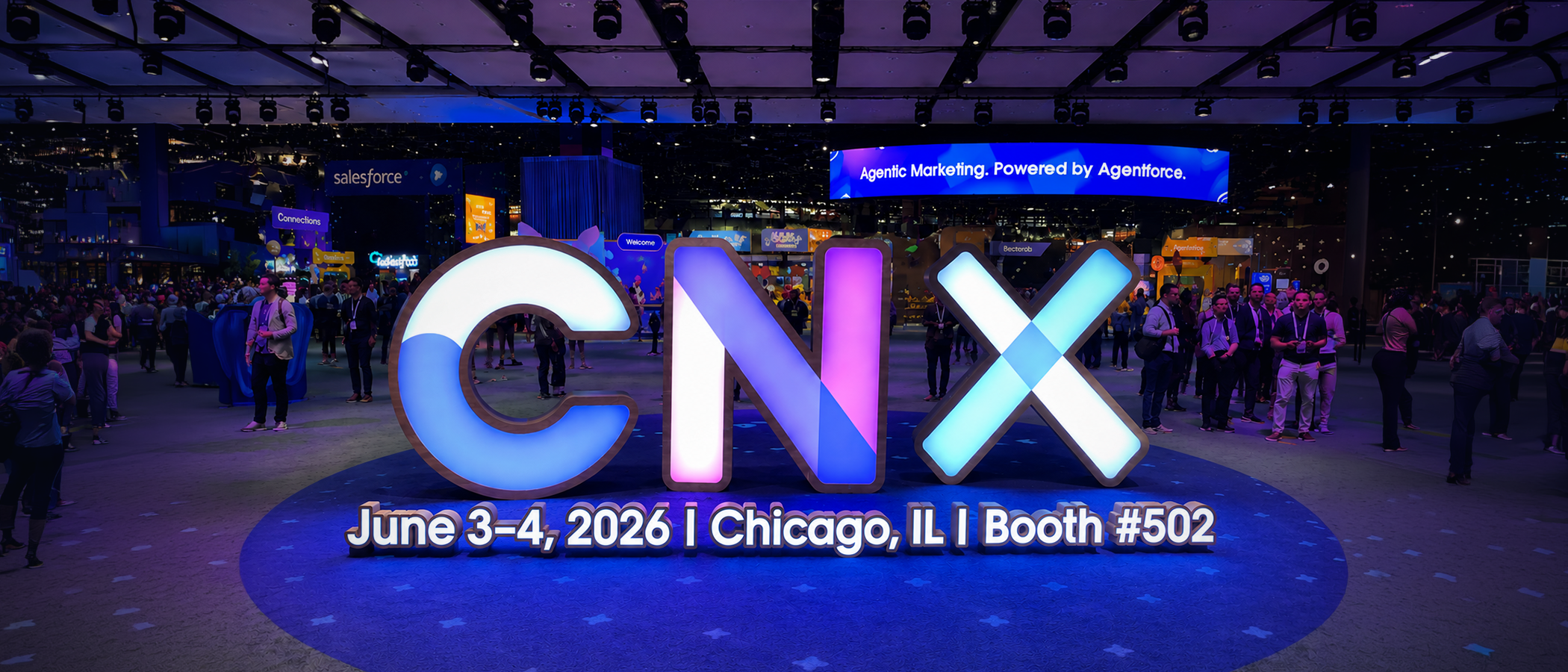
Over two days in Chicago at Salesforce Connections 2026, our team spoke with retailers, manufacturers, and digital leaders navigating that exact challenge. The conversations reinforced a belief we've held from the start: Agentforce is only as powerful as the foundation behind it.
From connected customer data and modern commerce architectures to the operational building blocks required to support autonomous agents, one theme surfaced again and again: success with Agentforce starts long before the first agent goes live.
Here's what we learned, what we shared, and what it means for organizations looking to move from AI ambition to AI impact.
The Big Theme: From Agentic Hype to Agentic Execution
If Salesforce Connections 2026 had a headline, it was this: the conversation has moved beyond AI potential to AI execution. Salesforce's vision of "Marketing Makers" painted a future powered by AI agents, but the real takeaway was that agentic marketing and commerce depend on something less glamorous: connected data, strong governance, and architectures built for scale.
Trust emerged as a defining challenge. While businesses are racing to adopt AI agents, consumers remain cautious. Brands must balance automation with transparency, control, and accountability. At the same time, the shift from SEO to GEO (Generative Engine Optimization) is reshaping digital discovery, forcing organizations to rethink how their content is found, interpreted, and recommended by AI.
Another standout trend was the rise of Slack as a hub for agentic workflows, where people and AI agents collaborate side by side. Together, these themes reinforced a simple reality: the winners in the agentic era won't be the brands with the most AI. They'll be the ones with the strongest foundation beneath it.
What We Brought to Connections
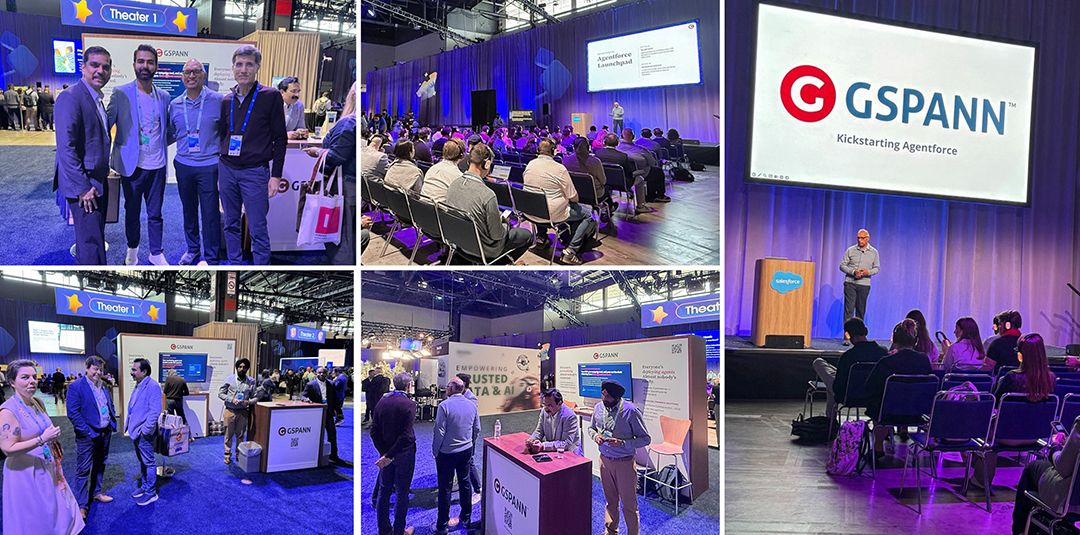
Our booth was centered on a straightforward premise: May the Agentforce Be With You!
We came to help enterprise brands connect two things that are too often treated as separate workstreams: customer data and commerce execution. Because you can't build effective AI agents on fragmented data, and you can't modernize commerce without a clear integration strategy.
Here's what we showcased:
Connected Customer Profiles: Unifying data across Marketing Cloud, Sales Cloud, Service Cloud, and Loyalty into a single, AI-ready view of the customer. This is the prerequisite for every agentic use case, and most teams are still not there.
AI-Ready Data Foundations: Governance, Trust Layer readiness, and the data harmonization work that makes Agentforce deployments trustworthy and scalable rather than fragile experiments.
Modern Commerce Architecture: Migrations from legacy storefronts (AEM, SiteGenesis, proprietary systems) to SFCC SFRA with composable MACH architecture, MuleSoft-powered integration, and omnichannel inventory management including BOPIS.
Mobile Commerce Acceleration: React Native apps built on SFCC in as little as three months, with Einstein AI personalization and proven results (1M+ downloads, 4.5-star ratings).
CX and Compliance Integration: Salesforce Service Cloud integrated with contact center platforms like NICE inContact, enabling complete call recording with real-time sensitive data masking.
Praveen Chandra's Theater Session: The 7 Building Blocks
One of the highlights of our participation was a theater seson led by Praveen Chandra, Business Head — Digital Marketing, Information Analytics & ERP.
His session, "Kickstarting Agentforce: Building Blocks to Your First Agent," tackled head-on the question that dominated hallway conversations all week: Why do most Agentforce projects stall before they ever deliver?
Praveen walked through the 7 foundational building blocks that determine whether an Agentforce program ships or stalls in its first 90 days. The session covered how to select the right first use case tied to measurable P&L impact, how to set up human-in-the-loop checkpoints, and how to build a practical 90-day roadmap that includes simulation testing, evaluation frameworks, and ROI measurement.
The response in the room made one thing clear: teams don't lack ambition; they lack a structured starting point. That's the gap this session was designed to fill.
Our Leadership on the Ground
Both days at Connections were anchored by two of our senior leaders who brought deep expertise and genuine enthusiasm for the conversations happening at the booth.
Between Rama's deep commerce architecture expertise and Praveen's marketing and data analytics perspective, our booth conversations covered the full spectrum — from SFCC migration strategy to Agentforce readiness assessments to MuleSoft integration planning.
What We Heard: The Conversations That Mattered
Beyond the sessions and keynotes, the most valuable part of any event is the unfiltered, booth-side conversations. Here's what came up again and again:
We know we need Agentforce, but we don't know where to start. This was by far the most common theme. Teams are excited about agentic AI, but the gap between the demo and a production-ready agent feels enormous. That's exactly why Praveen's session on the 7 building blocks resonated so strongly, it gave people a concrete first step.
Our data isn't ready. Connected customer profiles sound simple in a keynote. In reality, most enterprise brands have customer data scattered across Marketing Cloud, Service Cloud, commerce platforms, loyalty systems, and third-party analytics tools. Before any AI agent can be effective, that data needs to be harmonized, governed, and made accessible. This is foundational work, and it's where a significant portion of our conversations at the booth focused.
We're stuck on legacy storefronts. Whether it's AEM, SiteGenesis, or a custom-built platform that's become unmaintainable; teams know their current commerce architecture is holding them back. The shift to SFCC SFRA with composable MACH principles isn't just a technology upgrade; it's a strategic unlock for everything else they want to do with AI and personalization.
How do we build trust with customers when AI is making decisions? Echoing the MIT research presented at the event, brand teams are genuinely grappling with how to deploy AI agents in customer-facing contexts without eroding the trust they've built. This isn't just a UX problem, it's a governance, transparency, and policy challenge that needs to be baked into every Agentforce deployment from day one.
Taking the Theater Session Further: Join Our Upcoming Webinar
If our theater session sparked ideas about what's possible with Agentforce, the webinar is where we'll dive into the details of how to make it happen.
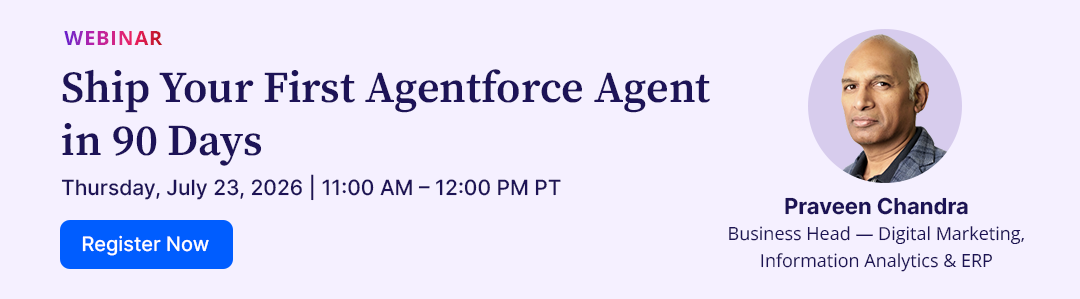
Join Praveen Chandra, Business Head – Digital Marketing, Information Analytics & ERP, for a 60-minute hands-on session focused on one question: How do you get Agentforce into production and delivering measurable business value in the first 90 days?
In this deeper discussion, attendees will learn:
- The seven building blocks that determine whether an Agentforce initiative scales successfully or stalls after the pilot phase
- How to identify a high-impact first use case tied to a tangible business outcome
- A practical Trust Layer framework covering governance, masking, grounding, and fallback policies
- A 90-day rollout roadmap featuring simulation testing, human-in-the-loop checkpoints, and measurable ROI milestones
Drawing from real-world deployments, this session focuses on proven implementation patterns, lessons learned, and the operational realities of moving from AI experimentation to enterprise adoption.
📅 Thursday, July 23, 2026 | 11:00 AM – 12:00 PM PT (11:30 PM IST)
🔗 Register here: Ship Your First Agentforce Agent in 90 Days
Looking Ahead: What Connections 2026 Means for What's Next
Salesforce Connections has always been the event where marketing, commerce, and data teams come together to figure out what's next. This year, "what's next" felt more tangible and more urgent than ever.
The industry is at an inflection point. Agentic AI isn't coming; it's here. But the brands that will succeed aren't the ones rushing to deploy the flashiest agent. They're the ones doing the foundational work — connecting their data, modernizing their architecture, building trust layers, and creating roadmaps that are realistic about what it takes to get from experiment to production.
That's the work we do. And after two days of conversations in Chicago, we're more confident than ever that the market is ready for it.
Continue the Conversation
Didn't make it to Connections? The conversations don't stop in Chicago.
Whether you're exploring Agentforce readiness, planning a commerce platform migration, or trying to figure out how to unify your customer data — we'd love to talk.
Feel free to reach out to us: marketing.team@gspann.com