
Most B2B leaders still talk about AI as something they add to commerce. A chatbot here, a recommendation engine there. That framing expired this quarter.
With B2B Online Chicago 2026 opening next week (May 4-6), here are 10 data points that expose how fast agentic commerce is rewriting the B2B playbook and what it will take for catalogs to stay in the consideration set.
1. By 2028, 90% of B2B Buying Will Be Agent-intermediated
The agentic shift is not a distant forecast, it is a two-year runway.
Gartner's top strategic prediction for 2026 is that 90% of B2B buying will be AI-agent intermediated by 2028, pushing over $15 trillion through agent exchanges.
That is roughly half of US Gross Domestic Product moving through machines acting on behalf of buyers. Every Chief Technology Officer (CTO) and Vice President (VP) of Digital has one budget cycle to decide whether the catalog is built to be read by a machine or by a human who no longer exists in the flow. Agent-readiness is the new commerce architecture mandate. .[1] & [2]

2. Rep-free Buying is Already the Norm. 67% of B2B Buyers Prefer it
Gartner's March 2026 survey of 646 B2B buyers puts hard numbers on a shift most sales organizations are still denying:
- 67% of B2B buyers now prefer a representative-free experience
- 45% used AI during their most recent purchase
- Nearly half of recent B2B deals had AI in the loop before a human rep was ever contacted
Any supplier evaluation, shortlisting, and quote flow tuned for a rep to nudge forward is optimizing for a journey that has already ended.[3] & [4]

3. Platforms Have Already Made Their Call. Adobe and Shopify Are Agent-ready
The infrastructure race for agentic commerce is already underway, and the biggest platforms are not waiting:
- Adobe Commerce committed to both the Universal Commerce Protocol (UCP) and the Agentic Commerce Protocol (ACP) in February 2026, the two emerging standards for how AI agents query catalogs and transact
- Shopify made agentic storefronts available to millions of merchants as of March 2026, with products discoverable directly inside ChatGPT
- The question is no longer whether to prepare, it is how fast enterprises can meet the standards their commerce platform is about to expose
The platforms have moved. The catalogs have not. .[5] & [6]
4. AI Agents Do Not Call to Clarify. They Skip to the Next Supplier
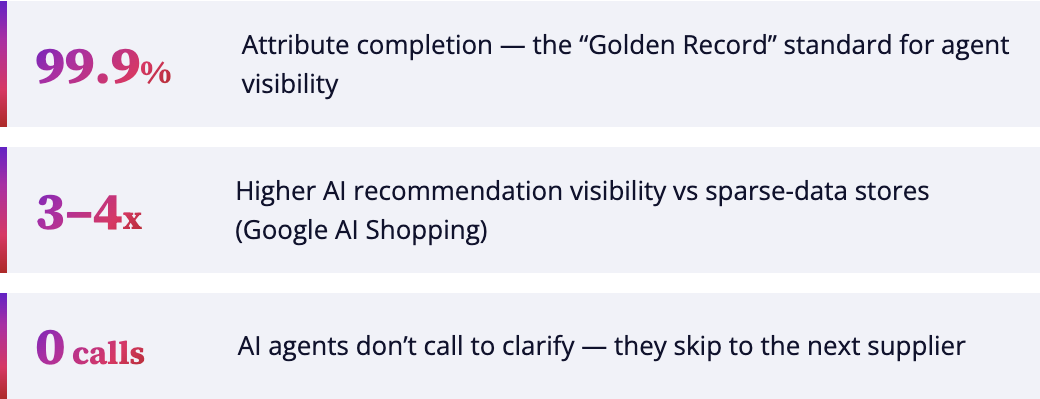
The uncomfortable truth about agent behavior is that incomplete data is now a deal-breaker:
- A human buyer might call to clarify a missing dimension, an AI agent simply skips to a supplier whose data answers the question cleanly
- Stores with 99.9% attribute completion, the so-called Golden Record, see 3 to 4x higher visibility in AI recommendations versus sparse-data stores (Google AI Shopping)
- Most B2B catalogs still live in PDFs and batch syncs, with product content embedded in marketing copy instead of as discrete attributes
Incomplete catalogs are now a revenue leak, not a hygiene issue.[7] & [8]
5. Answer Engine Optimization is Disrupting Search Engine Optimization
Buyers no longer open ten tabs, they ask one Large Language Model (LLM) and receive a synthesized answer. HubSpot launched a dedicated Answer Engine Optimization (AEO) product on April 14, 2026, signaling this is now a formal marketing discipline.
The strategic question has shifted from "where do we rank" to "are we in the answer." If a buyer's AI assistant does not cite your brand in a category answer, you are not in the consideration set.[9] & [10]
6. Seller-side Agents Are Now Negotiating With Buyer-side Agents
Forrester's 2026 predictions expose a shift most sellers have not priced in yet. 20% of B2B sellers will be forced to engage in agent-led quote negotiations in 2026, responding to AI-powered buyer agents with dynamically delivered counteroffers via seller-controlled agents.
That is agent-to-agent quote negotiation, happening live, right now. Suppliers without a real-time pricing Application Programming Interface (API) will see win rates collapse quietly, the buyer's agent never even sends an email. The deal is lost in a protocol handshake, not a conversation.[11]

7. AI Agents Do Not Browse Like Humans. They Query Four Things, Constantly
Mirakl's 2026 B2B commerce research identifies the structural problem most enterprises have not modeled. AI agents do not browse, they query four critical elements constantly, pricing, promotions, inventory availability, and delivery estimates, and they expect each to be accurate in real time.
Agents perform rapid, multi-step searches and apply complex filters, dramatically increasing the API calls and database queries hitting commerce systems.
Enterprises running monolithic commerce platforms or batch-syncing inventory to the storefront will see latency spike and conversion collapse the moment agentic traffic scales. The shift is not just about visibility, it is about whether the stack can handle being the supplier of choice.[12]]
8. The Winners Are Rebuilding Foundations, Not Buying Shiny Tools
Top performers are fixing the data foundation first, not buying agentic AI tools first.
McKinsey's State of AI research, refreshed in 2026 commentary, finds high performers are 3x more likely to fundamentally redesign their workflows around AI rather than layer it on top of existing processes, and only 6% of organizations qualify as AI high performers tied to material Earnings Before Interest and Taxes (EBIT) impact.
That means structured product data, real-time pricing APIs, Enterprise Resource Planning (ERP) and Product Experience Management (PXM) wired to the commerce layer, and governance on what agents can do autonomously. The unglamorous work is the moat. [13] & [14]

9. Product Data Quality is the Single Biggest Agent-readiness Blocker
Agents are only as good as the data they read, and most B2B data is not built for machines:
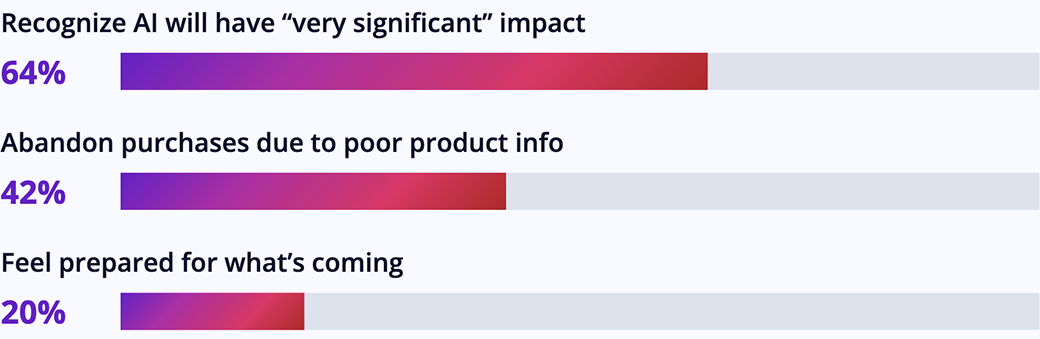
- 64% of B2B leaders recognize AI will have a "very significant" impact on digital sales, but only 20% feel prepared for what's coming (Mirakl 2026 commerce research)
- 42% of customers abandon purchases due to insufficient product information, and over a quarter abandon due to poor image quality, agents inherit and apply the same evaluation criteria at scale
- B2B catalogs that still live in PDFs, EDI feeds, and spreadsheets must be converted into agent-ready content, modern AI-powered platforms now do this in days instead of months
Clean data is the entry ticket to agentic commerce, not an optimization.[15] & [16]
10. AgenticLift is Live. The Tooling Race for B2B Commerce Has Started
The market is no longer theorizing about agent-ready commerce, the platforms are shipping. commercetools launched AgenticLift on January 21, 2026, a fully managed layer that connects existing catalogs, pricing, and transactions to AI channels including ChatGPT, Gemini, and Microsoft Copilot, without replatforming.
Forrester projects one-third of B2B payment workflows will leverage AI agents by end of 2026. The window for "we will get to it next year" closed in Q1.
Enterprises that wait now compete against suppliers whose stack is already responding to agent-led demand.[17] & [18]

GSPANN's Perspective: Your Commerce Stack Needs to Speak to Machines
The commerce stack most enterprises run today was designed for a world where humans searched, browsed, and clicked. That world is disappearing. What is replacing it demands three capabilities:
- Agent-readable product content
Attribute-complete, channel-consistent catalogs are how products get surfaced inside ChatGPT, Perplexity, and procurement agents. GSPANN's ContentHubGPT uses generative AI to turn raw product data into structured, AI-discoverable content at scale. - Real-time commerce APIs
Agents do not wait for nightly batch syncs. GSPANN's commercetools and Adobe Commerce engagements align the stack with UCP and ACP standards so pricing, availability, and configuration are live the moment an agent asks. - ERP to commerce integration
The back office must speak the same language as the front door. Our Application Services practice wires ERP, PIM, and commerce into a single orchestration layer that agents can trust.
GSPANN's Digital Commerce practice works across commercetools, Adobe Commerce, and BigCommerce to help manufacturers, distributors, and retailers build agent-ready commerce systems where every product is connected, governed, and discoverable by both humans and machines.[19] & [20]
Meet us at B2B Online Chicago 2026 (May 4–6, Chicago Marriott Downtown) to explore how we can help you rewire your commerce stack for the agentic era.

All References
Ref 6: https://www.shopify.com/blog/agentic-commerce
Ref 8: https://www.iovista.com/blog/machine-readable-b2b-ai-visibility/
Ref 9: https://www.martechnotes.com/hubspot-launches-aeo-and-ai-prospecting-agent-in-spring-2026-spotlight/
Ref 12: https://www.mirakl.com/blog/top-5-ai-trends-in-b2b-reshaping-commerce-in-2026
Ref 14: https://www.cfogrowthadvisors.com/post/how-finance-teams-use-ai-today-mckinsey-2026
Ref 15: https://www.mirakl.com/blog/top-5-ai-trends-in-b2b-reshaping-commerce-in-2026
Ref 16: https://www.metarouter.io/post/agentic-commerce-trends-statistics
Ref 18: https://commercetools.com/blog/agentic-commerce-in-b2b-from-efficiency-to-autonomy
Ref 19: https://www.gspann.com/services/digital-commerce
Ref 20: https://contenthubgpt.gspann.com