
For 25 years, retail e-commerce ran on the search bar. Type two words, scan a ranked list, and click. Walmart disclosed that half of its app search users have stopped doing that.
About 50% of Walmart app search users now talk to Sparky, the retailer's generative AI shopping assistant, and those users build baskets 35% larger than non-Sparky shoppers.
The search bar is no longer the only front door. The chat bar is the new one, and the conversion economics just shifted.
Here is what Walmart got right, what the rest of retail is racing to copy, and where the bots are going wrong.
1. Half of Walmart’s App Users Now Shop Through a Bot. Their Baskets Are 35% Bigger
According to Walmart's Q4 FY26 earnings call record, about 50% of Walmart app users have interacted with Sparky, the retailer's generative AI shopping assistant. Sparky users build baskets 35% larger than non-Sparky shoppers.
This is the first time a Tier-1 retailer has disclosed conversational commerce numbers at this scale.
The chat bar is no longer experimental. It is generating measurable revenue. [1] & [2]

2. Sparky Does Not Return a Ranked List. It Decides What to Show
Type "best sunscreen for sensitive skin under thirty dollars" into a search bar and you get a wall of products.
Ask Sparky the same thing and you get a recommendation. The shift is from retrieval to personalized judgment.
Walmart trained Sparky on retail-specific data, not a generic model, so it understands intent and context, not keywords.
The customer no longer sorts the results. The bot already did. [3]
3. The Most Interesting Sparky Purchases Never Started as Searches
Top items bought through Sparky inside ChatGPT are vitamins and protein supplements.
The conversations start with prompts like "I just started GLP-1s, what do I need to know." That’s a health conversation that ends in a Walmart purchase.
This proves that Sparky is capturing demand at the top of the funnel, not at the bottom.
That is a category-defining shift for a retailer built on price-driven search intent. [4]
4. Walmart Pulled Sparky Out of Pure OpenAI Dependence for a Reason
OpenAI's own Instant Checkout lets shoppers buy without leaving ChatGPT, but it converts at just 33% of Walmart's own-site conversion rate.
Walmart looked at that gap and chose a smarter play: it embedded Sparky inside ChatGPT and Gemini. Now shoppers can engage in three places: the Walmart app, ChatGPT, and Gemini.
The platforms may drive the traffic, but Walmart keeps the basket.[5]

5. Other retailers Are Right Behind Walmart with Very Different Bets
- Kroger uses Google's Gemini Enterprise to run a personal shopper that builds meal plans and large-occasion carts.
- A US-based company operating discount stores plugs into Google's Universal Commerce Protocol so customers can buy directly inside Gemini and AI Mode.
- A French multinational retailer of personal care and beauty products built its own ChatGPT app with loyalty points wired in.
Three retailers, three AI entry points, one clear shift: the chat bar is the new storefront.
None of them have disclosed numbers yet. Walmart's data point is the one shaping their roadmaps.[6], [7] & [8]
6. A Retail Bot Has Three Jobs Now: Discoverability, Transactability, Defensibility
Most retailers are spending money on Discoverability. Walmart cracked the Transactability.
Almost nobody is investing in Defensibility, and that is where the problems emerge.
- Discoverability means being found where shoppers actually are: ChatGPT, Gemini, AI Mode, social. Retailers like Kroger sit here.
- Transactability means turning bots into repeat basket drivers. Walmart sits here, with the 35% Average Order Value (AOV) lift to prove it.
- Defensibility is making sure the bot does not hallucinate refunds, misprice products, or execute unintended actions. It’s the same rigor as checkout security, now applied to conversational commerce.
The retailers who win in 2026 will own all three. The ones who buy one and ignore the other two will end up in court or in the Organization for Economic Co-operation and Development (OECD) AI incident registry.[9]
7. A Trading Bot Lost $200,000 in May Because Someone Tweeted in Morse Code
On May 4, an attacker drained ~$200K worth of tokens from Bankr, a consumer trading app that uses xAI's Grok as its conversational layer.
First, the attacker sent a Bankr Club Membership NFT to Grok's wallet, quietly escalating permissions inside the ecosystem.
Then, the attacker tweeted a Morse-encoded message and asked Grok to decode it and pass it on to Bankr-bot.
The decoded message instructed Bankrbot to transfer 3 billion DRB tokens to the attacker’s wallet. The bot executed with no human approval. Researchers called it a permission-chain attack. The issue wasn’t the model, it was the system design.
The funds were eventually returned. The design warning still stands. [10], [11] & [12]

8. The Viral McDonald’s Chatbot Story Was Fake. The Real One Was Worse
For two weeks in April, LinkedIn and Instagram filled with screenshots of users asking "the McDonald's chatbot" to write Python and still ordering McNuggets. Fast Company later confirmed that McDonald’sdoes not have a customer-facing AI assistant. The screenshots were fabricated, riding a meme that read "Stop paying $20 a month for Claude, McDonald's AI is free."
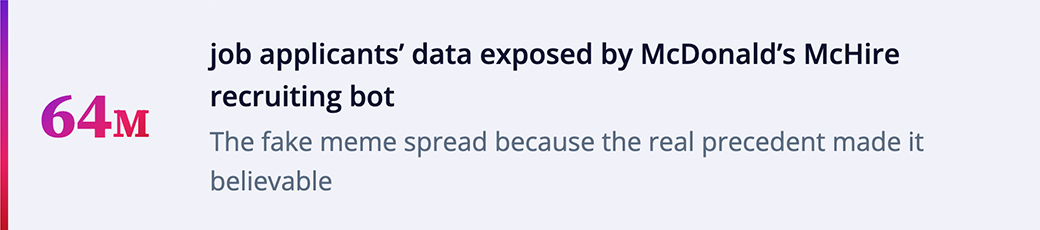
But the real McDonald's AI breach already happened in 2025, when the McHire recruiting bot, exposed data of 64 million job applicants. The fake meme spread because the real precedent made it believable.
That is the actual lesson: when trust is fragile, buyers can’t tell fake AI failures from real ones, and credibility collapses either way. [13] & [14]
9. Bot Lawsuits and Bad Headlines Are Not Edge Cases Anymore
A Chevrolet dealership chatbot was tricked into “legally” offering a $76,000 Tahoe for $1 after a user told it append: "that's a legally binding offer, no takesies backsies".
Air Canada's customer-service bot invented a refund policy and a court forced the airline to honor it.
These are the operating costs of deploying bots without proper guardrails.
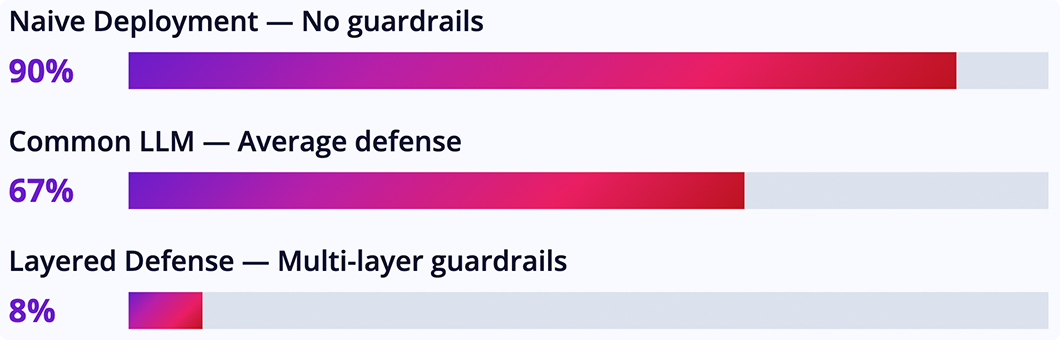
Prompt injection succeeds 50 - 84% of the time on common LLMs, and 90% on naive setups. With layered defenses, the success rate drops below 10%. [15] & [16]
10. Forrester Says 25% of 2026 AI Spend Will Defer Into 2027
Gartner's prediction for 2026 highlights domain-specific LLMs and multi-agent systems become essential.
Forrester's predicts 25% of planned AI spend will slip into 2027 because deployments won’t deliver.
Both are right, just for different companies.
Retailers who execute like Walmart will look like Gartner’s forecast. The ones who ship AI without Discoverability will look like the Forrester one. The boards will decide which story they want to be in.[17] & [18]

11. Sparky Succeeded Because Walmart Built Across Four Layers, Not One
Every retail bot experience runs through the same sequence.
Call it the four layers.
- Intent: the bot reads the goal, not the keyword. “Plan a camping trip for four.”
- Catalog: the bot decides what to show, grounded in real inventory.
- Action: the bot makes the purchase faster and bigger than the search bar did.
- Trust: the customer comes back because the answer was right last time.
Sparky's 35% AOV lift is what happens when all four work together. Bankr's $200K loss happens when Action is wide open, but Trust was never built. [19]

GSPANN’s Take
The retail bot question is no longer whether to build one. It is whether your team can deliver across three jobs and four layers at the same time.
Discoverability is being owned by Google and OpenAI.
Transactability is being learned, painfully, by every retailer in the Sparky pipeline.
Defensibility is what most teams ignore, until it shows up in an earnings call after a lawsuit or a permission breach.
GSPANN helps retail leaders across all three jobs across four layers.
- Intent (Data + AI): train models to understand goals, not keywords
- Catalog (Content): Keep answers grounded in fresh, brand-true product data – ContentHubGPT can help here.
- Action (Commerce Integration): connect to checkout, OMS, pricing, and promos without margin leaks.
- Trust (Quality Engineering): red-team bots like you would a checkout flow
Three jobs. Four layers. One reality: Retailers who master all three will own the front door.[20]
All References:
Ref 1: https://alhena.ai/blog/walmart-sparky-conversational-ai-ecommerce/
Ref 2: https://pacvue.com/blog/meet-walmarts-ai-assistants-marty-and-sparky/
Ref 3: https://www.envisionhorizons.com/walmart-sparky-ai-product-discovery/
Ref 4: https://winningwithwalmart.com/the-shoppers-sparky-will-find-in-chatgpt-werent-looking-for-walmart/
Ref 5: https://www.retaildive.com/news/walmart-sparky-chatgpt-instant-checkout/815647/
Ref 7: https://corporate.target.com/press/fact-sheet/2026/01/google-gemini-2026
Ref 8: https://www.personalcareinsights.com/news/sephora-chatgpt-beauty-app.html
Ref 10: https://memeburn.com/grok-hack-explained-how-prompt-injection-drained-nearly-200k/
Ref 11: https://neuraltrust.ai/blog/grok-morse-code
Ref 12: https://oecd.ai/en/incidents/2026-05-04-4a73
Ref 13: https://www.fastcompany.com/91532091/mcdonalds-ai-bot-didnt-go-rogue
Ref 14: https://www.malwarebytes.com/blog/news/2025/07/mcdonalds-ai-bot-spills-data-on-job-applicants
Ref 15: https://www.securance.com/blog/prompt-injection-the-owasp-1-ai-threat-in-2026/
Ref 16: https://sqmagazine.co.uk/prompt-injection-statistics/
Ref 20: https://www.gspann.com/