
Google's Universal Commerce Protocol checkout expansion into main Search results ends the browser-based purchase funnel.
Here's what agentic commerce means for your protocol strategy today.
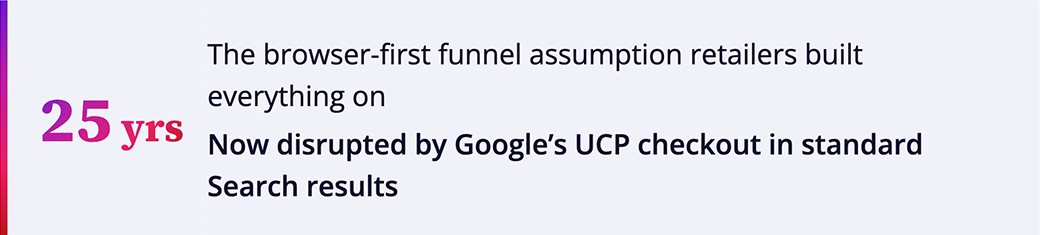
The browser-based purchase funnel is 25 years old and every every customer journey retailers envisaged on top of it is now in question. Retailer builds website. Google sends traffic.
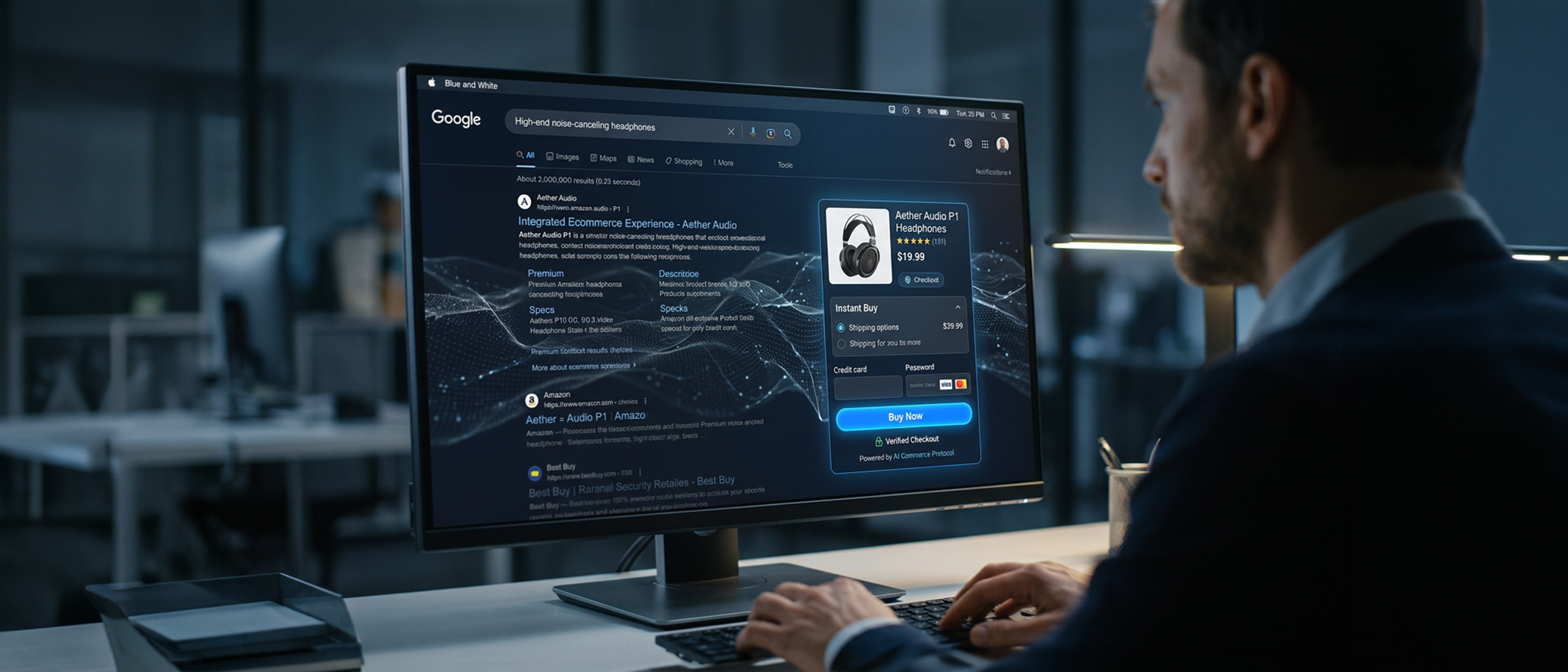
Customer lands, browses, and buys. On May 5, 2026, that sequence broke. Google moved its Universal Commerce Protocol (UCP) checkout out of AI Mode and into standard Search results for the first time, enabling shoppers and AI shopping agents to complete a real transaction, via Google Pay without a single click to the retailer's site.
Zero-click purchases are a fundamentally different problem from zero-click search. Two competing protocols UCP and ACP(Agentic Commerce Protocol) are now fighting for control of this new purchase layer, and the protocol strategy decision retailers make in 2026 will determine whether their products are even visible to AI agents at all.
Here is what happened, why OpenAI tried and failed first, which side is winning the protocol war, and the four-part agentic readiness framework every retailer needs before the window closes.
1. May 5, 2026: A “Buy” Button Appeared Inside Standard Google Search Results
- A SERP researcher, Brodie Clark, first spotted it on a "sofa bed couch" query: a Wayfair listing in the main results page with a live Buy button embedded directly in the product overlay no redirect, no cart page, no retailer checkout.
- A shopper with Google Pay credentials could complete the transaction without a single click to wayfair.com.
- Barry Schwartz at Search Engine Roundtable independently replicated the behavior the same day. Google later confirmed: Universal Commerce Protocol (UCP) checkout had moved out of AI Mode and into the main results page. [1] & [2]
2. This is Not a Zero-Click Search Problem. It is a Zero-Click Purchase Problem
- Zero-click search results, i.e., Google answering a query without the user clicking through, have been an SEO concern since 2019. Zero-click purchases are a different category. An impression can now become a completed transaction, and the retailer's website is not in the sequence.
- For 25 years, Google was the funnel. The May 5 expansion means Google can now also be the seller on your behalf. [3] & [4]
3. OpenAI Tried to Get Here First. It Promised Millions of Merchants. It Delivered for 30, and then pivoted
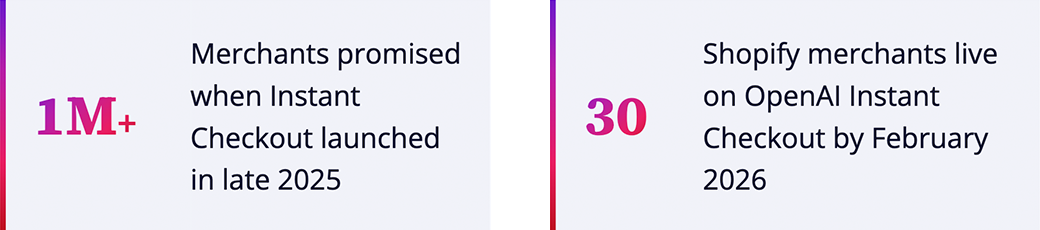
- Instant Checkout launched in late 2025 with Shopify, Walmart, and Etsy as anchor partners, promising to integrate "over a million" merchants into an AI-native buying flow.
- By February 2026, roughly 30 Shopify merchants were actually live. OpenAI pulled the feature back in March 2026. Forrester noted: "OpenAI underestimated how difficult transaction enablement would be." [5] & [6]
4. The Failure Wasn't the AI, it Was the Data Architecture
- OpenAI scraped retailer websites to pull inventory levels, pricing, and shipping timelines. One analysis called scraping "inadequate to get the full breadth of product data needed for e-commerce."
- An agent that commits a customer to free shipping and a 3-day delivery based on data pulled six hours ago destroys trust on first use and OpenAI couldn't support multi-item carts or loyalty program connections either.
- Its pivot: dedicated apps inside ChatGPT that route users back to the retailer's own site. That is the old funnel with a ChatGPT wrapper. [7] & [8]
5. Google Solved it with a Protocol Handshake, Not a Scrape
- UCP defines how an AI agent and a retailer's commerce systems negotiate capabilities before any transaction is committed. Inventory availability, delivery windows, checkout parameters the retailer declares what it can actually honor through a structured interface; the agent only promises what it can deliver.
- That is why the Wayfair Buy button on May 5 worked. Google had real data, not a cache. [9] & [10]
6. There Are Two Protocols: One Charges 7.2% of Gross Revenue, the Other Doesn't
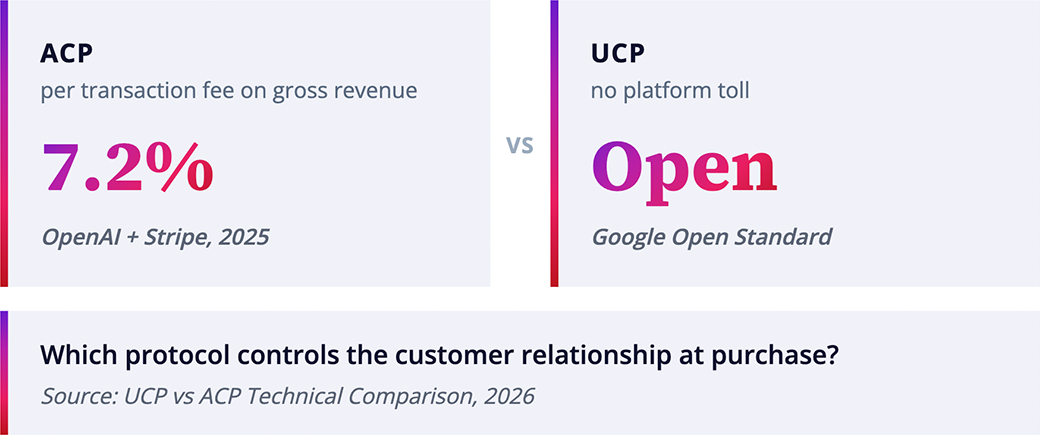
- ACP, co-created by OpenAI and Stripe in 2025, is platform-mediated: OpenAI sits between retailer and customer at the moment of purchase, and transaction fees stack to roughly 7.2% of gross revenue.
- UCP is open: no single platform owns the transaction relationship, the protocol defines how systems talk.
- At any meaningful transaction volume, that fee difference is not a technical decision, it is a strategic one. [9] & [10]
7. On April 24, 2026, Five Companies Joined the UCP Tech Council
- Amazon, Meta, Microsoft, Salesforce, and Stripe joined UCP's governing body on the same day.
- The Stripe addition is the most significant: Stripe co-created ACP with OpenAI and still benefits from its adoption. Joining UCP's standards body is a hedge.
- When the company that built the rival standard starts helping write your standard's rules, that is a signal about where the infrastructure rails are being laid. [13] & [14]
8. 45–47% of Consumers Already Use AI for Part of Their Buying Journey - Most Retailers Are Not Ready for Any of Them
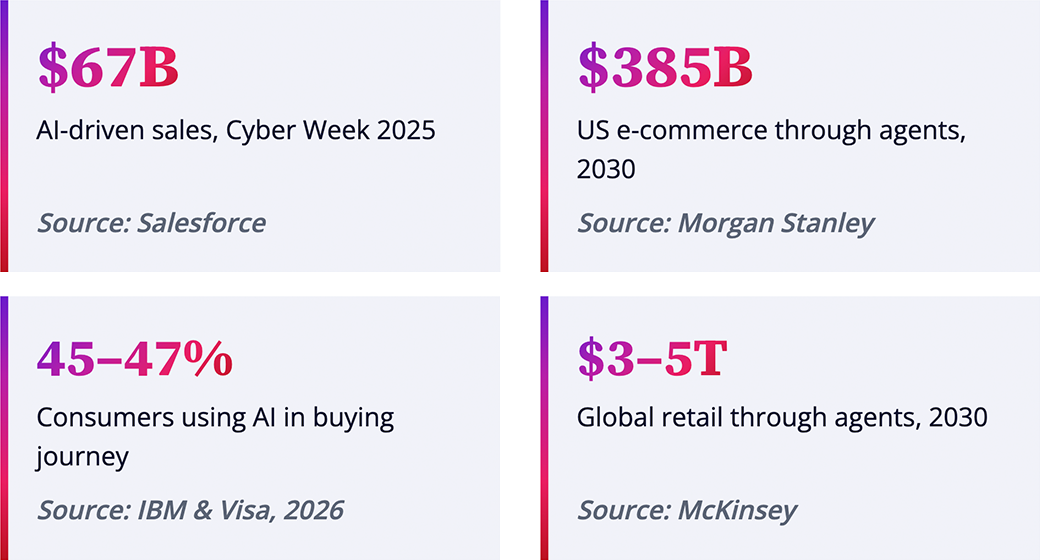
- A 2026 IBM study found 45% of consumers use AI for some part of the buying process. Visa puts the figure at 47% for US shoppers.
- McKinsey projects agentic commerce will orchestrate $3–5 trillion in global retail revenue by 2030; Morgan Stanley estimates $385 billion in US ecommerce through agents by the same year. AI already drove roughly $67 billion in sales during Cyber Week 2025 alone. [15] & [16]
The Market Isn’t Speculative. The Readiness Is.
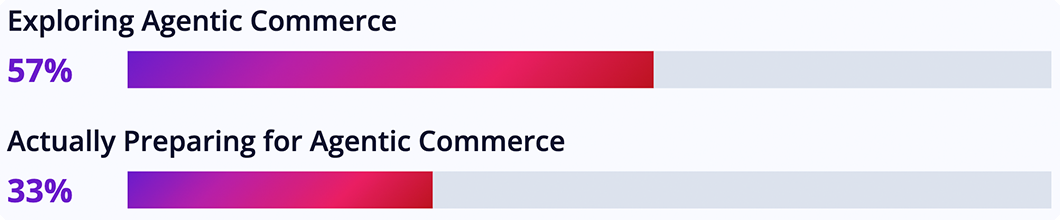
9. 57% of E-commerce Businesses are "Exploring" Agentic Commerce - 33% are Actually Preparing
- That gap, exploring versus preparing, is where damage will be done. Exploring means reading about it.
- Preparing means exposing APIs that return real-time product data, building checkout flows an agent can invoke without a browser session, and wiring fulfillment systems to honor what the agent committed to at 2am.
- The 57% exploring category is not a pipeline. It is a waiting room. [17]
10. There Are Four Places Agentic Readiness Breaks Down - Most Retailers Are Failing at the First One
- Discoverability - can an agent find your products through structured data feeds, not search rankings?
- Transactability - can it complete a real checkout via API, against live inventory, without a browser session?
- Fulfillability - can you honor what the agent committed to?
- Auditability when the agent makes an error, can you trace it through the chain?
UCP gives retailers a protocol to plug into. It does not give them readiness on any of these four dimensions. Those are separate problems, and they come in sequence. [18] & [19]
11. GSPANN's Take: The Window for Protocol Strategy is Not 2027
Google's May 5 expansion was the moment the funnel inverted. Retailers who are not UCP-ready don't get a lower conversion rate, they get completely excluded from the transaction entirely. The sequence matters:
- Product Data First - incomplete, siloed content is the fastest path to agent invisibility
- Commerce API Layer
- Fulfillment Integration
- Observability
GSPANN’s ContentHubGPT identifies the gaps and helps plug them by creating AEO-ready Product data at scale, and its integration with PXM solutions like Salsify, Syndigo, Akeneo, Inriver, etc. helps get product data into a clean, attribute-rich, API-queryable form — the same foundation that UCP-compliant agents need when querying merchant systems for discovery and checkout.[20]
The "Buy" button is already in Search. If you are still ‘exploring', you are already late to the UCP party. Act Now!
All References:
Ref 1: https://searchengineland.com/google-expands-ucp-checkout-to-main-search-shopping-results-476540
Ref 2: https://www.seroundtable.com/google-expands-ucp-checkout-to-search-41272.html
Ref 3: https://ppc.land/google-brings-ucp-checkout-out-of-ai-mode-into-main-search-results/
Ref 4: https://www.semrush.com/blog/google-ucp-checkout-in-main-serp/
Ref 5: https://www.cnbc.com/2026/03/20/open-ai-agentic-shopping-etsy-shopify-walmart-amazon.html
Ref 6: https://www.forrester.com/blogs/what-it-means-that-the-leader-in-agentic-commerce-just-pulled-back/
Ref 7: https://rye.com/blog/openai-chatgpt-checkout-agentic-commerce
Ref 9: https://blog.google/products/ads-commerce/agentic-commerce-ai-tools-protocol-retailers-platforms/
Ref 10: https://developers.googleblog.com/under-the-hood-universal-commerce-protocol-ucp/
Ref 11: https://dev.to/ucptools/ucp-vs-acp-in-2026-a-technical-comparison-of-ai-commerce-protocols-50j7
Ref 12: https://www.paz.ai/blog/ucp-vs-acp-which-agentic-commerce-protocol-should-retailers-choose
Ref 16: https://commercetools.com/blog/the-agentic-commerce-radar-key-market-shifts-insights
Ref 17: https://commercetools.com/blog/agentic-commerce-strategy-2026-a-retail-leader-playbook
Ref 18: https://www.bluestonepim.com/blog/how-to-prepare-for-agentic-commerce
Ref 20: https://blog.google/products/ads-commerce/agentic-commerce-ai-tools-protocol-retailers-platforms/