
At Google I/O 2026, Google made one thing clear: the traditional e-commerce journey is being rewritten in real time. Universal Cart is expanding across Gmail, YouTube, and Gemini, turning shopping into an agent-led experience where purchases may happen without a site visit.
Some major retailers were at the table when the protocols were being defined. Everyone else is now racing to adapt to standards they had no role in shaping.
We unpack what is changing, why it matters, and what brands need to do next.
1. The “Buy” Button in Google Search Was Just a Start.
The Universal Commerce Protocol (UCP) checkout in Google Search on May 5 was one surface of a much larger system. Universal Cart is a single, persistent Gemini-powered cart that lives inside Search, Gmail, YouTube, and Gemini simultaneously. Add in Search, get an alert in Gmail, check out through Gemini. The merchant's website is not part of any step in that sequence.[1] & [2]
2. 93% of Sessions in Google AI Mode End Without a Site Visit
In AI Mode, the shopper reads a synthesized answer, compares products, and resolves intent without loading any external website. Universal Cart accelerates this: sessions can now end with a completed transaction, not just a resolved query.[3] & [4]

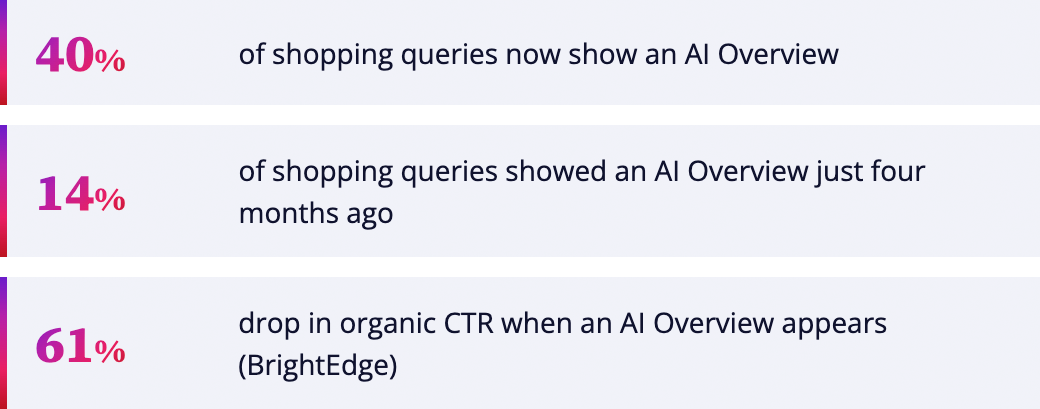
3. AI Overviews Appear in 40% of Shopping Queries. Four Months Ago, That Number Was 14%
That’s a jump of 26 points in just four months. When an AI Overview appears, organic CTR drops 61% (BrightEdge). For brands built on SEO-driven traffic, this is not a slowdown, but a bypass. The traditional browse funnel they spent years optimizing is no longer the path customers are taking.[5] & [6]
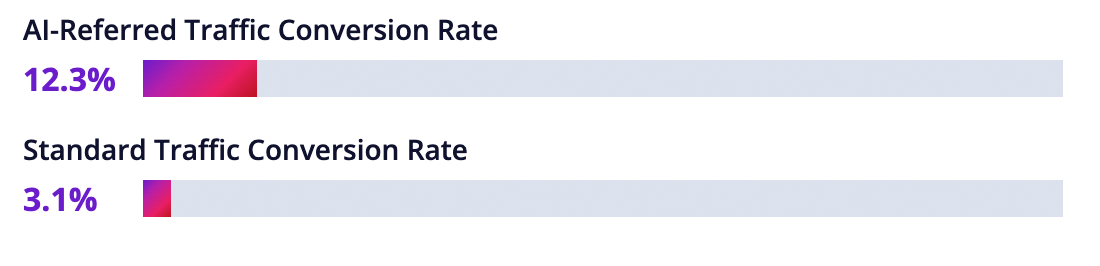
4. The Shoppers’ Agents Convert at Four Times the Rate of Everyone Else
AI-referred shoppers convert at 12.3% vs. 3.1% for standard traffic and spend 45% more time exploring products (April 2026).
AI-driven traffic to Shopify has grown 7x since January 2025 and AI-attributed orders are up 11x over the same period. The quality of agent-referred traffic is not the problem. Access to it is.[7] & [8]
5. Every Merchant Has Three Gaps Standing Between Their Catalog and a Completed Agent Purchase
Readiness for Universal Cart comes down to three questions.
- The Parse Gap: Can Google's AI read and include your product data
- The Transaction Gap: Can an agent complete a purchase without a site visit?
- The Fidelity Gap: Does Google present your brand on your terms?
Most brands are behind all three. The Parse Gap is the entry point. No UCP work matters if your catalog doesn't clear the data quality threshold.[9] & [10]
6. The New Ranking Signal in AI Shopping is Not Links or Reviews. It is Product Data Quality
Google's Shopping Graph now requires sustainability certifications, manufacturing origin, material composition, and professional photography before a product qualifies for AI-curated collections.
These collections appear above traditional organic listings. A product with incomplete structured data does not rank lower,it disappears entirely.[11] & [12]
7. Google Lens with Style-Matching Intelligence has Absorbed the Discovery Phase
A shopper can photograph a room, a fashion look, or a lifestyle scene and receive a shoppable cart with no query, no site visit, no ad impression.
Virtual Try-On now covers full apparel and beauty via generative AI and AR. The moment a shopper forms purchase intent now happens inside Google before any brand interaction occurs.[13] & [14]
8. This is Not a Paid Search Problem. Increasing Ad Spend Will Not Close the Parse Gap
More paid search does not work here. AI Overviews and Universal Cart are fed by catalog data quality and UCP configuration, not bid strategy. Brands increasing ad budgets in response to AI Overview expansion are paying more to reach a funnel that is being bypassed. The fix is a catalog problem, not a media buy. [15] & [16]
9. The Launch Partner Window Closed Months Ago. The Largest Retailers Got There First
Universal Cart launched with retail partners who had months to configure UCP endpoints, train Google's models on their catalog, and complete AP2 integration before a single consumer saw the cart.
Several big retailers and specialty brands are already part of the first wave of the summer rollout. Brands can now enter a channel where their biggest competitors already have a model-training head start. [17] & [18]
10. Gemini is Now the Storefront. Your Catalog is the New SEO
Google I/O 2026's framing was explicit: 'Welcome to the agentic Gemini era.'
Here’s what that means in practice:
- Gemini Spark monitors prices and executes tasks 24/7, not only when a user types a query
- Search agents work in the background continuously, surfacing products without prompting
- CX Agent Studio lets brands configure how Gemini represents their products in every AI conversation
The brands setting those rules now control what buyers see. The ones who don't are letting Google decide.[19] & [20]
11. Fix the Parse Gap First. Everything Else Follows
The three-gap framework has a sequencing logic:
Parse Gap (the fastest win):
Structured data cleanup and Shopping Graph compliance can be done in weeks and unlocks AI Overview inclusion immediately.
Transaction Gap (weeks to months):
Requires platform-level UCP and Agent Payments Protocol (AP2) integration, such as, Shopify, Adobe Commerce, or a headless stack.
Fidelity Gap (ongoing):
Requires configuring Agentic Storefront and CX Agent Studio rules on a continuous basis.
The Parse Gap determines whether any of the other work matters. [21] & [22]
GSPANN's Take
- For a decade, the platform decision centered on storefront flexibility and checkout speed. As of May 20, that question has changed.
- The right question now is: which platform gets your catalog to agentic-ready fastest?
- That means UCP and AP2 endpoints, Shopping Graph-ready product data, and Agentic Storefront config before summer rollout.
- GSPANN's commerce practice starts every new engagement with a readiness audit across all three gaps.
- ContentHubGPT helps create AEO-ready product description that can help your products to be shown more often by Google’s agents.
- The platform is not the destination anymore. The agent layer is.
Google is building a persistent layer between shoppers and every catalog on the internet, and it is being trained on data that exists right now.
A brand's position in that layer in 2027 will be shaped by whether its catalog was complete when the models were trained. The early adopter advantage is not cosmetic. It compounds.[23] & [24]
All References:
Ref 1: https://blog.google/products-and-platforms/products/shopping/google-shopping-cart/
Ref 2: https://thenextweb.com/news/google-universal-cart-agent-payments-shopping-io-2026
Ref 3: https://almcorp.com/blog/google-ai-overviews-shopping-queries/
Ref 4: https://launchcodex.com/blog/seo-geo-ai/google-io-ai-search-seo-update/
Ref 5: https://almcorp.com/blog/google-ai-overviews-shopping-queries/
Ref 6: https://coalitiontechnologies.com/blog/google-io-2026-seo
Ref 7: https://almcorp.com/blog/google-io-2026-ai-shopping-changes
Ref 8: https://www.icecubedigital.com/blog/shopify-summer-edition-2026/
Ref 9: https://www.rewarx.com/blogs/google-io-2026-announcements-ecommerce
Ref 10: https://thenextweb.com/news/google-universal-cart-agent-payments-shopping-io-2026
Ref 11: https://www.rewarx.com/blogs/google-io-2026-announcements-ecommerce
Ref 12: https://shinedezigninfonet.com/blog/google-ai-shopping/
Ref 13: https://www.tomsguide.com/news/live/google-io-2026-live-news-updates
Ref 14: https://www.rewarx.com/blogs/google-io-2026-announcements-ecommerce
Ref 15: https://coalitiontechnologies.com/blog/google-io-2026-seo
Ref 16: https://launchcodex.com/blog/seo-geo-ai/google-io-ai-search-seo-update/
Ref 17: https://blog.google/products-and-platforms/products/shopping/google-shopping-cart/
Ref 18: https://thenextweb.com/news/google-universal-cart-agent-payments-shopping-io-2026
Ref 19: https://blog.google/innovation-and-ai/sundar-pichai-io-2026/
Ref 20: https://cloud.google.com/transform/a-new-era-agentic-commerce-retail-ai
Ref 21: https://www.rewarx.com/blogs/google-io-2026-announcements-ecommerce
Ref 22: https://www.icecubedigital.com/blog/shopify-summer-edition-2026/
Ref 23: https://thenextweb.com/news/google-universal-cart-agent-payments-shopping-io-2026
Ref 24: https://cloud.google.com/transform/a-new-era-agentic-commerce-retail-ai