

For three decades, enterprise security meant defending a perimeter. Harden the firewall, patch the server, scan the network. Threats came from the outside in.
On June 1, 2026, a self-spreading piece of malware slipped into 32 official Red Hat software packages and began mapping the company's cloud accounts. Three weeks earlier, the same wave had already reached inside OpenAI and compromised two employee laptops. Neither attack touched a firewall. Both arrived through the software supply chain, the open-source code and tools almost every company builds on.
A supply chain attack poisons that shared code so it spreads to everyone who installs it, hidden inside packages teams trusted because they carried a Red Hat or OpenAI name. Trace it back and it starts with one thing: a file someone downloaded after seeing a free tool advertised on YouTube or in a LinkedIn message. Here is how the whole chain works, and the three places to break it.
1. How Company Logins Get Stolen in 2026: A Single Click on a Free Offer
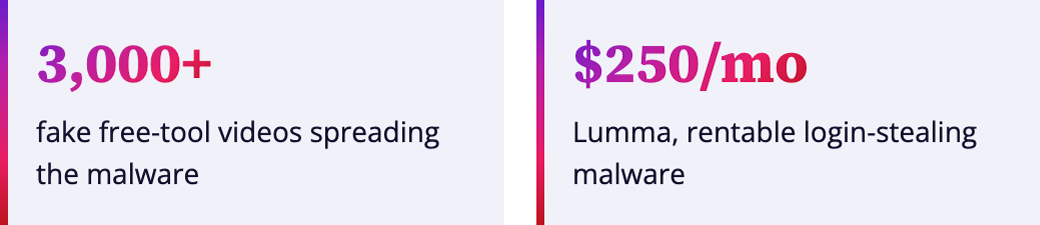
Check Point traced a network of more than 3,000 fake YouTube accounts pushing videos for cracked software and free AI toolkits. Each download quietly installs Lumma Stealer, a login-stealing program anyone can rent for 250 dollars a month.
The same trick runs in LinkedIn messages. The way in is not a clever hack. It is an employee clicking on a free offer. [1] [2] [3]
2. The Malware's Not After Passwords. It's After the Keys Your Systems Run On
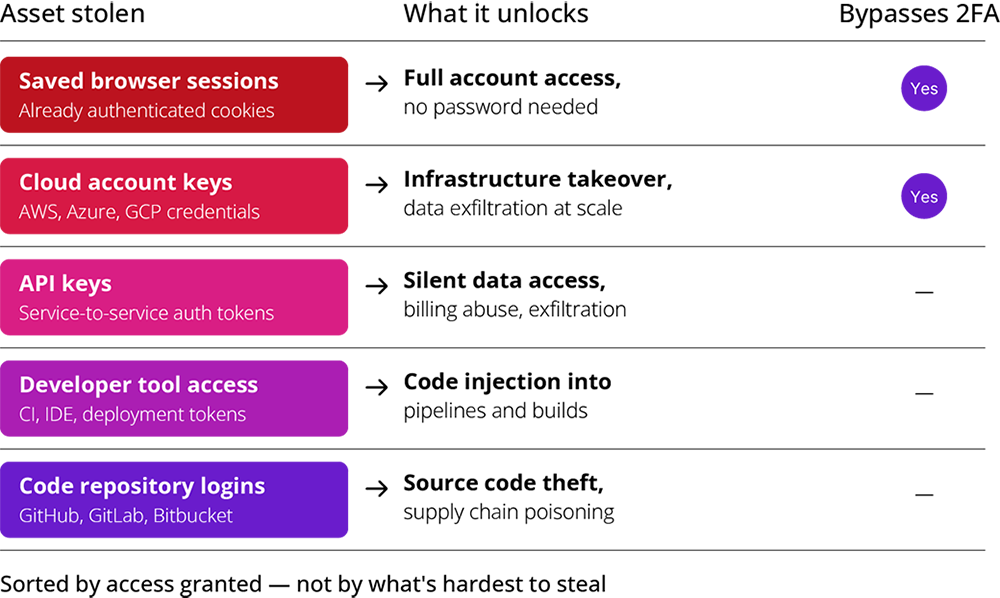
Lumma does not chase passwords. It steals the keys that a company's systems use to trust each other: the logins for code, cloud accounts, and developer tools, plus the saved sessions that let it skip the two-factor login step.
Microsoft found 394,000 infected Windows machines in two months. A single laptop is enough to start. [4] [5]
3. Five Attacks in Twelve Days. The Hackers Started with the Security Tools
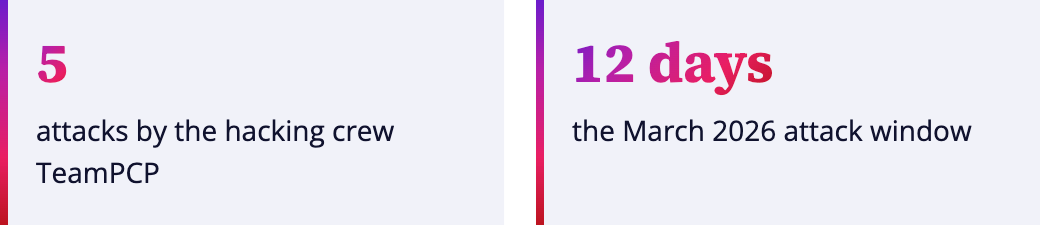
TeamPCP, a financially motivated hacking crew that breaks in through trusted developer tools, ran five attacks in twelve days in March 2026.
They started with the security tools themselves: the code scanners Trivy and KICS, then LiteLLM and Axios, developer tools so common that one is downloaded around 100 million times a week. Once they controlled a scanner, it quietly handed over every secret it touched.
Disable the alarm, then walk through the door. [6] [7]
4. TanStack, May 11: 518 Million Downloads Exposed, Security Signature Still Valid
On May 11, the attackers slipped malicious code into 42 widely used software packages in just six minutes. Those packages had been downloaded 518 million times. Two OpenAI laptops were caught in it.
Every poisoned release still carried a valid security signature, because the attackers had taken over the trusted system that signs the software. The lock was not picked. The factory that makes the keys was. [8] [9] [10]

5. 5,561 Projects in Six Hours. The Victims Were Already Infected
On May 18, a single automated attack planted hidden code in 5,561 software projects on GitHub in six hours, quietly stealing passwords and access keys from every build that followed.
Investigators at Hudson Rock found the cause. Almost every account used to push the attack belonged to a developer whose own computer was already infected by the same login-stealing malware. [11] [12] [13]
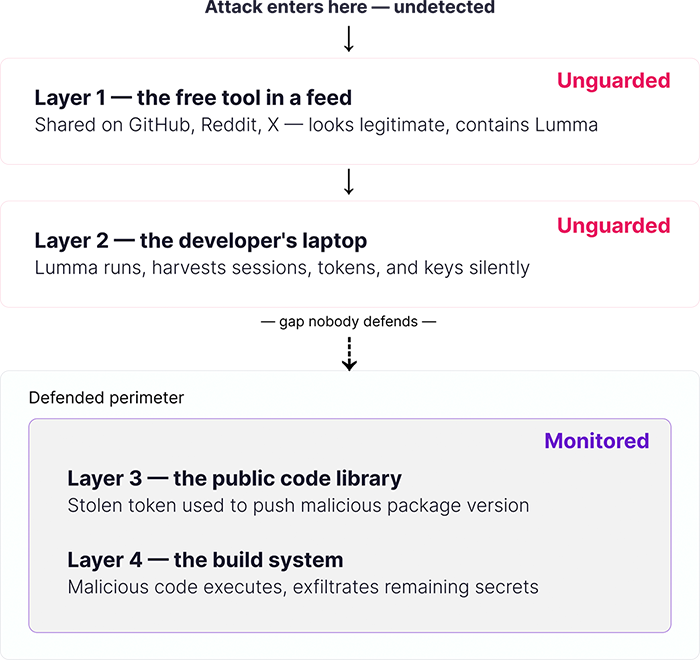
6. The Four-Layer Kill Chain: Defenders Guard Layer 3. The Attack Starts at Layer 1
Think of the attack as four layers. Layer 1 is the social bait: the LinkedIn message or YouTube video offering a free tool. Layer 2 is the developer's laptop, where the malware harvests logins and keys. Layer 3 is the public code library, where the poisoned software is published and looks legitimate.
Layer 4 is the company's build system, where that software runs and quietly leaks secrets. Almost every company spends its security budget on Layer 3. The attack begins at Layer 1, and the first two layers are left unguarded. [14] [15]
7. Red Hat: The Worm Maps Your Cloud, and Its Code is Now Public
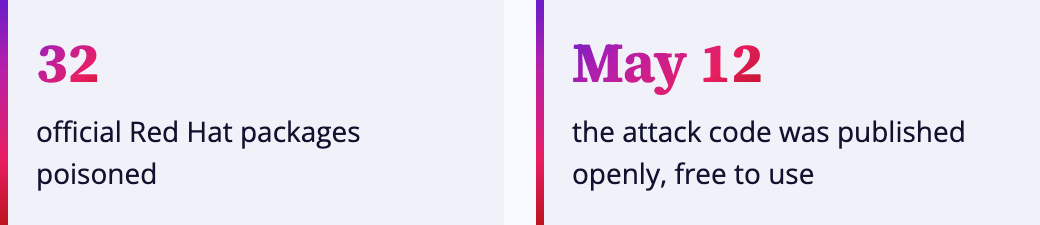
On June 1, 32 official Red Hat software packages were poisoned through one employee's hijacked GitHub account. That login had already turned up for sale in stolen-data logs weeks earlier, taken by the same kind of malware.
The worm, called Miasma, maps a company's cloud accounts and then spreads to every other package the hijacked account can reach. Since May 12, the attack code behind it has been public, so anyone can now run a campaign like this. [16] [17] [18]
8. The Hidden Dependency: Code No Security Check Ever Sees
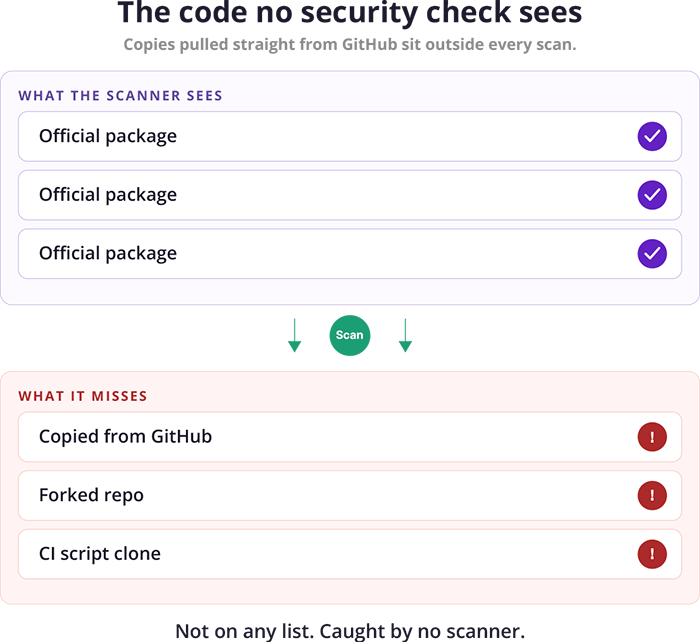
Some teams copy code straight from a public GitHub project instead of getting it through the official library. That copied code is invisible to normal security checks.
When the May 18 attack hit 5,561 projects, every team relying on one of them pulled in the poisoned code automatically, with no warning. [19] [20]
9. Your Software Inventory is a Snapshot. The Attack Moves Between Snapshots
Many companies keep an inventory of the software they use, but it is only a snapshot in time, and these attacks move faster than the snapshot.
The inventory taken at 10 in the morning looks clean, while the build that runs at 3 in the afternoon quietly pulls in the bad version. A snapshot cannot catch what changes between snapshots. [21] [22]
10. The Economics Have Flipped, and Almost Anyone Can Afford the Attack
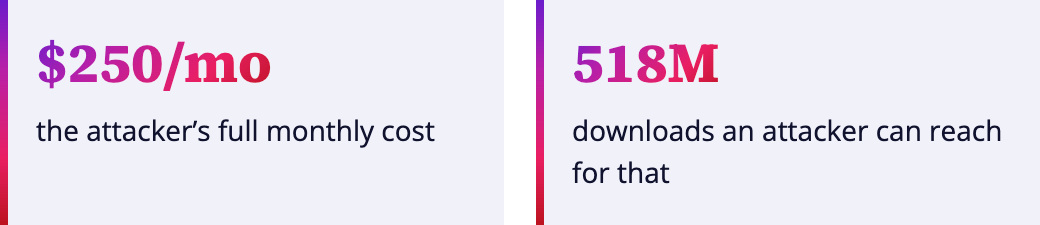
The malware costs 250 dollars a month, the attack code is now free, and spreading it on social media costs nothing. For less than a streaming subscription, an attacker can reach hundreds of millions of downloads, while companies spend millions defending against them. The imbalance is not new. The fact that almost anyone can now afford the attack is. [23] [24]
11. Three Steps That Break the Chain Before It Reaches the Build System
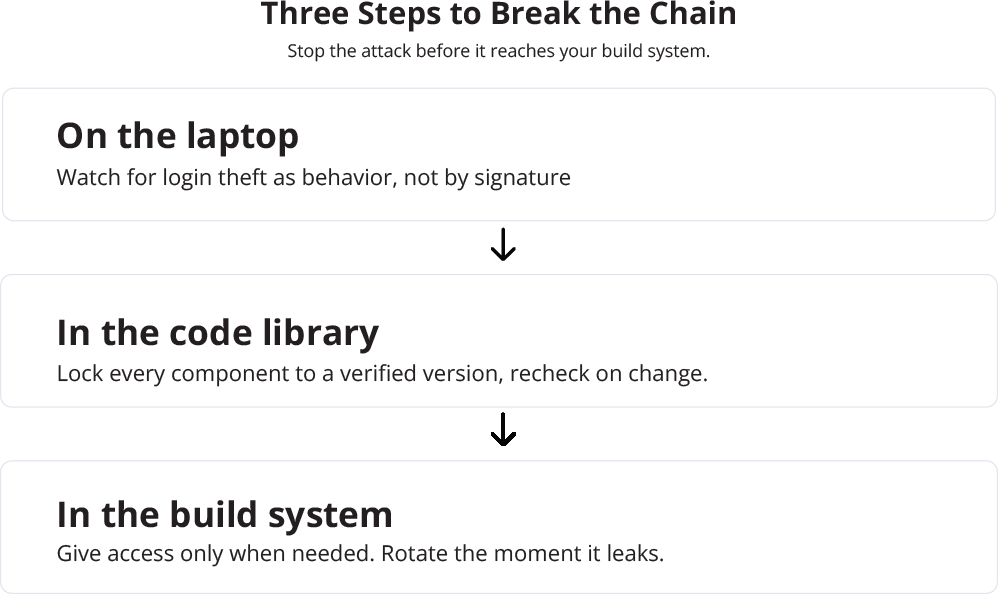
Here is the good news: three steps break the chain before it ever reaches the build system. [25] [26]
12. Where a Real Security Review Should Start: The Code You Copy From GitHub
Most security reviews only check the official software lists. They miss the code that teams copied directly from public GitHub, which sits outside every list and every scanner.
Ask any engineering team to name the code they pull straight from GitHub. Most cannot. That missing list is exactly where a serious security review should start. [27] [28]
GSPANN's Take
This is a coverage problem, not a new threat.
Most security tools only watch Layer 3, the code library, while the attack starts two layers earlier.
- Layers 1 and 2 are people and laptops, and defending them is cross-functional: security awareness for the bait, IT for the laptop, engineering for the keys.
- Layers 3 and 4 are work our DevSecOps and Quality Engineering teams already do, locking down components and enforcing least-privilege access, where every system gets only the keys it truly needs and nothing more. This framework extends that discipline upstream.
- A breach like this is now a board-level event. It can trigger formal disclosure duties, the SEC's rules in the US, NIS2 and DORA in Europe, so it is a governance question, not just an IT one.
- No new product needed. Put all four layers on one diagram and move the defenses to where the attack actually starts.
The Bottom Line
A defense is only as strong as its weakest link, and right now the first two links are nobody's job. The security tools companies bought are real, but they start one step too late, after the attacker is already inside.
The teams that move their defenses back to where the attack truly begins, the laptop and the free offer in a social feed, are the ones who will read about the next attack instead of starring in it.
All References
Ref 5: https://www.eset.com/blog/en/business-topics/threat-landscape/lumma-stealer-threat/
Ref 7: https://www.trendmicro.com/en_us/research/26/e/analyzing-teampcp-supply-chain-attacks.html
Ref 8: https://tanstack.com/blog/npm-supply-chain-compromise-postmortem
Ref 9: https://openai.com/index/our-response-to-the-tanstack-npm-supply-chain-attack/
Ref 11: https://www.hudsonrock.com/blog/infostealers-just-spawned-a-5000-repo-github-supply-chain-attack
Ref 13: https://thehackernews.com/2026/05/megalodon-github-attack-targets-5561.html
Ref 14: https://securitylabs.datadoghq.com/articles/shai-hulud-open-source-framework-static-analysis/
Ref 15: https://safedep.io/megalodon-mass-github-repo-backdooring-ci-workflows/
Ref 16: https://www.wiz.io/blog/miasma-supply-chain-attack-targeting-redhat-npm-packages
Ref 18: https://www.akamai.com/blog/security-research/mini-shai-hulud-worm-returns-goes-public
Ref 19: https://www.hudsonrock.com/blog/infostealers-just-spawned-a-5000-repo-github-supply-chain-attack
Ref 20: https://safedep.io/megalodon-mass-github-repo-backdooring-ci-workflows/
Ref 21: https://snyk.io/blog/tanstack-npm-packages-compromised/
Ref 23: https://securitylabs.datadoghq.com/articles/shai-hulud-open-source-framework-static-analysis/
Ref 24: https://www.trendmicro.com/en_us/research/25/g/lumma-stealer-returns.html
Ref 25: https://www.wiz.io/blog/miasma-supply-chain-attack-targeting-redhat-npm-packages
Ref 27: https://safedep.io/megalodon-mass-github-repo-backdooring-ci-workflows/
Regulatory frameworks referenced
SEC Cybersecurity Disclosure Rule (US) Release No. 33-11216, 2023. Public companies must report a material cyber incident within four business days.
https://www.sec.gov/news/press-release/2023-139
NIS2 (EU) Directive (EU) 2022/2555. Cybersecurity risk-management and incident-reporting duties across critical and important sectors.
https://eur-lex.europa.eu/eli/dir/2022/2555/oj
DORA (EU) Regulation (EU) 2022/2554. Operational-resilience and incident-reporting rules for the financial sector, in force since January 2025.