
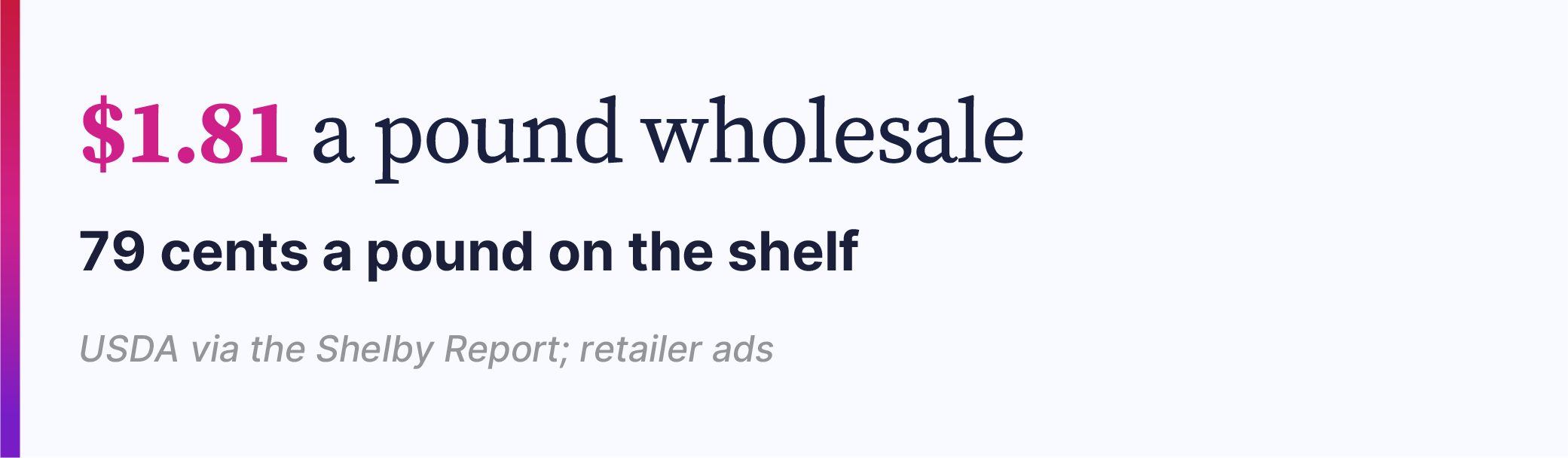
Put a 16-pound frozen turkey on the Thanksgiving table at 79 cents a pound and it rings up at $12.64. At this month's wholesale price of $1.81 a pound, the same bird trades for about $29.
Big chains are selling at 79 cents anyway, and Meijer alone expects to sell more than a million turkeys. The loss is the plan: the turkey wins the Thanksgiving trip, and the cranberries, rolls, pie and wine on the same table are meant to pay for it.
Merchants have long set loss leader pricing by experience and the weekly ad. Pricing algorithms, and now pricing agents, can help work it out across the whole basket, just as shoppers start sending AI agents of their own to fill the cart.
Grocers are paying $1.81 a pound for turkeys they sell at 79 cents
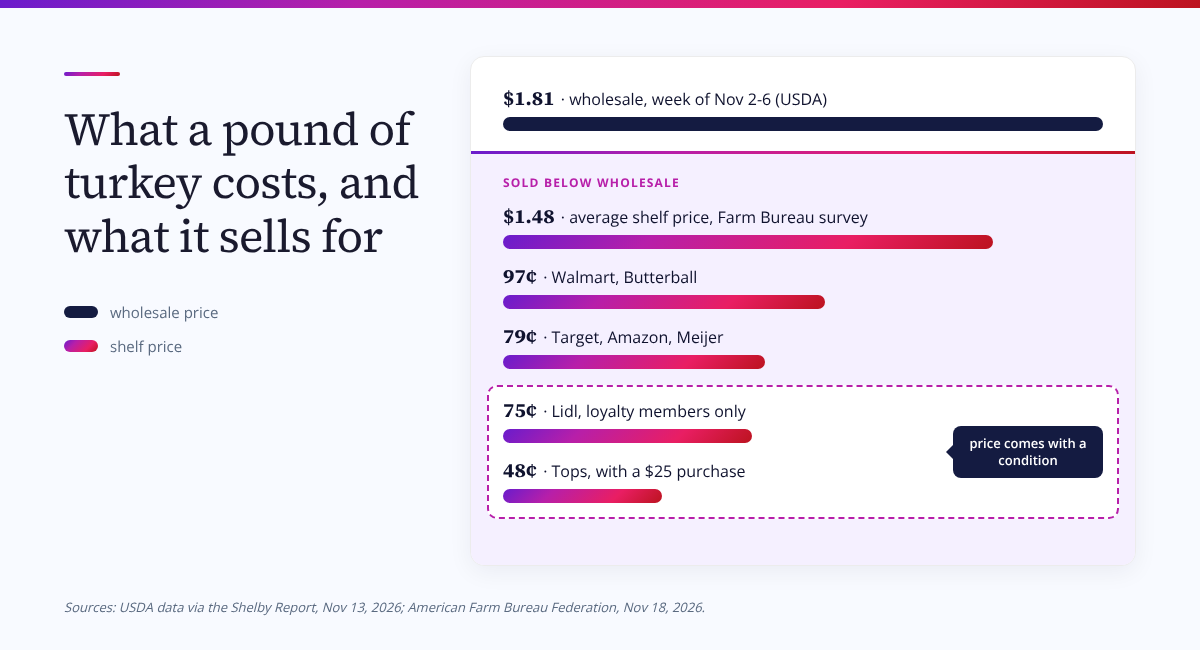
USDA data shows frozen turkey hens trading at $1.81 a pound whole-sale in the week of November 2 to 6, and puts the 2026 average at $1.77, up 30% from last year.
Retailers are selling well under that. Target, Amazon and Meijer sell at 79 cents or less, and Walmart has Butterball at 97 cents. Even the average shelf price in the Farm Bureau's volunteer survey, $1.48 a pound, sits below wholesale.
Each of these retailers chose to sell the bird below wholesale before the first shopper walked in. [1] [2]
Why do grocery stores sell turkeys at a loss?
Because the turkey wins the trip, and the other items in the cart pay for it. Walmart's holiday post prices a 26-item meal for ten at $35, then suggests ham, crab cakes, lobster tails and cheesecake to go with it.
The sides carry the margin. In this year's Farm Bureau survey, cranberries rose 8.8%, dinner rolls 7% and stuffing 5.4%, while pie crusts and the veggie tray got cheaper.
A 2010 Journal of Retailing study found that only about 2% of shoppers buy the deals and little else, and that loss leader pricing still added to the bottom line. The real pricing decision this week is everything that goes into the cart around the turkey. [3] [4] [5]
What are key value items in grocery retail?
Key value items are the few products whose prices shoppers remember and use to judge the whole store. Bain names bananas, milk and bread, and shoppers rarely check other shelf prices the same way.
Oliver Wyman estimates that a cut to a base price can take more than two years to pay off in full. The turkey joins the list for one week a year.
Choosing which items join that list, and for how long, is work that pricing software can now help with. [6] [7]
Every item in the basket has one of three jobs
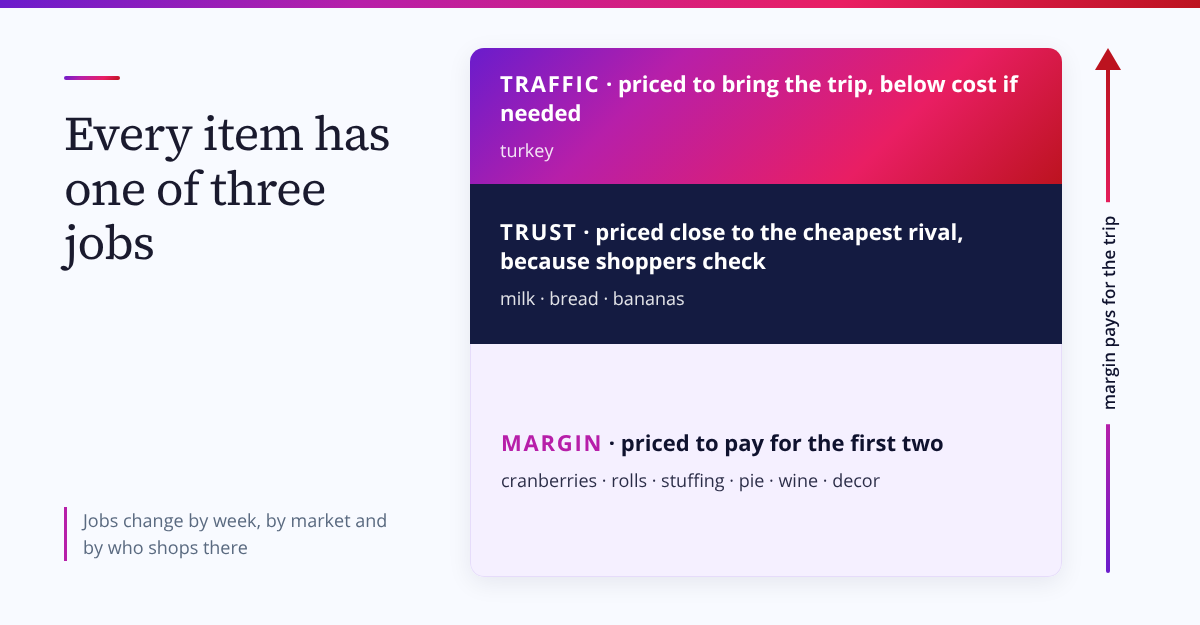
Traffic items, like this week's turkey, are priced to drive the trip, below cost if needed. Trust items are the ones shoppers judge the store by, priced close to the cheapest rival because shoppers check them.
Margin items are everything else. They are priced to make the money that pays for the first two.
The jobs change by week, by market and by who shops there, which is more sorting than a weekly ad can keep up with.[8]
Can AI agents set retail prices automatically?
Yes, inside limits a person sets. Revionics says one agent in its pricing system executes price changes within a retailer's margin rules, and Impact Analytics stages every change for approval by default.
In the Netherlands, ESM Magazine reports, Albert Heijn already lets AI cut bread prices through the day, by up to 70%, as loaves near their date.
Walmart's CEO, John Furner, drew the line for the largest US retailer on September 25: "our people will continue to oversee pricing." The working model is an agent that proposes and moves routine prices, with a merchant signing off the traffic items. [11] [12] [13] [14]
Shopping agents can take the cheap turkey and buy the stuffing somewhere else
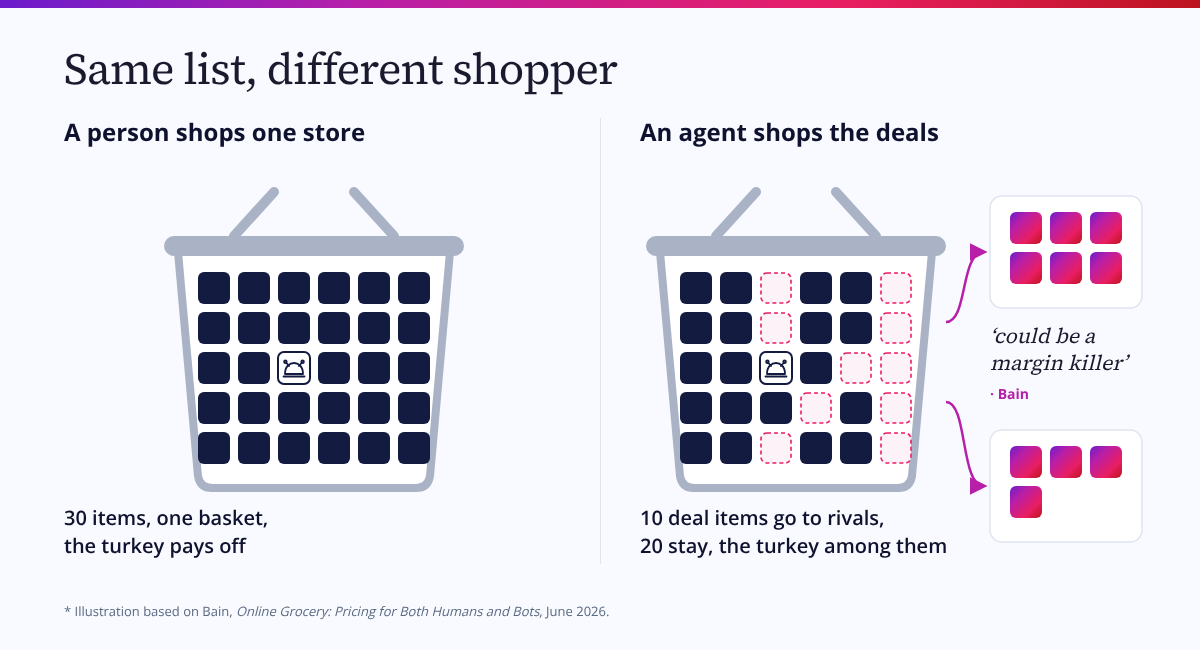
Bain warned in June that AI shopping agents will grab loss-leading deals across stores and will not be swayed by a few familiar prices the way people are. In its example, an everyday-low-price grocer loses 10 items of a 30-item basket to rivals' deals, which "could be a margin killer."
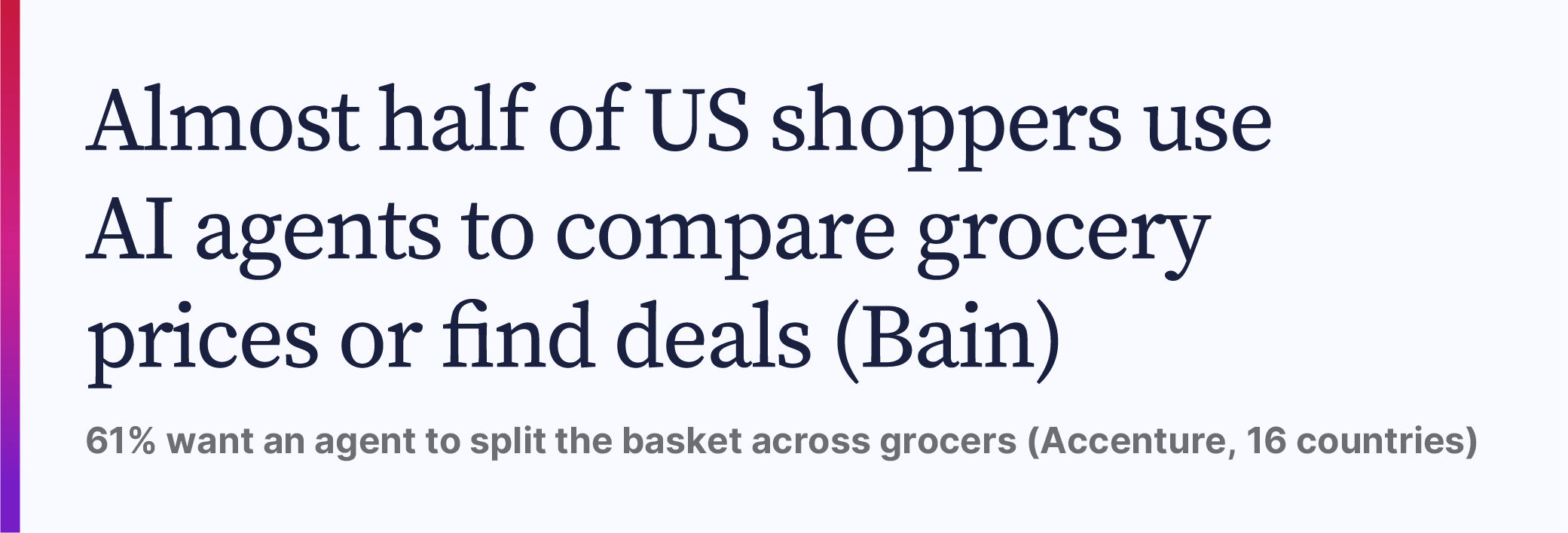
Bain says almost half of US shoppers already use AI agents to compare grocery prices or find deals, though it gives no sample. In Accenture's survey across 16 countries, 61% want an agent that splits the basket across grocers, yet fewer than 1 in 10 are ready to hand over the whole shop.
A loss leader relies on the habit of buying everything in one place, and an agent hunting for the deal has no such habit. [15] [16] [17]
This year's cheapest turkeys come with conditions attached
Tops sells turkeys at 48 cents a pound with an extra $25 purchase. Lidl charges 75 cents for loyalty members, Giant gives one away for 400 loyalty points, and ShopRite gives a free holiday item for $400 of loyalty spending.
Most of those conditions tie the cheap bird to a fuller basket or a membership, two of the remedies Bain recommends against basket-splitting agents.
A pricing agent can test which thresholds keep the basket whole without scaring off the trip, as long as shoppers' agents can read the condition. [18] [19]
Is AI pricing legal for grocery stores?
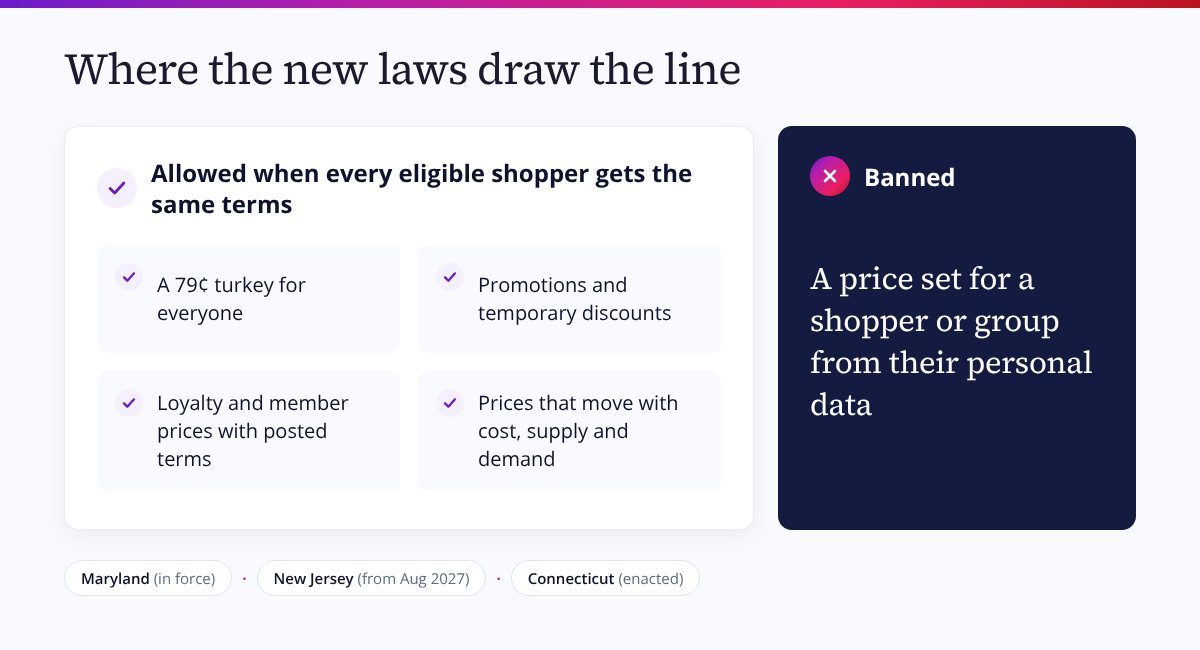
Yes, under the state surveillance-pricing laws enacted so far, as long as the price depends on the product and the market and not on the shopper's personal data.
Maryland, since October 1, bars large food retailers from using personal data to set a higher price for a shopper or a group, and leaves promotions and loyalty deals alone. New Jersey's ban starts in August 2027, and Connecticut has passed its own.
On October 28 the FTC asked nine companies, Walmart and Target among them, for data on personalized pricing, without alleging wrongdoing. In a February Harris Poll for Quad, 71% of US adults said personalized online pricing makes them want to shop in stores where everyone pays the same price. [20] [21] [22] [23] [24]
The margin items still have to be found and chosen
A low price on the turkey brings the shopper, or the shopper's agent, to the store. The sides, desserts and wine earn their margin only if the product page answers what that shopper asks.
When a shopper asks what goes with a 16-pound turkey for ten, an AI assistant answers from product data, so pairings, how many each dish feeds, dietary facts and recipes belong on the page as plain facts.
ContentHubGPT prepares that content from approved product facts across a full catalog, and ACE structures product data for the AI shopping agents that now build carts. A side dish an agent cannot read is one it will not put in the cart. [25] [26]
Five moves before the next holiday basket
- Give every item a job. Tag traffic, trust and margin items by market from your basket data.
- Write the guardrails before the agent. Put margin floors and merchant sign-offs in rules the agent cannot override.
- Test price rules the way you test code. Check loyalty eligibility, spend thresholds and member prices before the busiest week of the year.
- Make the margin items readable. Write product pages, feeds and offer terms as plain facts.
- Judge the turkey by the basket it brings. Report margin per trip that includes a traffic item, and let it set next year's loss leaders.
None of these moves needs a pricing agent on day one, only the data and rules an agent would need. [27] [28]
GSPANN'S TAKE
- The cheap Thanksgiving turkey is a planned loss, and it pays only when it can get the right traffic in and has margin items around it.
- Pricing agents can now help make that decision, market by market, inside guardrails a merchant writes, and two of the biggest US grocers are putting algorithms behind their price cuts.
- GSPANN works on the parts of the basket a price cannot fix on its own: basket and affinity data on Databricks to give each item its job, pricing and offer rules tested before peak, and margin items described with ContentHubGPT so shoppers and their agents can find them.
- Price for the basket, never for the person, and make the rest of the cart worth finding.
This week, millions of carts will hold a turkey sold below wholesale, and beside it the cranberries, the rolls and the pie meant to pay for it. That bargain has held because people shop in one place and fill the cart as they go.
The software on the retailer's side can now plan the trade more precisely than any weekly ad, and the software on the shopper's side is learning to pull it apart. Next Thanksgiving the turkey will still be cheap, and how much of the rest of the basket comes with it will depend on how your AI agent placed and priced other items.
All References
Ref 2: https://www.fb.org/news-release/cost-of-thanksgiving-dinner-increases-remains-below-2022-record-high
Ref 3: https://corporate.walmart.com/news/2026/11/how-to-make-walmarts-holiday-meal-basket-your-own
Ref 4: https://www.fb.org/news-release/cost-of-thanksgiving-dinner-increases-remains-below-2022-record-high
Ref 5: https://ideas.repec.org/a/eee/jouret/v86y2010i4p336-354.html
Ref 6: https://www.bain.com/insights/online-grocery-pricing-for-both-humans-and-bots/
Ref 8: https://www.bain.com/insights/online-grocery-pricing-for-both-humans-and-bots/
Ref 10: https://www.webull.com/news/15743659621819392
Ref 12: https://www.impactanalytics.ai/ai-agents/pricing-agent
Ref 14: https://corporate.walmart.com/about/everyday-affordability/letter-from-our-ceo
Ref 15: https://www.bain.com/insights/online-grocery-pricing-for-both-humans-and-bots/
Ref 16: https://www.accenture.com/us-en/insights/consulting/talk-my-ai-agent
Ref 17: https://www.supermarketnews.com/grocery-technology/how-ai-agents-are-changing-the-grocery-basket
Ref 19: https://www.bain.com/insights/online-grocery-pricing-for-both-humans-and-bots/
Ref 20: https://mgaleg.maryland.gov/2026RS/Chapters_noln/CH_154_hb0895e.pdf
Ref 22: https://fpf.org/blog/third-times-the-charm-connecticut-enacts-annual-privacy-update/
Ref 25: https://www.gspann.com/solutions/contenthubgpt
Ref 26: https://www.gspann.com/solutions/ace
Ref 28: https://www.impactanalytics.ai/ai-agents/pricing-agent