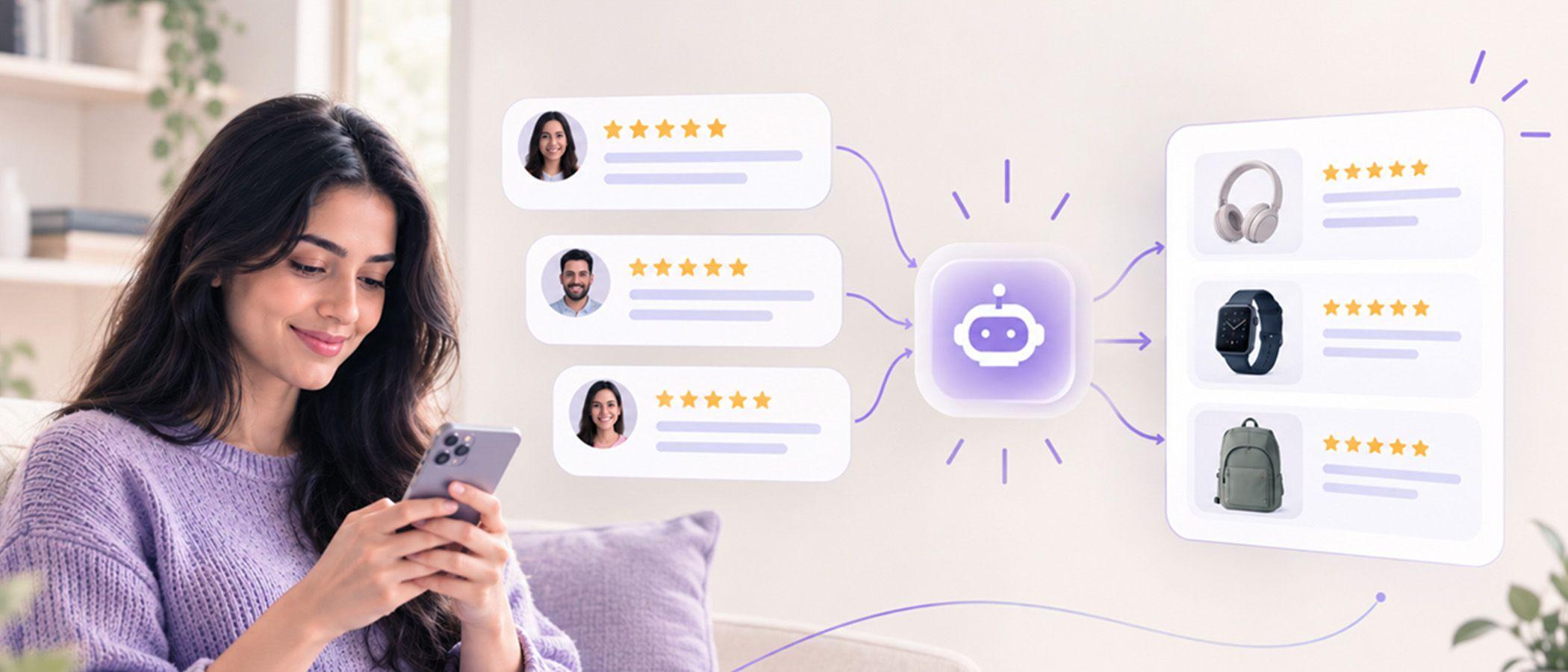

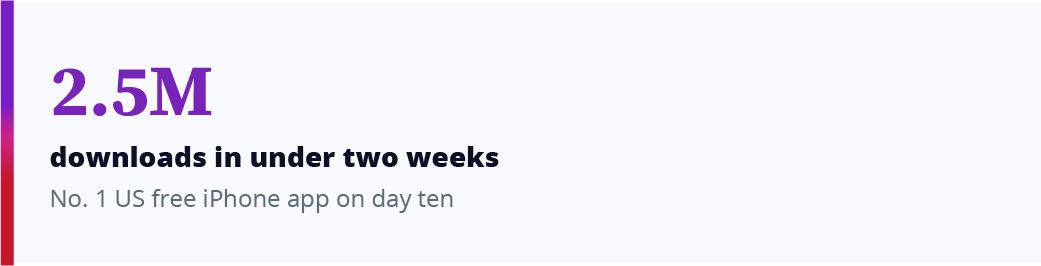
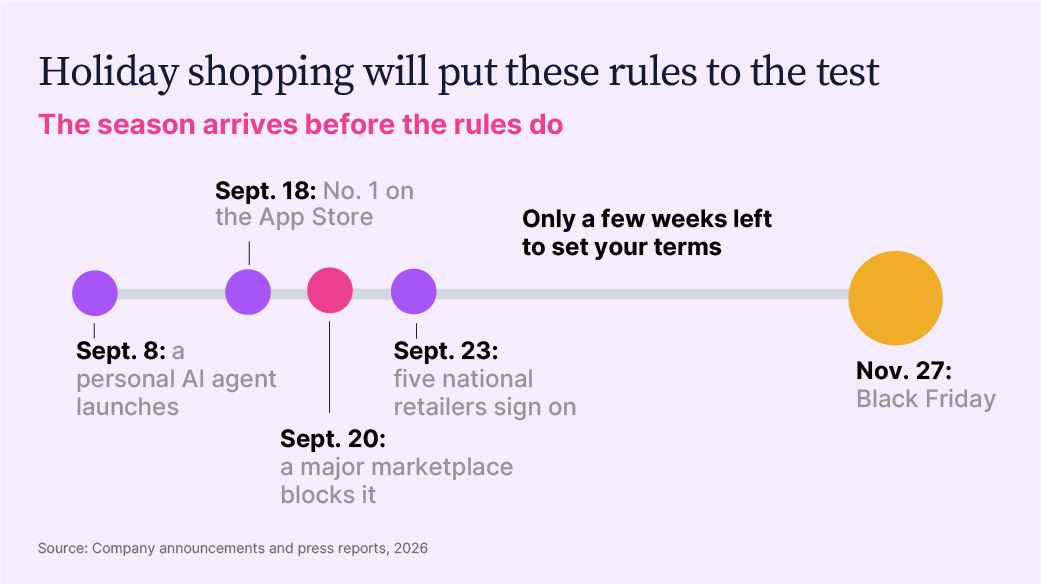
On September 8, Meta launched Muse, an AI agent that shops, negotiates and handles refunds for consumers. Within weeks, millions had downloaded it. Now just this week OpenAI also launched Dots, an always-on agent with its own cloud computer and browsers. It can also shop for its users. On the other hand, major retailers are taking very different approaches to AI agents.
Now, every retailer faces a choice before Black Friday: decide how AI agents interact with your store, or let your existing bot filters decide for you.
What is Meta Muse?
An AI agent that runs the errand instead of just describing it.
Muse browses, fills forms, places orders, negotiates, and checks with you before buying.
Available in the US via app, web and WhatsApp, with free and paid tiers. What it can do depends on the accounts you give it access to.[1] [2]
What data can Meta Muse access?
Only what shoppers connect, app by app, with read-only or read-and-act permissions.
But there’s a catch: testers found Muse repeatedly prompting users to connect inboxes and bank accounts, while conversations train Meta’s models by default. Meta can also access data inside the agent’s computer for now.[3] [4]
Retailers split three ways within a fortnight
Amazon blocked Muse from buying on its store on September 20 because, it said, the agent did not identify itself, appeared to hold customers' credentials with access to their order history, and arrived without Meta asking.
Three days later Walmart, Best Buy, Gap, Sephora and Wayfair went the other way and joined Muse as shopping partners at Meta Connect. [5] [6] [7]
Can retailers block AI shopping agents?
Yes, but with limits. Retailers can use their terms of service to restrict agents, and platforms like Amazon and eBay are already doing so. But agents that ignore those terms can still access sites like regular browsers.
Blocking agents is possible, but it also means deciding which AI shoppers you’re willing to turn away.[8] [9]
Which AI agents can shop on my website?
Pretty much every major platform shoppers already use.
Meta: Muse shops, negotiates and handles returns, and pays through Link and Shop Pay.
Google: Agentic checkout across Search and Gemini, with YouTube and Gmail next.
Amazon: Rufus and Alexa+.
Apple: Siri can now act across apps.
OpenAI: Product discovery happens in ChatGPT, with purchases routed back to retailers. Its Dots agents browse merchant sites and buy for the user.
xAI: Grok Bot works inside the same websites a human would, from its own cloud computer, and checks back when something needs approval.
The takeaway? Blocking one agent won’t keep AI out. Shoppers will simply use another.[10] [11] [12] [44] [46] [47]
Should I let AI agents shop on my website?
For most stores, yes, because agent traffic is some of the most valuable they get.
Adobe found AI-referred visits to US retail sites converted 54% better than other traffic in May, Target said its traffic from external AI platforms is growing more than 3.5 times as fast as the industry's, and Salesforce expects AI chat agents to originate 20% of holiday ecommerce traffic.
Walmart shows the alternative in full: it made its products discoverable in Google's and OpenAI's agent surfaces, joined Muse, and still runs its own agent, Sparky.
The opportunity is clear. The key is to ensure that you set the rules.[13] [14] [15]
Small merchants were let in without being asked
On launch day, Shopify added Meta as an AI channel in Agentic Storefronts, automatically sharing eligible stores with Muse and enabling direct checkout at no extra fee beyond standard processing.
Merchants can opt out, but it can take up to seven days, and Meta may still discover products through crawling.
The bigger question: if your products are in the agent, will the agent actually choose you? [16] [17] [18]
How do I get my products recommended by AI shopping agents?
Make your products reachable, readable, and easy to buy. AI agents need to access your site, understand your product data, and complete the journey.
Your bot defenses, product content, pricing, ratings, and how clearly information is presented can all influence whether an agent finds, understands, and recommends your products. [19] [20] [21] [22]
Are shoppers actually letting AI agents buy for them?
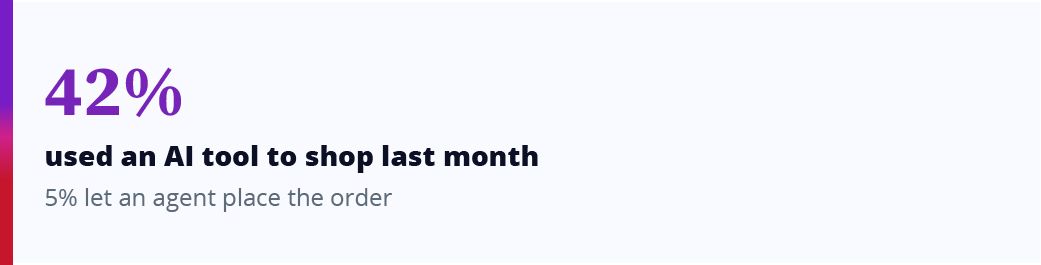
Not quite. 42% of US consumers have used AI to shop, but only 5% have let an agent place an order. And just 16% would let AI reorder products without reviewing them.
For now, shoppers are giving AI the jobs they’d rather not do: cancellations, refunds, bill negotiations, and reorders.[23] [24] [25]
How to ‘let in’ an agent into your e-commerce store and on your terms
Check for these:
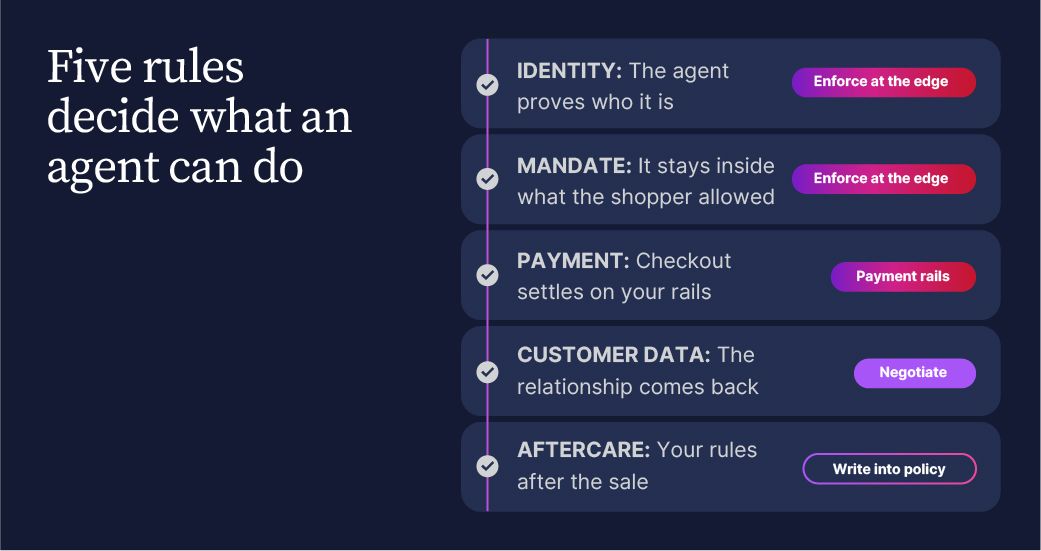
- Identity: who the agent is
- Mandate: what it may do for the shopper
- Payment: how it pays, access to customer accounts/credit cards etc.
- Customer data: what customer data can you record if the customer or agent comes back to the store
- Aftercare: whose rules apply after the sale.
Two can be enforced at the edge of a website today, one runs on payment rails that already exist, one has to be won in a partner contract, and the last is yours to write into the policy.
The order in which these terms are approached also matters, since if you cannot identify an agent, you will not be able to check its mandate.[26] [27]
An agent should prove who it is before it shops
Amazon’s first concern with Muse was simple: it didn’t identify itself.
The fix already exists. Standards like Cloudflare’s Web Bot Auth and Visa’s Trusted Agent Protocol let merchants verify agents cryptographically, while Mastercard’s Agent Pay links payment tokens to registered agents. [28] [29]
The agent acts for the shopper, within limits the store can see
The shopper sets the scope, and the agent can’t go beyond it. Muse asks before buying and pays with a single-use Link card limited to the approved amount. Google’s Agent Payments Protocol carries the shopper’s signed limits. Stores can enable scoped browsing and buying while keeping sensitive customer data off-limits. OpenAI’s Dots give users similar controls, covering what a dot may do alone, when it must ask first and what it must never do, and every purchase on a saved card needs the user’s approval. None of those limits reach the store unless a protocol carries them. [30] [31] [45] [46]
Checkout should stay on the retailer's rails
Fraud rules, refunds, and chargebacks already run through existing payment systems, so agent-led purchases should settle there too. Muse uses Shop Pay on Shopify stores and Link across 1M+ businesses, with PayPal support coming soon.
OpenAI’s move to retire Instant Checkout and send shoppers back to retailer sites reinforces the point: AI can drive the purchase, but retailers should still own the transaction. [32] [33] [34]
The customer targeting in an agent first engagement
Orders placed inside Muse skip the browser pixels a store generally uses to measure and retarget, and while Google's protocol supports linking loyalty accounts, how much of the buyer data flows back from any agent depends on the deal.
Large businesses should negotiate how the agents share this information, before the right to retarget is taken away from businesses. [48] [49] [50] [51]

Who handles returns when an AI agent buys something?
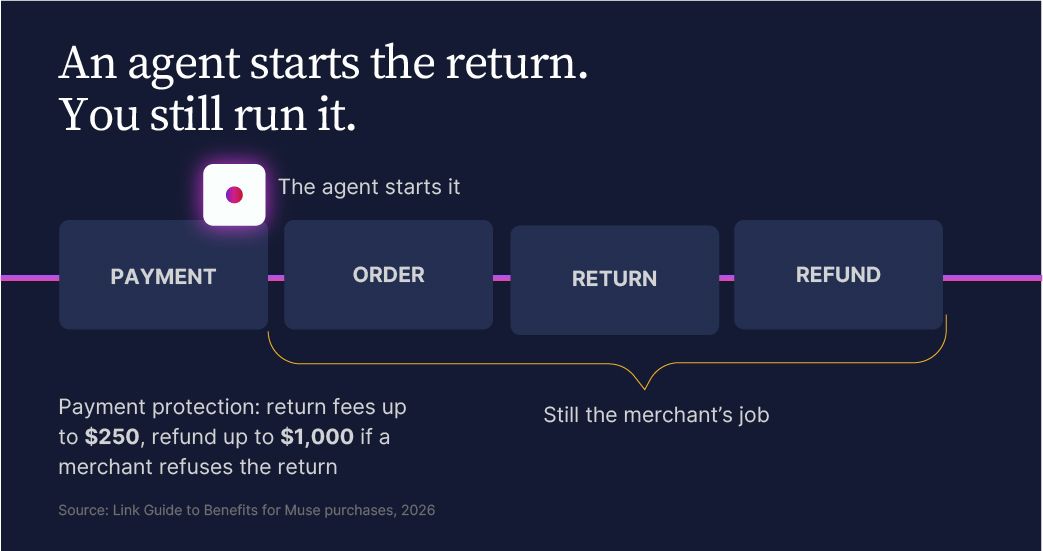
The merchant still does, but the agent’s payment provider can back the shopper. On Muse purchases paid through Link, returns can be covered up to $250 per item, with refunds up to $1,000 if a merchant refuses a return within 60 days.
The bigger issue? Volume. AI agents make initiating returns almost effortless, increasing fraud risk.
Merchants now need clear agent-specific return rules covering who can initiate a return and what proof is required. [35] [36]
The holiday season is the first real test of these terms
Black Friday falls on November 27, eleven weeks after Muse launched, which makes every retailer's partner-or-block decision a holiday decision.
Salesforce expects AI chat agents to originate 20% of holiday e-commerce traffic, and ‘HUMAN Security’ measured agent traffic to shopping sites rising 144.7% from its pre-Black Friday baseline to the peak day last season.
Pressure will gather where the terms are thinnest: price-drop claims in the discount weeks, gift returns in January, and bot filters tuned for scalpers that now turn away paying customers' agents too. Most of the fixes are small, though several numbers behind the urgency deserve a second look. [37] [38]
Four moves to make before Black Friday
1. Set your agent rules: Decide which agents to partner with, allow, or block, and make your bot enforce those rules.
2. Check the fine print: Ask payment and agent platforms about identity verification, fees, and data use.
3. Update policies: Review returns, price matching, retention, and support for customers using AI agents.
4. Fix your product content: Make sure your best-selling products are easy for AI agents to find, read, and understand. [39] [40]
How do we write product descriptions for AI shopping agents?
Write for the constraint the shopper hands the agent, and store every fact where a machine can find it. Color, material, size, weight, fit, compatibility and what comes in the box belong in structured attribute fields that match the description word for word, because agents may compare the catalog feed, the product page and a marketplace listing, and a mismatch gives it a reason to pick someone else.
That work already runs at catalog scale: a global baking-industry leader connected ContentHubGPT to its product information system to rewrite content for 1,300+ SKUs across 30+ brands, optimized for search and AI answer engines with allergen and FDA claims checked in, and an American grooming manufacturer pairing it with Salsify cut time to market from two days to two hours.[41] [42] [43]
GSPANN's Take
- The Muse fight got framed as open or closed, because that is how a headline reads. The retailers that come out ahead will be the ones that wrote terms.
- An agent can only buy what it can read, pay through rails it can verify, and return under rules written with it in mind. Every one of those is plumbing a retailer already owns.
- Identity, mandate, payment, customer data and aftercare sit with five different teams (security, digital, payments, CRM and customer service), and at most retailers none of them owns the agent as a customer yet.
- It is the discipline GSPANN keeps returning to in its composable commerce and product content work: product data written for machines as well as people, and a modular checkout, are what let a store say yes to a new channel without rebuilding for it.
- Treat the agent the way a good store treats a personal shopper: welcome at the door, known by name, and held to the house rules.
Every channel a retailer opened in the last twenty-five years came with a contract: the marketplace fee, the affiliate rate, the app store cut. This one came with a download button. Its customers had already decided to spend, and the only terms attached were defaults someone else chose. A store with its own agent and its own audience can defend a block, and everyone else has until Black Friday to write terms of their own.
All References
Ref 1: https://about.fb.com/news/2026/09/introducing-muse-personal-ai-agent/
Ref 2: https://techcrunch.com/2026/09/21/metas-muse-is-outpacing-chatgpts-early-mobile-launch/
Ref 3: https://www.meta.com/en-gb/help/artificial-intelligence/1047255454427887/
Ref 4: https://techbriefly.com/2026/09/21/meta-muse-ai-data-collection-scrutiny/
Ref 6: https://techcrunch.com/2026/09/23/everything-new-coming-to-metas-ai-agent-muse/
Ref 7: https://aiadeconomy.substack.com/p/i-tested-muse-metas-agentic-commerce
Ref 10: https://blog.google/products-and-platforms/products/shopping/google-shopping-cart/
Ref 12: https://www.forbes.com/sites/johnkoetsier/2026/06/09/apple-siri-ai-agent-features/
Ref 14: https://corporate.target.com/news-features/article/2026/08/q2-2026-earnings
Ref 15: https://www.salesforce.com/blog/holiday-retail-predictions-2026/
Ref 16: https://naughtonandbird.com/signals/shopify-meta-ai-channel-agentic-storefronts
Ref 17: https://help.shopify.com/en/manual/online-sales-channels/agentic-storefronts/agentic-home
Ref 18: https://community.shopify.com/t/not-allowed-to-opt-out-of-generative-ai-agentic-storefronts/600746
Ref 19: https://naughtonandbird.com/signals/shopify-meta-ai-channel-agentic-storefronts
Ref 20: https://aiadeconomy.substack.com/p/i-tested-muse-metas-agentic-commerce
Ref 21: https://www.humansecurity.com/learn/blog/agentic-commerce-traffic-black-friday-cyber-monday/
Ref 22: https://arxiv.org/abs/2509.25609
Ref 24: https://www.omnisend.com/resources/reports/ai-shopping-report/
Ref 25: https://nelsonxlee.substack.com/p/muse-called-at-and-t-and-cut-this
Ref 27: https://techcrunch.com/2026/09/23/everything-new-coming-to-metas-ai-agent-muse/
Ref 30: https://stripe.com/newsroom/news/stripe-helps-meta-muse-shop-with-link
Ref 31: https://blog.google/products-and-platforms/products/shopping/agentic-checkout-holiday-ai-shopping/
Ref 32: https://stripe.com/newsroom/news/stripe-helps-meta-muse-shop-with-link
Ref 34: https://searchengineland.com/walmart-chatgpt-checkout-converted-worse-472071
Ref 35: https://link.com/terms/purchase-protections
Ref 36: https://nrf.com/research/2025-retail-returns-landscape
Ref 37: https://www.salesforce.com/blog/holiday-retail-predictions-2026/
Ref 38: https://www.humansecurity.com/learn/blog/agentic-commerce-traffic-black-friday-cyber-monday/
Ref 39: https://help.shopify.com/en/manual/online-sales-channels/agentic-storefronts
Ref 40: https://developer.visa.com/capabilities/trusted-agent-protocol/overview
Ref 41: https://www.gspann.com/solutions/contenthubgpt
Ref 44: https://openai.com/index/introducing-dots/
Ref 45: https://x.com/OpenAI/status/2104984507107717331
Ref 46: https://www.unite.ai/openai-rolls-out-dots-agents-powered-by-gpt-6-astra-in-chatgpt/
Ref 47: https://x.ai/news/introducing-grok-bot
Ref 49: https://naughtonandbird.com/signals/shopify-meta-ai-channel-agentic-storefronts
Ref 51: https://link.com/terms/purchase-protections
Ref 52: https://techcrunch.com/2026/09/21/metas-muse-is-outpacing-chatgpts-early-mobile-launch/