
On August 4, 2026, a ruling changed how agentic commerce will work. It declared that when a shopper directs an AI agent to a retail site, the shopper is the one accessing the servers.
The visit belongs to your customer. The thing is an extension to the shopper but it does not essentially belong to the shopper.
And that thing can arrive with more purchasing power than any channel you fund, and does not care for any customer experience optimizations on your storefront.
What is an agentic experience?
A storefront that serves a customer's AI agent all the details about any chosen product, service or categories in a comprehensible format for the agent.
The agent needs an identity it can present, product data it can read, and a checkout it can finish smoothly without any business intervention. The only human in the loop can be the customer and the agent can work on the rules set by it.
The industry has started calling this Agentic Experience, or AX, and treats it as a discipline alongside customer experience.
The shift underneath is critical. The primary interaction in agentic commerce is already reshaping B2B buying is no longer a shopper and a web page, it is an agentic model and a company's structured backend. [1] [2]
Companies put $120 billion a year into customer experience and left the agent with just robots and llms.txt files
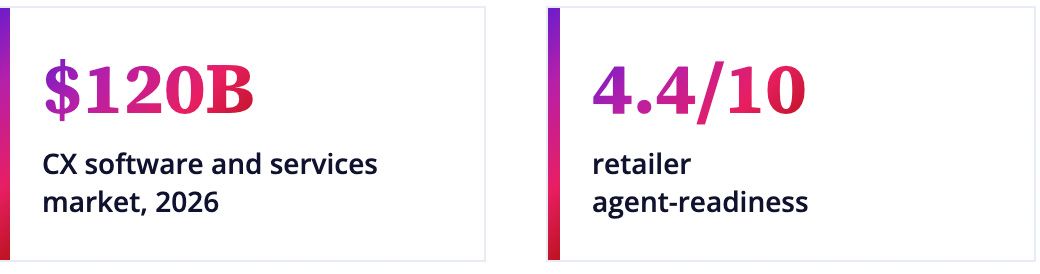
Futurum sizes the customer experience software and services market at $120 billion worldwide in 2026, and the average company now puts around 11% of revenue into CX programs.
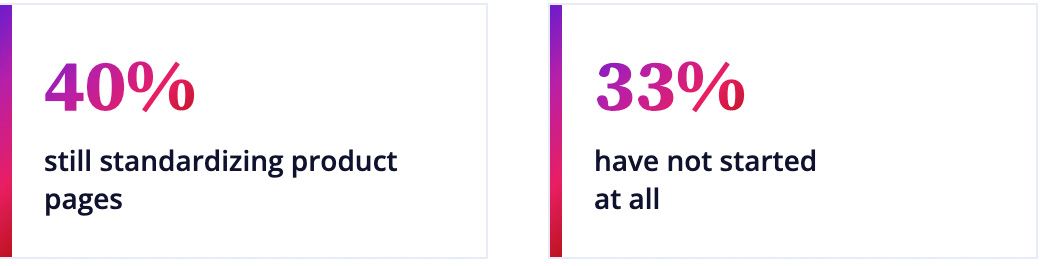
40% of e-commerce businesses are still standardizing product pages for agent consumption, 33% have not started, technology partners score retailer agent-readiness at 4.4 out of 10, and the most common merchant response on record so far has been a line in a robots file or an LLMS.txt that agents hardly read these days. [3] [4]
An agent is not your usual customer
An agent does not look at the hero image, the urgency banner, the loyalty nudge, or the brand copy a team worked hard on.
Shopify's data shows that more than half of agent-referred visits land straight on a product page against about 20% for organic search.
What the agent wants is a deterministic price, live stock, a stable identifier, and correct terms in the correct field. It may carry your customer's money and your customer's judgment of your product, which is why it earns the same weight on the customer acquisition roadmap while sharing almost none of the same work. [5] [6]
Does agentic traffic convert better than search?
That traffic outspends everything else you pay for, by a widening margin.
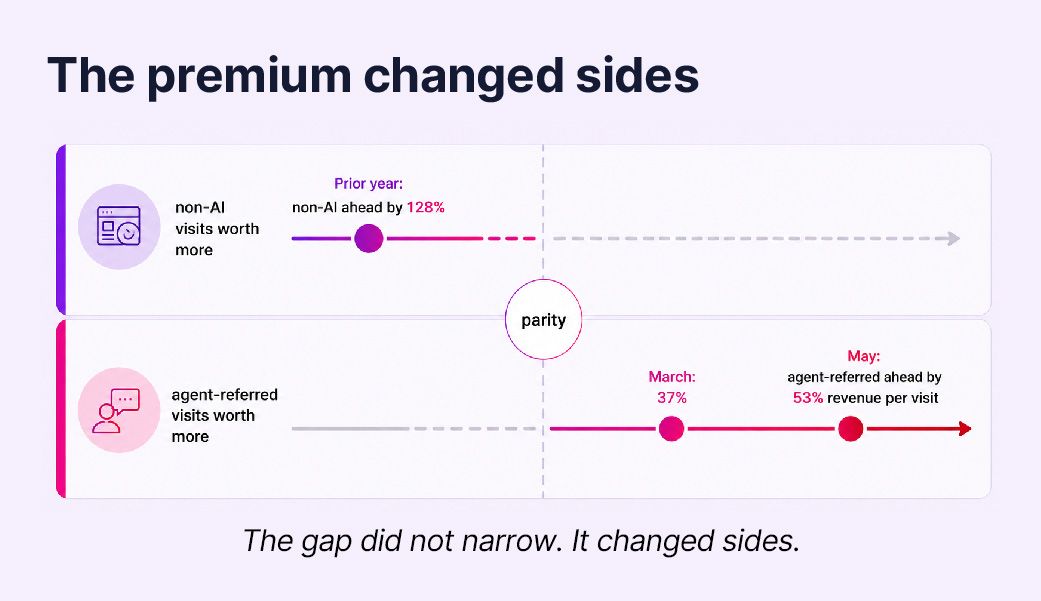
Adobe measured over a trillion visits to US retail sites. Agent-referred visitors generated 53% more revenue per visit than non-AI traffic in May 2026, up from 37% in March.
Shopify's Q1 data puts agent-referred orders up nearly 13x year over year. They convert about 50% higher than organic search, carry 14% higher order values, and beat organic in 23 of 25 merchant categories, the same pattern showing up in e-commerce AI assistants that outsell the search bar.
Then the discipline: Etsy told analysts on 6 August that agent platforms send under 1% of its total traffic. This is the best-converting sliver you have, and it is still a sliver. [7] [8] [9]
Why do AI agents abandon checkouts?
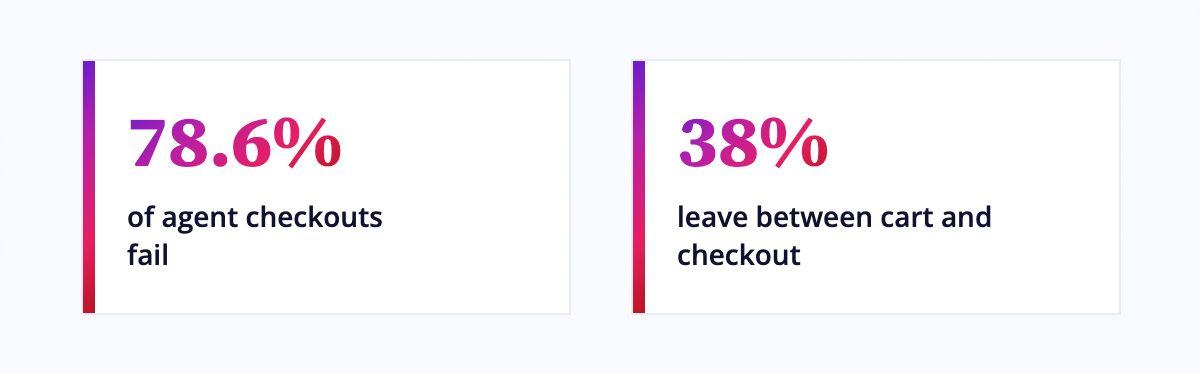
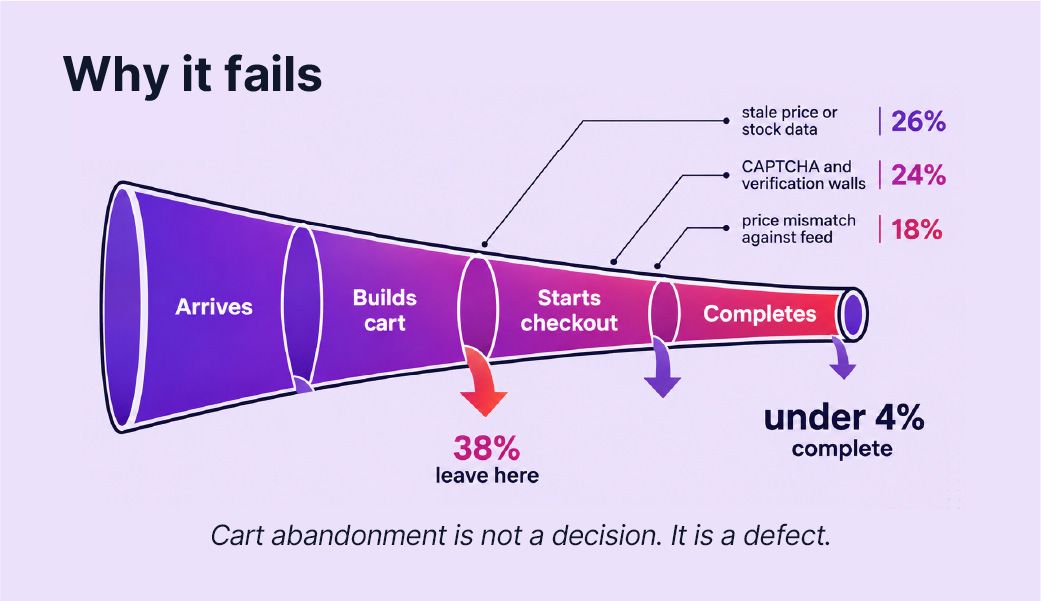
Monitored panel data puts agent cart abandonment at 78.6% against a human benchmark near 70%, with observed checkout completion for browser agents under 4%. The playbook to reduce shopping cart abandonment in Salesforce Commerce Cloud covers the human half of that problem.
The documented causes are your own site: stale price or stock data at 26%, CAPTCHA and verification walls at 24%, and a price that does not match the listed feed at 18%.
The single biggest dropout in the agentic checkout is between cart and checkout start, where 38% of agents leave, which is exactly where login walls and challenges live.
Agents fail 36% of CAPTCHA attempts, and general-purpose agents fail 60% of the time against modern systems. So should you remove CAPTCHAs from your website? NO. That failure demands human-in-the-loop and is perfectly fine. However, other issues should be worked on. [10] [11]
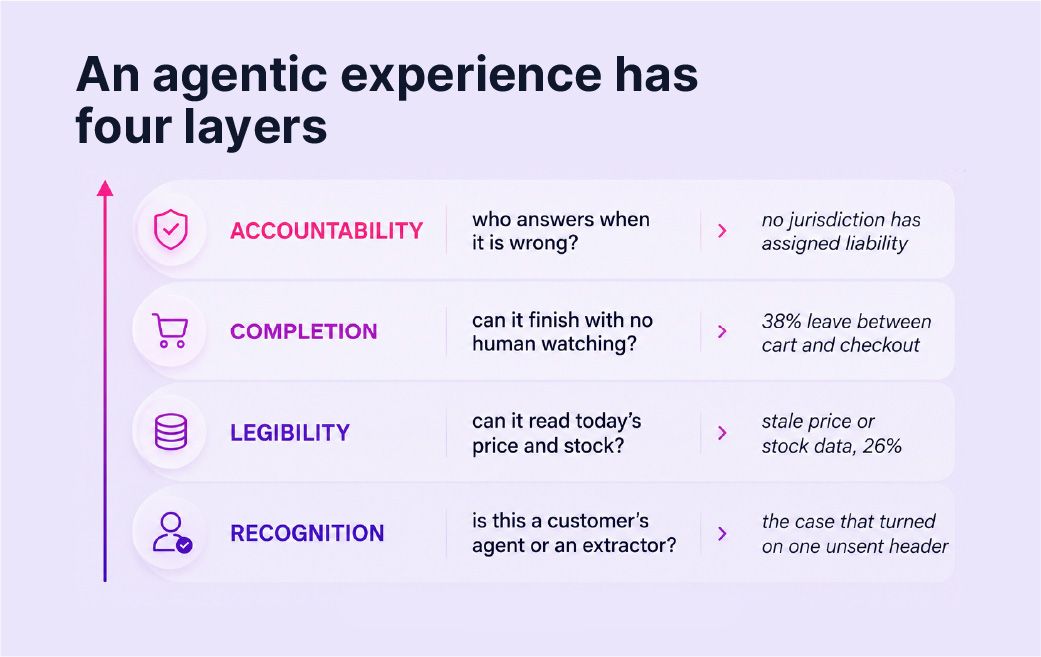
The Four layers of an agentic experience
Recognition: can you tell this is a customer's agent and not an extractor.
Legibility: can it read what you sell, at the price you are charging, from the stock you actually hold.
Completion: can it finish the purchase with no human eyes on the session.
Accountability: when it gets something wrong, who answers for it. [12] [13]
How do you tell a customer's agent from a scraper?
Recognition starts with what the client declares, then checks what it does.
Web Bot Auth has agents sign every request using HTTP Message Signatures under RFC 9421, an Ed25519 key per agent, a Signature-Agent header, and a public key directory at /.well-known/http-message-signatures-directory.
Cloudflare, Amazon, Akamai and OpenAI back it, AWS WAF, Vercel, Shopify and Akamai verify it, and an IETF working group was chartered this year. Behavior settles the rest. Cloudflare Radar publishes a crawl-to-referral ratio, and in June 2026 it read roughly 4,580 requests per referral for one major AI lab, 848 for another, 186 for the company in this lawsuit, and 5 for Google.
An agent sending five requests per shopper is running errands. An agent sending four thousand is creating its own inventory. [14] [15]
What product data does a customer AI agent need to read?
Legibility means structured product data, real-time inventory, standardized product identifiers, and return terms in a field rather than a paragraph, which is the same case for a semantic layer that keeps enterprise data accurate for AI agents.
Microsoft introduced a Dynamics 365 Commerce MCP server at NRF covering discovery, inventory, pricing, promotions and checkout.
SAP scheduled a Commerce Cloud storefront server for the same year, and Shopify now runs four official servers with Stripe and PayPal exposing their own.
Adobe shipped one for Adobe Commerce at its April Summit keynote.
Traffic from AI shopping agents to retail keeps climbing while retail pages stay hard to read, and a page an agent can read is still a page it cannot pay on. [16] [17]
What makes a checkout agent-safe?
OAuth-scoped authority lets a customer grant an agent the right to check out and handle post-purchase actions without handing over a password, and that mechanism is what removes the 38% cliff. The same authority model sits under autonomous commerce agents in Salesforce Agentforce.
The rest is subtraction: no forced account creation, CAPTCHA as per the policy, no price that appears different from the product feed, and shipping cost disclosed clearly before the last step.
Pay-by-link completion and the published commerce protocols both exist to carry that final handoff. [18] [19]
Can retailers still block AI shopping agents?
There are two available strategies, fight the agent or serve it. Blocking the agent is still legal, and it stopped being enforceable through the anti-hacking statute on 4 August.
The lawsuit Amazon lost in March had Judge Milan D. Smith Jr. write for the panel: "However advanced the Assistant currently is, it is a tool, not a person for statutory purposes."
However, the agent ran on the shopper's laptop; screenshots went from that laptop to the AI company; and the AI company's servers never touched Amazon's servers directly.
"This outcome does not impair Amazon's ability to regulate access to Amazon.com via private terms of service for its users." The judge maintained it as a footnote. [20] [21]
Who is liable when an AI agent buys the wrong thing?
No government has answered who pays.
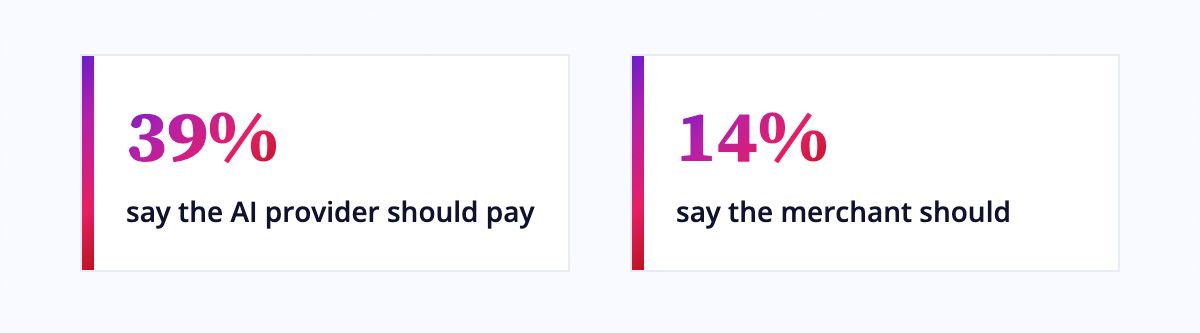
Existing payment rules were drafted for a world where human clicks buy, and one industry survey found opinion split four ways on who should carry the loss: 39% said the AI provider, 20% the customer, 14% the merchant or platform, and 11% the bank.
In practice the merchant absorbs it, which is why American Express has committed to covering erroneous agent purchases on its network.
Friendly fraud already accounts for 75% of all disputes, and Datos Insights projects global chargeback volume rising 24% between 2025 and 2028 to 324 million disputes a year. Contract enforcement makes that worse rather than better. [22] [23]
How to make an agentic experience measurably better
Measure it on your own logs first, then fix the layer that pays back fastest.
Report agent sessions as their own channel, because a cohort converting 42% better deserves a line in the weekly numbers and you cannot repair a funnel you cannot see.
Then walk your own checkout as an agent would and delete what stops it: the CAPTCHA in the purchase path, the forced account creation, the price that only renders client-side.
Legibility is the layer most teams cannot staff, because it means every attribute on every product accurate in every channel, continuously, which is the problem ContentHubGPT was built to solve: enrich and govern product content across multi-brand e-commerce listings before it is syndicated anywhere, so the price and the claim an agent reads are the ones you meant to publish.
Read your terms of service last, now that they carry the enforcement weight the statute used to. [24] [25]
GSPANN's Take
Two decades of spending built an experience for a shopper who now sends an agent to shop instead. The agent arriving on your company website should earn the same weight on the roadmap, as your customer.
- Four layers decide whether that visit converts: recognition, legibility, completion, accountability. Most teams do not go beyond the first. That is where you can win.
- Legibility is now much more important, and it is the discipline ContentHubGPT has mastered, because a system can only sell what it can accurately describe.
- It may also be time to revisit and redefine your terms of service for an agentic customer.
Your customer decided to use agents, the court agreed that the agent's visit by extension should be considered as the customer's visit. The only variable left is whether you as a business can share and provide the right kind of agentic experience your customers' agents demand. If ignored or done badly, it may hit your topline.
All References
Ref 1: https://www.pixelmojo.io/blogs/what-is-ax-design-complete-guide-agentic-experience-2026
Ref 2: https://commercetools.com/blog/ai-trends-shaping-agentic-commerce
Ref 4: https://www.mirakl.com/blogs/agentic-commerce/ai-commerce-readiness-gap/
Ref 5: https://www.shopify.com/enterprise/blog/ai-search-insights
Ref 6: https://commercetools.com/blog/ai-ready-product-data-for-agentic-commerce-success
Ref 8: https://www.shopify.com/enterprise/blog/ai-search-insights
Ref 9: https://novadata.io/resources/news/ai-shoppers-high-intent-low-conversion-august-2026
Ref 10: https://presenc.ai/research/agent-cart-abandonment-statistics-2026
Ref 11: https://alhena.ai/blog/ai-agent-checkout-abandonment/
Ref 12: https://www.pixelmojo.io/blogs/what-is-ax-design-complete-guide-agentic-experience-2026
Ref 13: https://presenc.ai/research/agent-cart-abandonment-statistics-2026
Ref 14: https://blog.cloudflare.com/signed-agents/
Ref 15: https://nobori.ai/blog/crawl-to-refer-ratio-ai-crawler-traffic-b2b-2026
Ref 17: https://business.adobe.com/blog/ai-traffic-surge-retail-sites-not-machine-readable
Ref 18: https://learn.microsoft.com/en-us/dynamics365/commerce/commerce-mcp
Ref 19: https://agentexperience.ax/articles/
Ref 20: https://cdn.ca9.uscourts.gov/datastore/opinions/2026/08/04/26-1444.pdf
Ref 22: https://www.chargeflow.io/blog/ai-agent-chargeback-liability
Ref 24: https://www.gspann.com/insights/newsroom/gspann-acquires-zorang-contenthubgpt