About the Client
A global beverage and snack retailer.
The Challenge
For many years the client had developed and maintained a custom enterprise mobile app used by thousands of sales staffers in-store. Over the years, however, incorporating security patches and adding new features was becoming increasingly difficult. The app ran on iOS and was based upon an old version of React Native (0.57.1). Performance and security issues were becoming increasingly evident, especially when the app was compared with similar but more modern apps. A further obstacle to a smooth upgrade was that the legacy technology had forced developers to build custom workarounds to avoid problems caused by legacy components.
To sum the situation up, the client needed help to:
- Update the app’s code base and dependent toolchain to an up-to-date version without unduly affecting business operations.
- Ensure that after replatforming, the app would continue to function with the maze of associated third-party SDKs and proprietary APIs.
- Extended the app’s compatibility to support newer OS versions and a broader range of devices on both Android and iOS platforms.
- Future-proof the application so that it could easily incorporate new features.
Our Solution
Instead of just jumping right in and performing the upgrade, our team crafted a detailed plan of attack with the goal of bringing React Native to the latest stable version, updating all third-party libraries and dependencies, while ensuring that app functionality remained intact.
The table below summarizes our eight-step approach:
| Steps | Activities |
|---|---|
Research and Planning | Researched React Native and third-party library release notes to identify backwards incompatible changes, deprecated methods, and new features. |
Create Staging Branch | A new branch was created in the code base allowing changes to be made without affecting the main branch. |
React Native Update | The React Native foundation of the app was updated to the most recent stable version. Any changes required by way of project structure, configuration files, and API usage were addressed. |
Third-Party Library Updates | Third-party libraries and dependencies were incrementally updated to their latest versions. Libraries with deprecated or removed features were identified, and the code base was adjusted to ensure app functionality. |
Codebase Cleanup | The codebase as a whole was analyzed, giving our team a chance to refactor, optimize, and clean up the app. |
Test and Debug | An iterative process was pursued consisting of thorough testing looking for performance bottlenecks, UI/UX issues, and crashes. |
User Acceptance Testing (UAT) | Once the testing and debugging phase ended, we released the new app to a selected group of internal users to perform UAT. This helped identify edge cases or issues before moving the code base to production. |
Documentation | Project documentation was updated to reflect all the changes made. We also added usage instructions for new features, and provided troubleshooting advice. |
Key points in our solution included:
- Architecture simplification: Our team removed custom hacks and redundant layers as well as using time-tested software design patterns to reduce future maintenance.
- Updated analytics: We added Firebase Analytics that gave the client real-time behavioural insights and usage statistics.
- Automated crash detection: We incorporated Firebase Bugsnag/Crashlytics monitoring, providing automated crash detection, allowing developers to catch and fix issues before they reach business users.
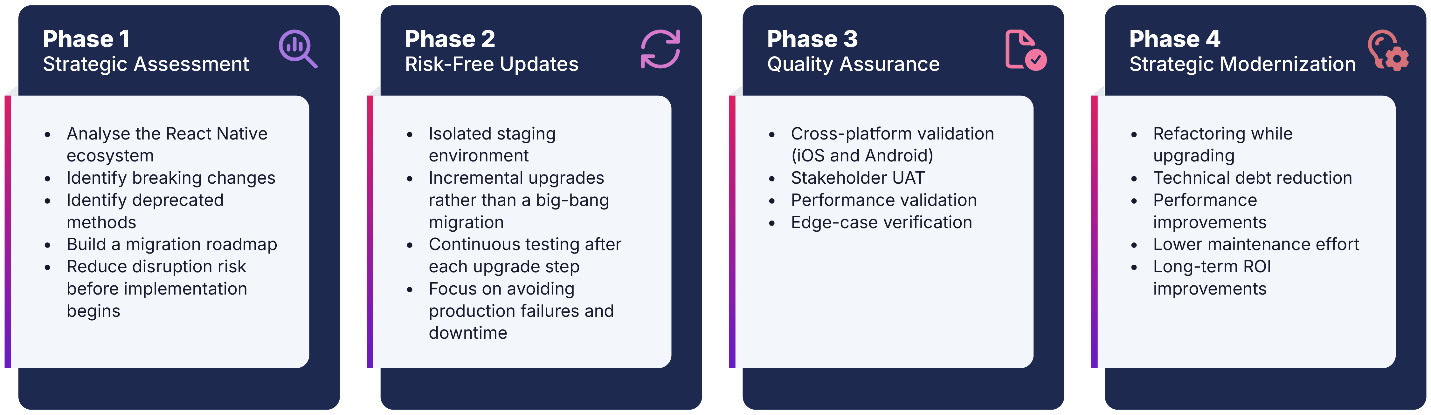
The Methodology
Our Learnings
1. Incremental Modernization: Instead of migrating everything at once, our team executed upgrades incrementally with continuous validation after each step. This reduced risk and enabled earlier detection of issues.
2. Comprehensive Testing: The team relied on regression testing, UI/UX validation, and stakeholder acceptance testing to ensure business continuity throughout the modernization effort.
3. Strategic Refactoring: The engagement wasn't treated as a simple version upgrade. The team used the opportunity to remove technical debt, improve maintainability, and improve performance, which produced long-term business value beyond the migration itself.
4. Business-First Risk Mitigation: A recurring theme throughout the engagement was protecting production systems, preventing downtime, maintaining user productivity, and preserving business operations. The modernization strategy was deliberately designed around business continuity.
Business Impact
- Better user experience: In-store users report that the app is easier to use and loads faster. This helps improve staff productivity and makes the client’s stores a better place to work.
- Tighter security: The outdated tech stack prevented critical security patches from being installed. The new app not only incorporates all security fixes, but adds new layers of security helping the client stay ahead of attackers.
- Shorter release cycles: The updated application infrastructure allows app developers to release new features and app updates quicker. This leads to increased staff engagement and satisfaction.
- Lower TCO: By reducing the existing technical debt, the modern tech stack allows the client to waste less time developing elaborate workarounds and spend more time focusing on useful features.
- Wider platform support: We took advantage of React Native’s cross-platform abilities and provided the client the ability to run the app on Android devices in addition to iOS.
Related Capabilities
Revitalize legacy apps: Modern solutions for tomorrow's mobile experiences.
With your business goals firmly in mind, we transform outdated mobile applications with modern architecture, intuitive interfaces, and best-fit technologies. Our proven modernization approach enhances performance, integrates AI and cloud capabilities, incorporates deep analytics, and ensures seamless connectivity with existing systems, improving your competitive position and reducing costs.
Technologies Used
- React Native
- JavaScript
- Redux
- Redux-Saga
- Firebase (with Bugsnag/Crashlytics)