
Traditionally, B2B go-to-market rested on one assumption about the B2B buyer research process: a human being would eventually read your marketing. Someone filled a form, someone got scored, someone took a call. Every system you bought since 2001 was built on that chain.
Forrester shared at B2B Summit North America that the chain is now no longer the same with AI in the mix. They named it ‘GTM Singularity’.
Here, we attempt to demystify what GTM singularity really means and how it may be affecting your marketing strategies going forward.
1. What is the GTM singularity, in simple words?
Forrester defines it as "the point where AI and changing buyer behaviors permanently reshape how companies attract, win, and grow customers."
The claim goes past a leaking funnel: buyers now research, shortlist, and decide inside AI tools before any seller knows a deal exists. [1][2]
2. Is this again an analyst firm rebranding something we already know?
The behavior change is measured, not asserted.
According to Forrester's 2026 Buyer Insights research, nine in ten B2B buyers have adopted genAI. They use it evenly across the whole B2B buying process: vendor research, RFP drafting, comparison, and final validation.
Forrester expects 20% of B2B sellers to face agent-led quote negotiations before the end of 2026. AI now sits as an intermediary between you and every buyer evaluating you, which turns how an AI system describes your company into a competitive variable. [3][4]
3. How much does that change?
It impacts the buyer, which is the only thing that has ever mattered.
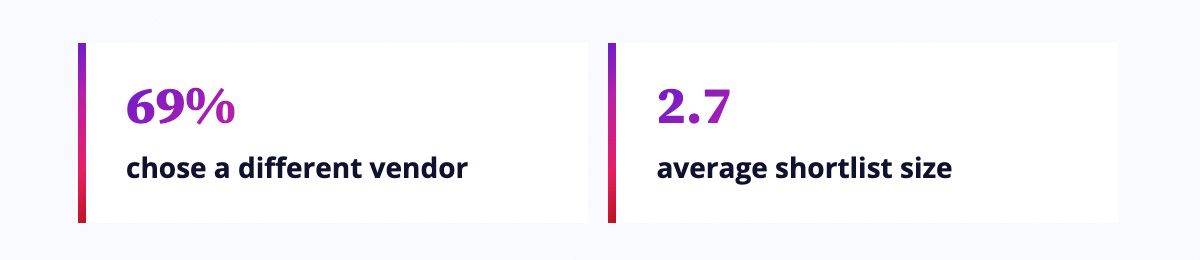
G2 surveyed 1,076 B2B software buyers and found 69% chose a different vendor than they had planned after guidance from an AI chatbot, with one in three buying from a vendor they had never heard of before.
TrustRadius puts the target you are aiming at: 83% of buyers shortlist three or fewer products, the average shortlist is 2.7, and 67% buy their first choice. [5][6]
4. Frameworks that are capable of replacing the old model
There are four key frameworks.
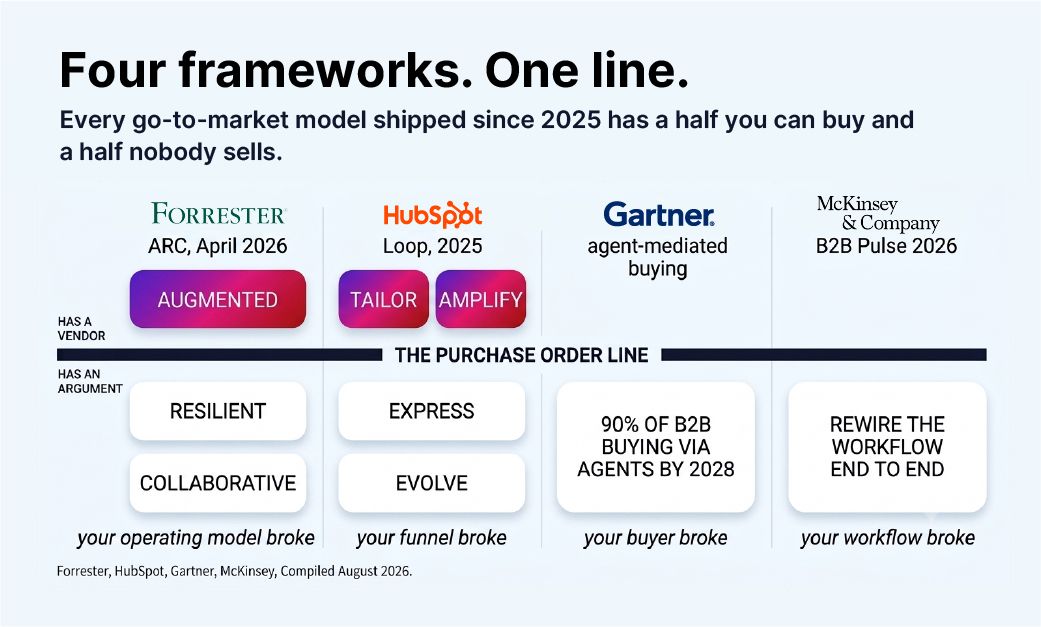
Gartner is describing the market you now sell into. McKinsey is describing why your AI spend has not shown up in revenue: high-growth firms are three times more likely to have raised AI investment by double digits year on year, 71% against 25%, and yet fewer than 10% of organizations have scaled AI in any function.
Forrester is describing the org that has to respond. HubSpot is describing the demand engine inside it. Pick the one that matches the layer you can actually move this year. [7][8]
5. Meanwhile ‘TrustRadius’ study claims AI has not changed what buyers ‘trust’
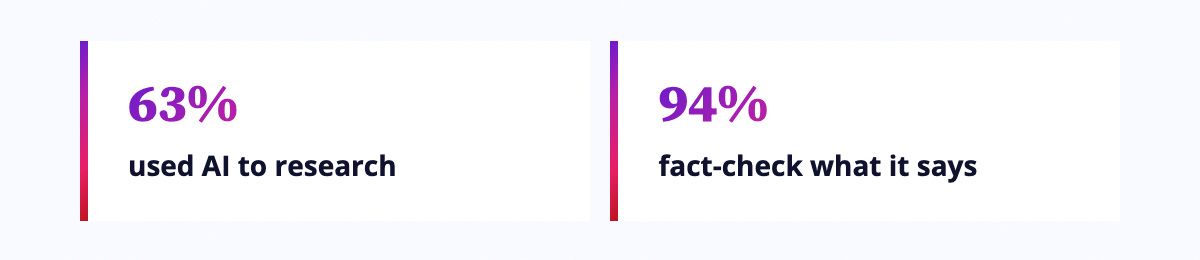
TrustRadius published its 2026 B2B Buying Disconnect Report, titled “AI Has Changed How Buyers Research, But Not What They Trust,” which is built on 1,862 technology buyers and 444 vendors. 63% used AI during the purchase. 94% of them fact-check what it tells them.
Demos, free trials, prior experience, and peer reviews still rank as the most influential inputs at the decision. Discovery moved into the machine. Conviction did not. Forrester is describing the first half of the journey and TrustRadius is measuring the second, and a strategy that treats the whole funnel as automated will lose the half that still runs on proof. [10][11]
6. Why does every company end up implementing the same third of ARC?
Call it the purchase order line. Augmented is above the line where you will find anything you can buy: a tool, a licence, a seat count, a pilot with a payback number. Resilient and Collaborative are below it where you will find anything you have to win: a planning calendar, a shared target, a reorganized team.
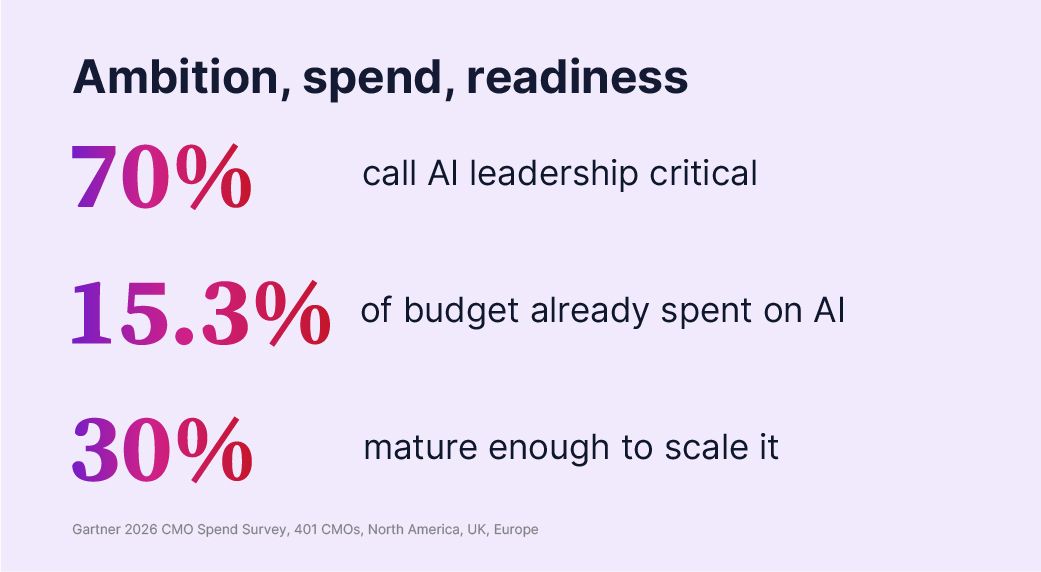
Gartner's 2026 CMO Spend Survey, run across 401 CMOs in North America, the UK, and Europe, most at over $1 billion in revenue, measures the split precisely: 70% call becoming an AI leader a critical goal, 15.3% of the marketing budget is already going to AI, and 30% have the maturity to scale it. [12]
7. Does the purchase order line cut through the other frameworks too?
It cuts through all of them, and in the same place.
HubSpot's Loop starts with Express, which is brand identity and customer understanding work with no product attached, then moves to Tailor and Amplify, which are things you can license.
McKinsey's entire finding is below the line: the companies pulling ahead redesigned the workflow the tool sits inside and put someone in charge of the customer, product, and pricing data an agent needs to act on.
Gartner's thesis is below the line by definition, because no purchase changes what your buyer has become. Every framework has a buyable half and an unbuyable half. The unbuyable half is the half that decides whether it works. [13][14]
8. Is the hype real, or is it all vendor noise?
In its inaugural Hype Cycle for Agentic AI study, Gartner maps more than 30 innovations and places AI Agents for Sales at the ‘Peak of Inflated Expectations’ and Machine Customers back at ‘Innovation Trigger’, which is early rather than imminent.
Gartner also coined "agent washing" for legacy automation and RPA relabeled as agentic. Its 2026 CIO survey puts 17% of organizations with AI agents actually deployed against more than 60% expecting to deploy within two years. The gap between 17 and 60 is the purchase order line, drawn by Gartner rather than by me. [15][16]

9. Rep-free buying is up. Should we cut sales headcount?
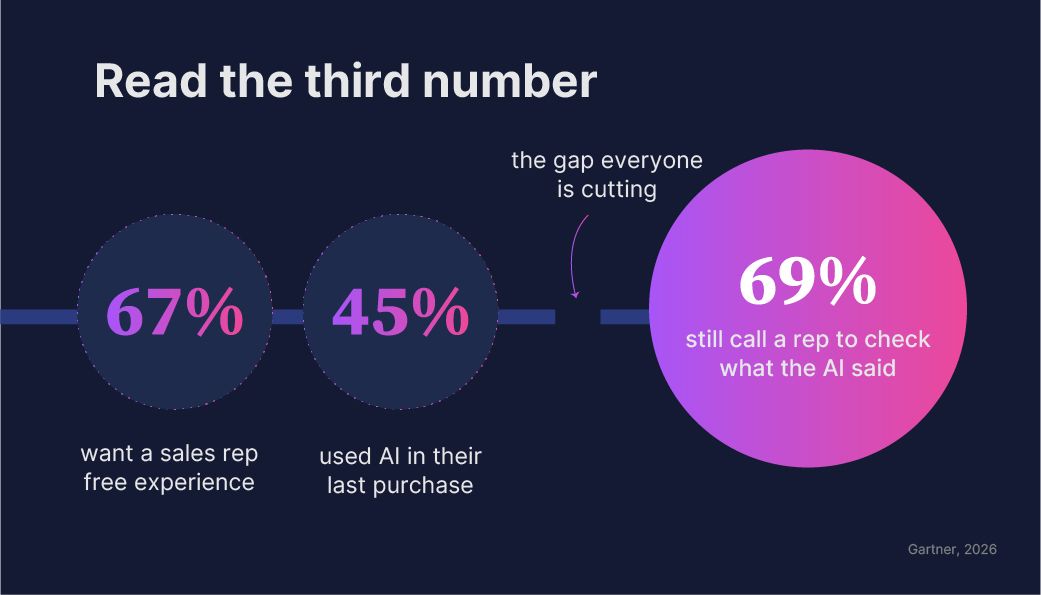
67% of B2B buyers say they prefer a rep-free experience and 45% used AI during a recent purchase, which reads like a staffing argument until you reach the third number: 69% still turn to a sales rep to validate what the AI told them.
TrustRadius found the same reflex from the other direction, with 94% of AI users fact-checking the output. Forrester attributes it to AI answers arriving incomplete or unreliable.
The rep moved from the front of the process to the end of it. Cutting the role because the first half went automated removes the person who closes the second half. [17][18]
10. Why is our inbound volume up but our pipeline remains flat?
Because AI made it free to ask and expensive to recommend.
Harvard Business Review named the mechanism: buyers use AI to generate supplier lists, draft procurement emails, and fire polished requests for quotation at a dozen firms in minutes. More RFQs arrive without more real opportunities behind them.
One manufacturer in their case set recovered its sales efficiency only by screening AI-generated inquiries out before quoting. The hit lands hardest on firms whose value is interpreting a brief before proposing a solution, which describes most engineering, manufacturing, and specialist software businesses.
Your inbound chart goes up. Your win rate goes down. Both are the same event. [19]
11. Are Marketing Qualified Leads (MQL) relevant in the new GTM singularity?
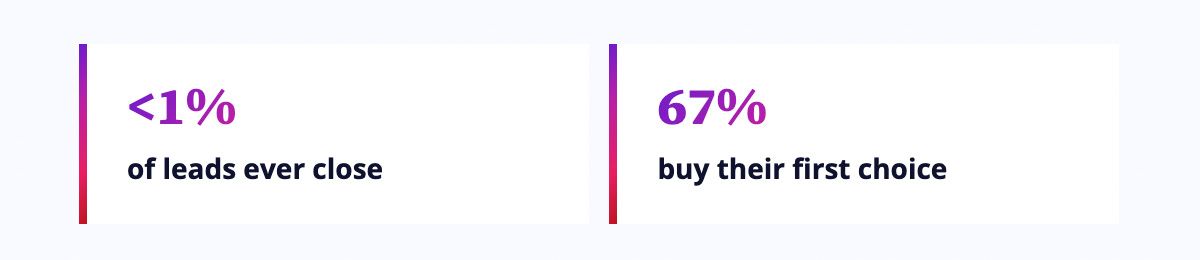
Forrester's own research found fewer than 1% of leads ever close, and TrustRadius now shows 67% of buyers purchasing their first choice off a shortlist of under three. When the shortlist is assembled inside a chatbot before a form is ever filled, a hand-raise is a receipt, not a signal.
Forrester's replacement has been in the field for years and most teams never moved to it: the B2B Revenue Waterfall, which scores buying groups against opportunities rather than individuals against forms. [20][21]
12. What is the risk if we run the “augmented” without governing it?
Forrester’s 2026 predictions put losses from ungoverned use of generative AI at more than $10 billion across B2B companies this year, and forecast 15% of agency jobs eliminated in 2026 as work moves in-house faster than the controls around it.
The mechanics are visible in outbound, where AI-driven volume has pushed ISPs to throttle and reject at the protocol level, and where 39% of marketers say they do not know how to use generative AI safely and 43% say they cannot get value from it.
Put an agent in front of your market without an agentic AI governance layer and every claim it makes is unowned. Somebody still signs for them. [22][23]
13. If we do one thing in the next 90 days, what is it?
Audit the below-the-line half before you buy anything above it. Two questions answer it.
First, take the fifty questions your buyers actually ask during evaluation and count how many can be answered from structured data you publish today rather than from a PDF or a conversation.
Second, name the one person accountable for keeping that data correct. If the first number is low and the second is nobody, every framework on the table will fail for the same reason, and no vendor demo will tell you, because the demo runs on their data. [24]
GSPANN'S TAKE
Four research houses describe the same shift from different angles. It looks like disagreement, but they are really mapping different floors of the same building. Here is what we think:
- Buyer data settles the debate: AI is reshaping discovery, while demos and peer reviews still build conviction. Fund only discovery and you risk losing the second half of the journey.
- The industry is funding what it can measure. Gartner puts the gap at 70% ambition versus 30% readiness.
- The hidden problem is data, not just change management. Resilient GTM needs trusted signals; collaborative GTM needs a shared view of the customer. Neither works without the right data foundation.
- That is the lesson behind GSPANN's work on B2B agentic commerce: whether the agent is yours or your buyer's, it can only act on what your data can answer.
The uncomfortable part: the buyer may change without leaving a trace in your reporting. They can research, evaluate, and rule you out inside AI without ever visiting your site or entering your CRM. Meanwhile, inbound traffic rises and your dashboards still look healthy. You only notice the shift when deals start disappearing.
All References
Ref 2: https://www.forrester.com/blogs/get-ready-for-the-gtm-singularity-at-forresters-b2b-forum-emea/
Ref 4: https://hbr.org/2026/07/ai-is-changing-how-customers-choose-your-business
Ref 5: https://learn.g2.com/g2-2026-ai-search-insight-report
Ref 7: https://blog.hubspot.com/marketing/loop-marketing-strategy
Ref 14: https://blog.hubspot.com/marketing/loop-marketing-strategy
Ref 15: https://www.gartner.com/en/articles/hype-cycle-for-agentic-ai
Ref 16: https://tray.ai/blog/gartner-agentic-ai-hype-cycle-2026/
Ref 19: https://hbr.org/2026/07/ai-is-changing-how-customers-choose-your-business
Ref 20: https://www.forrester.com/b2b-marketing/b2b-revenue-waterfall-guide/
Ref 22: https://www.forrester.com/press-newsroom/forrester-b2b-marketing-sales-product-2026-predictions/
Ref 23: https://blog.hubspot.com/marketing/hubspot-blog-marketing-industry-trends-report