
For 25 years, APIs connected enterprise software, letting applications exchange data at virtually no additional cost once you bought the software.
That era is changing.
On June 9, 2026, SAP began enforcing API Policy v.4.2026a, routing third-party AI agents, bulk data extraction, and proxy workarounds through its MCP and Integration Suite gateway. Organizations relying on ODP-based extraction pipelines now need to re-architect onto supported routes.
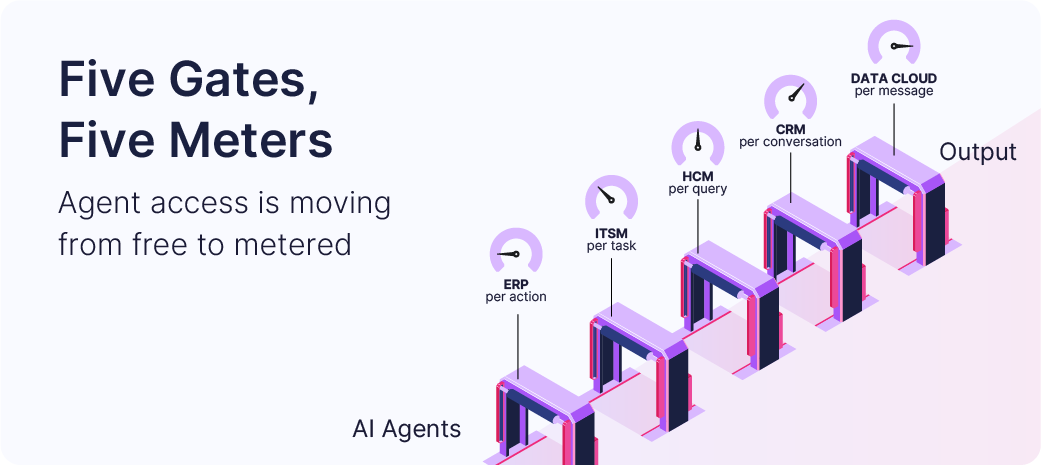
SAP isn't alone. Across enterprise software, vendors are introducing governed gateways that meter how AI agents access business data. The cost of enterprise AI may soon include not just the model, but also the price of reaching the data that powers it.
Forrester has warned CIOs against allowing a single vendor to become the gatekeeper of enterprise AI, describing SAP's approach as a potential pricing cliff. Joule remains free through December 31, 2026, but pricing for 2027 has not yet been disclosed.[1]
The pattern is spreading. ServiceNow's Action Fabric meters external AI agents through its governed layer using Assist currency. [2]
As reported by PYMNTS, JPMorgan analyst Mark Murphy characterized the charge as effectively a tax on customers using outside AI agents, and Seeking Alpha framed it as a potential mispriced tollbooth for agentic AI. [3]
Workday's Agent Gateway and Agent System of Record charge Flex Credits based on AI work performed, such as retrievals and autonomous tasks, shifting pricing from per-seat licenses to per-agent activity. Meanwhile, analysts have described these emerging access fees as a new toll on customers choosing third-party AI agents. [4]
Does This Mean Per-Seat Software Licenses May Become Obsolete?
Yes. When one agent does the work of ten seats, a per-seat license stops reflecting value, so vendors price the work instead.
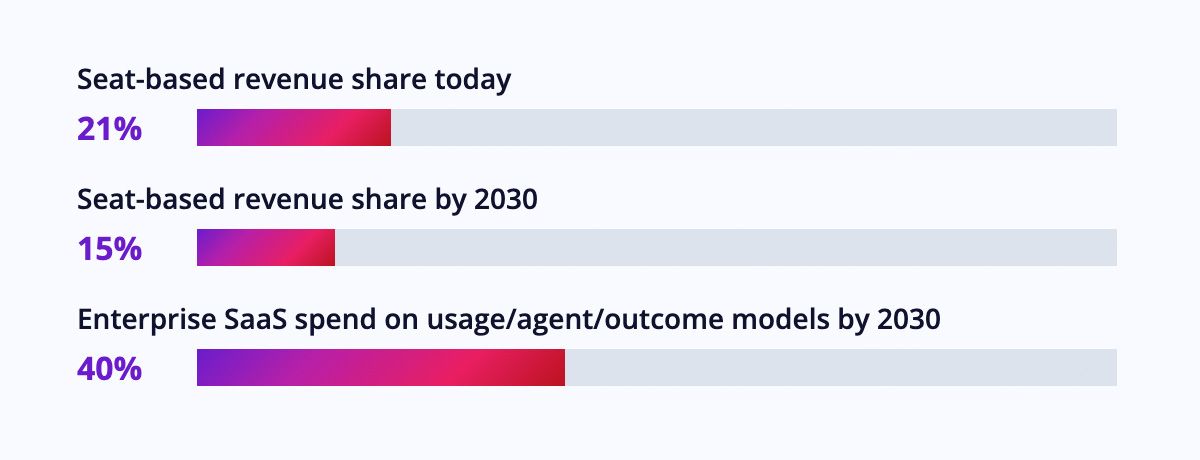
Gartner projects at least 40% of enterprise SaaS spend shifts to usage, agent, or outcome models by 2030, with seat-based revenue share falling from 21% to 15%.
Salesforce Agentforce prices a standard action at 20 credits, or $0.10; HubSpot charges $0.50 per resolved conversation, unresolved free. [5]
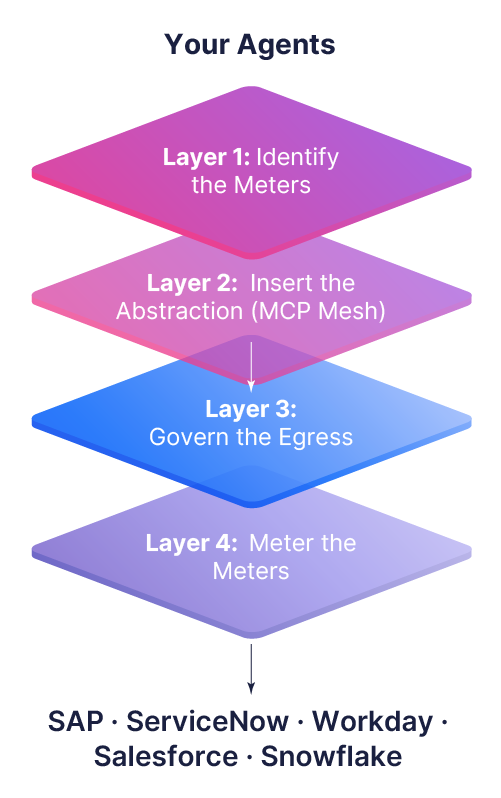
Use the Agent Toll Map, a Four-Layer Meter-to-Mesh Model
Layer 1: Identify the meters. Inventory every vendor boundary an agent crosses and flag its unit cost and 2027 exposure.
Layer 2: Insert the abstraction. A vendor-neutral MCP mesh so agents bind to a contract you control, turning a vendor change into a config change.
Layer 3: Govern the egress. Cache and stage data so only traffic that needs a live metered call makes one.
Layer 4: Meter the meters. Cross-vendor agent FinOps with budgets, rate limits, and per-agent chargeback. [6]
Platforms Reserve Fuller Context for Agents Built on Their Endorsed Stack
Salesforce notes that agents on its stack get fuller context and capability, with MuleSoft Flex Gateway and Agent Fabric governing each interaction, and ServiceNow follows a similar pattern.
That leaves three postures to design around: block (SAP), meter (most platforms), and context-tiering (native agents get more). None is unreasonable, but a multi-vendor strategy needs architecture to keep an independent agent on equal footing. [7]
Every Retry and Every Extra Token Rebills
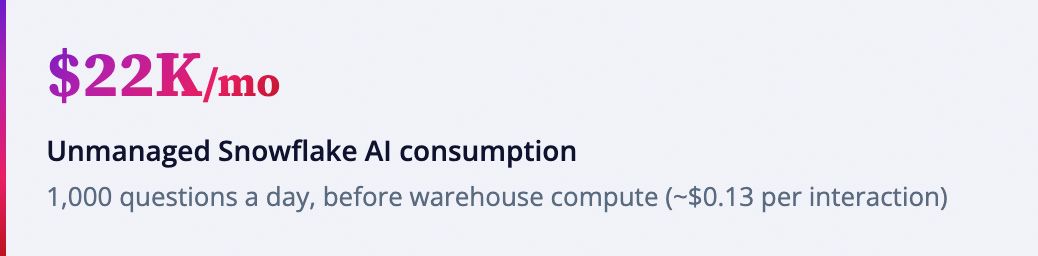
Snowflake has charged AI usage through AI Credits since April 1, 2026. A typical AI interaction costs around $0.13, and because AI agents perform more work than a standard query, they also consume more computing resources, increasing overall costs.
Left unmanaged, 1,000 questions a day reaches roughly $22,000 a month before warehouse compute. The cost is a function of how the consumption is designed, which is the part teams control. [8]
There is No Cross-Vendor Consumption API
The billing unit moves from seat to per-action meter, the buyer shifts from procurement to engineering, and a visibility gap opens because no single view spans vendors. The scale is easy to underestimate.
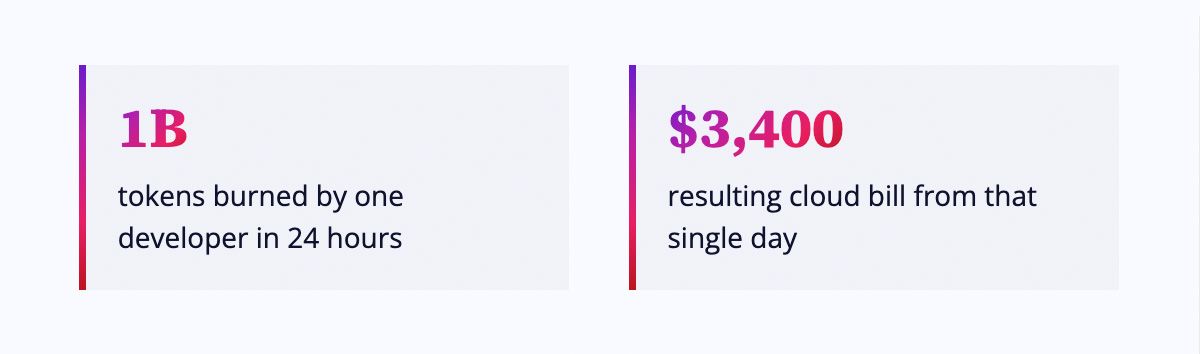
At Dell Technologies World 2026, Dell's Jon Siegal described one developer burning through 1 billion tokens in 24 hours, a $3,400 cloud bill. Each meter is clear on its own. The gap is between them. [9]
They Run Out Early
Uber spent its entire 2026 AI budget by April and now caps employees at $1,500 a month per tool, with Amazon, Walmart, and Meta setting caps too.
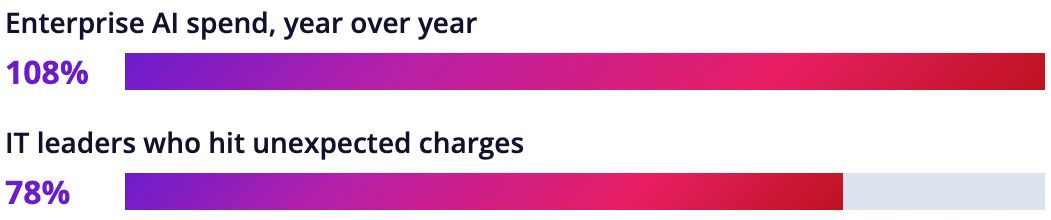
Enterprise AI spend is up 108% year over year, 78% of IT leaders hit unexpected charges, and pilots understate production cost by 500 to 1,000%. [10]
Concentration Risk
Relying on a single AI vendor gives that vendor significant control over your costs and innovation roadmap. We're already seeing this play out in software pricing.
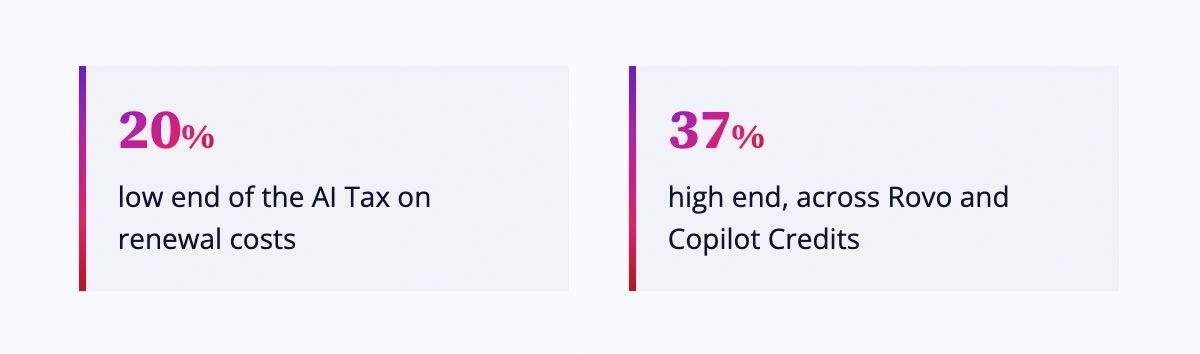
Procurement platform, Tropic, calls it the AI Tax, where AI features can increase renewal costs by 20 to 37%. The pattern is consistent across Atlassian's Rovo and Microsoft's Copilot Credits, and the takeaway is same: build your AI strategy so you're not locked into a single vendor. [11]
By building the layer that keeps an agent strategy from depending on a single vendor's meter. GSPANN implements these same platforms to optimize for the metered access.
The aim is to adopt the platforms, while avoiding concentration risk. [12]
All References:
Ref 3: https://www.theinformation.com/newsletters/applied-ai/servicenow-putting-new-tollgate-ai-agents
Ref 6: https://www.finout.io/blog/your-agents-are-about-to-be-charged-per-data-query-at-every-saas-vendor
Ref 7: https://vantagepoint.io/blog/sf/data-360-agentforce-pricing-flex-credits-guide
Ref 8: https://www.seemoredata.io/blog/snowflake-cortex-ai/