
About the Client
A US-headquartered cloud communications SaaS company serving thousands of enterprise and mid-market customers worldwide.
The Challenge
The company's accounts receivable (AR) team managed subscription billing operations that required constant reconciliation between two systems: subscription data stored in the company’s ERP system, and sales order records flowing in from its enterprise data warehouse. Because these systems operated independently, their records rarely aligned without manual intervention.
On every billing date, the AR team began the reconciliation process, starting in the early morning, manually exporting records, comparing them line by line, investigating mismatches, and resolving discrepancies before invoices could go out. When the process extended past the intended billing date, it created downstream complications, including tax calculation errors and delayed invoice delivery to customers. The team's expertise was being consumed by data investigation rather than issue resolution.
The reconciliation process surfaced five recurring areas of concern:
- Missing subscriptions: The ERP system contained no matching record for an active subscription.
- Quantity mismatches: The licensed seat count differed between the two systems.
- Pricing inconsistencies: Sales order pricing had not propagated correctly to billing records.
- Renewal timing differences: Contract renewal dates conflicted across systems.
- Missing sales orders: Orders visible in the enterprise data had no corresponding entry in ERP.
The company recognized that the bottleneck lay not in the team's capability but in the lack of an intelligent system to perform the comparison automatically and only bring into focus the exceptions that required human judgment.
Quantifying the Reconciliation Burden
Other data sources contributed to the reconciliation on each cycle, spanning subscription records, sales orders, invoice adjustments, refunds, cancellations, currency and tax calculations, customer master data, promotions, and historical amendments. Compounding this complexity was a fundamental timing mismatch.
While ERP processed transactions in near real time, the data warehouse synchronized data in batches every few hours, meaning reconciliation inconsistencies were effectively built into the architecture before any human error could even occur.
Estimated Transaction Volume and Manual Effort
Based upon our experience with SaaS-based applications, we were able to provide the following estimates:
- Approximately 40,000 to 60,000 subscriptions and order records processed each month.
- The AR team manually reviewed 3,000 to 5,000 exception records per month, averaging 150 to 250 discrepancies daily.
- Overall, 12% to 18% of records required manual validation or correction before financial close activities could proceed.
It is important to note that actual savings and revenue protection depend upon transaction volumes, discrepancy rates, analyst effort, and your organization’s financial controls.
Our Solution
The company partnered with GSPANN to design and deploy an agentic AI reconciliation system built on Boomi's native agent capabilities, enabling AR analysts to submit reconciliation requests in natural language and receive structured, business-readable discrepancy reports within seconds.
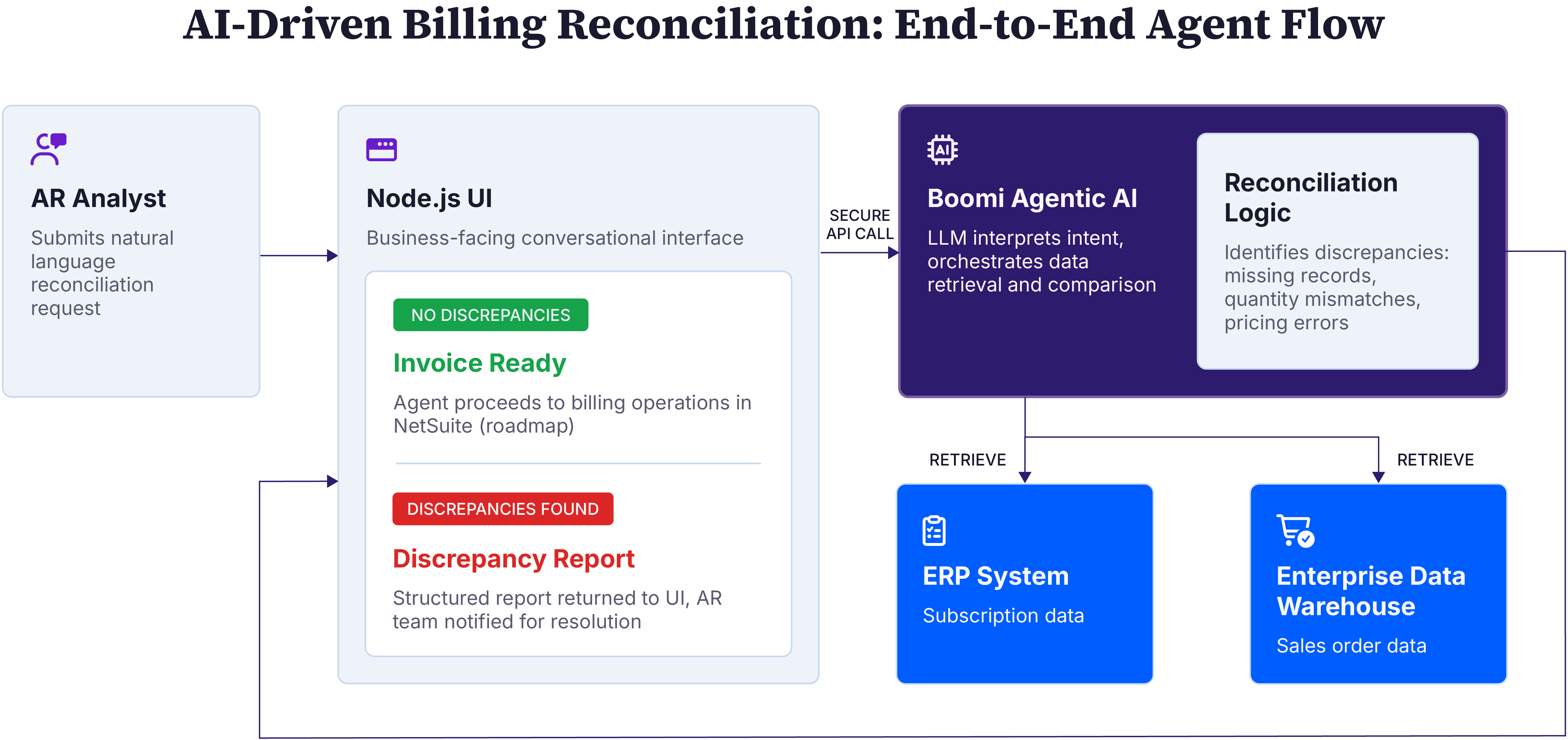
Key highlights of our solution include:
- Boomi-powered AI agent. The team built the reconciliation agent on Boomi's agent framework, which includes built-in large language model (LLM) support for natural language intent interpretation. When a reconciliation request arrives, the agent parses the request, determines what data needs to be analyzed, retrieves the relevant subscription records from ERP and sales order records from the data warehouse, and executes comparison logic to identify discrepancies including missing records, quantity differences, pricing mismatches, and status inconsistencies. Rather than returning raw technical output, the agent generates a business-readable reconciliation summary that highlights only what the AR team needs to act on.
- AI model pattern. The solution combines prompt-driven LLM reasoning with a hybrid rule-plus-AI hybrid validation layer, enabling context-aware discrepancy interpretation rather than rigid pattern matching. This design establishes a single source of truth for reconciliation logic, eliminates duplicated validation rules previously maintained across teams, and forms the foundation for future AI pipelines, including the planned remediation agent and autonomous billing extensions.
- Custom business-facing UI. To ensure AR analysts could access the agent without requiring direct access to the Boomi platform, the team developed a lightweight, custom application using Node.js. The UI provides a simple, conversational interface through which users can submit plain-language requests such as "compare subscriptions for customer X" or "identify missing sales orders for this billing period." The UI securely invokes the Boomi agent through a dedicated API, making the entire integration layer invisible to the end user.
- End-to-end reconciliation workflow. The solution covers the complete reconciliation cycle in a structured, seven-step sequence. The AR analyst submits a request through the custom UI. The application routes the request to the Boomi agent via API. The agent interprets the natural language request using its embedded LLM, executes reconciliation logic across datasets, and returns a structured discrepancy report. The report is displayed directly within the UI, eliminating the need to switch between systems or export and compare spreadsheets manually.
- Extensible architecture for full billing automation. The agent's architecture was designed for progressive expansion beyond the initial comparison and flagging phase. The roadmap includes full billing automation: when no discrepancies are detected and the billing date has arrived, the agent will proceed to execute billing operations in ERP, generate and group invoice PDFs, and trigger a notification to the AR team for final review before customer delivery. A separate remediation agent is being scoped to handle discrepancy correction, maintaining a clean separation of concerns across the analysis, billing execution, and resolution workflows.
Business Impact
- Reconciliation speed: What previously required the AR team's full attention across an entire billing day can now be completed in seconds per request. Manual reconciliation work dropped by and estimated 60–75%, with exception identification time falling from hours to minutes, freeing the team to focus on resolution rather than comparison.
- Reduced billing delays: Removing the manual comparison bottleneck eliminates the primary cause of invoices spilling past billing dates, reducing the downstream tax calculation errors and customer experience issues that followed.
- Business-user accessibility: AR analysts interact with the reconciliation system through a familiar, conversational UI without requiring access to or training on backend integration platforms, reducing both operational friction and onboarding overhead.
- Audit-ready discrepancy records: Each reconciliation run generates a structured report documenting what was checked, what was flagged, and what requires resolution. AI-generated discrepancy summaries accelerate investigation and strengthen audit traceability, supporting internal review and future audit requirements.
- Foundation for autonomous billing: Built on Boomi orchestration, AI-driven comparison logic, and automated discrepancy classification, the agent architecture is designed to scale into a fully autonomous billing pipeline covering invoice generation, PDF grouping, and customer delivery. Human approval serves as a review checkpoint rather than a mandatory operational entry point.
Related Capabilities
GSPANN's Application Services and Modernization practice specializes in designing and deploying agentic AI systems that replace manual operational workflows with intelligent, event-driven automation. This engagement demonstrates the practice's ability to combine enterprise integration platforms, cloud data systems, and custom UI development to deliver measurable operational efficiency for finance and operations teams.
Technologies Used
- Boomi
- Node.js