

Mobile now drives most of the retail e‑commerce globally, with m‑commerce on track to comprise ~63% of online retail by 2028 [42]. At the same time, shoppers expect experiences that feel tailored, instant, and helpful across every touchpoint.
The challenge: most apps still deliver static journeys that miss the moment. The opportunity: AI can turn your app into a responsive, predictive shopping companion—one that reduces friction, grows baskets, and lowers operating costs.
This blog delivers:
- A clear strategy for embedding AI into your mobile app—without rocking the boat.
- Use‑case blueprints tied to retail pain points and customer impact.
- A phased roadmap and governance guardrail.
- Brand stories and benchmark ranges with citations.
Core Retail AI Use Cases
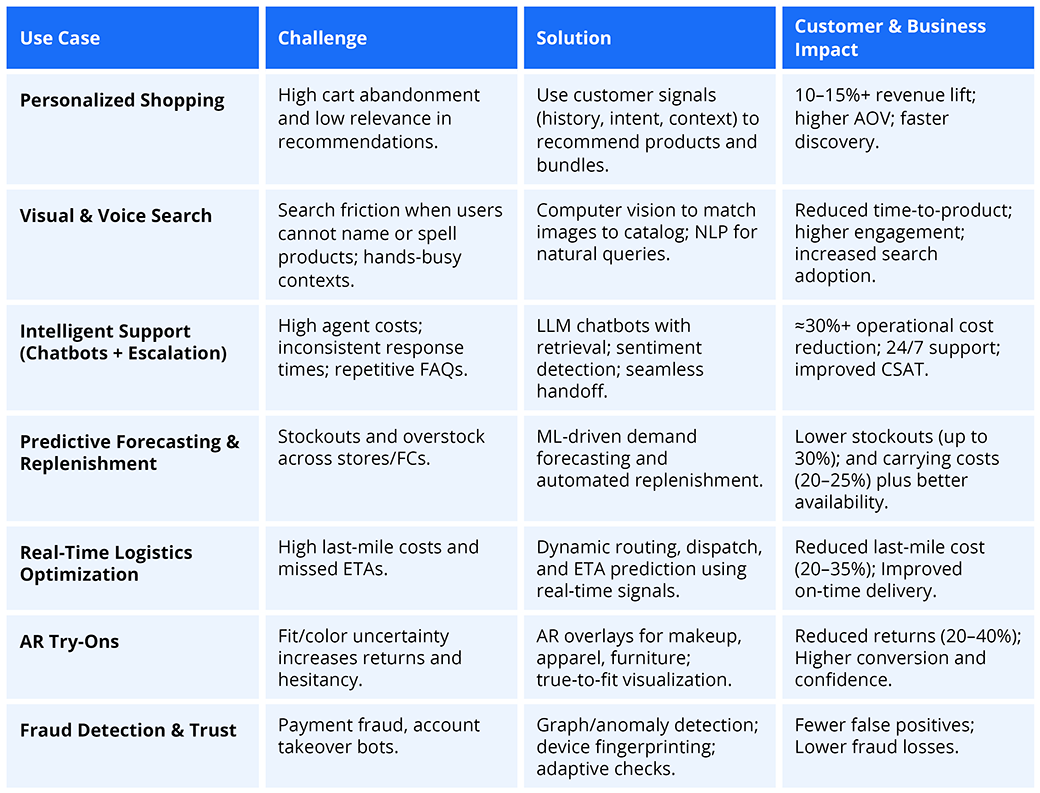
Today's retail landscape demands more than just a digital presence—it requires smart, responsive systems that anticipate customer needs while optimizing operations behind the scenes. The use cases summarized in Table 1 illustrate how leading retailers are deploying AI not as a futuristic experiment, but as a practical toolkit to solve real business pain points.
From helping shoppers find exactly what they're looking for through visual search, to preventing costly stockouts with predictive forecasting, each application delivers measurable impact where it matters most: customer satisfaction and the bottom line.

The table below breaks down seven core use cases, mapping each business challenge to its AI solution and the tangible results retailers are already seeing.
Brand Stories: How Leading Retailers Transform Data into Customer Delight
Walk into any retail conference today and you'll hear the same buzzwords thrown around: AI, personalization, data-driven insights. But let's be honest—most of it sounds like marketing fluff until you see real numbers.
Three retail giants have actually cracked the code on turning technology into genuine customer value, and their results are worth examining.
Sephora: From Uncertainty to Confidence
Here's a problem every makeup buyer knows too well: you're scrolling through foundation shades online, squinting at your screen, wondering "Will 'Warm Honey' actually match my skin tone or will I look like an Oompa Loompa?" For decades, this uncertainty kept beauty shopping firmly in the physical store territory.
Sephora decided to tackle this head-on with their Virtual Artist feature—basically, point your phone camera at your face and virtually "try on" thousands of products before buying. Sounds simple, right? But getting customers to actually use it was the hard part.
In Southeast Asia, Sephora went all-in on promoting this feature through targeted in-app campaigns. The payoff? Adoption jumped 28% and traffic to the AR feature surged 48%. Even better, once people tried it, they kept coming back—usage per person climbed 16%. That's the difference between a gimmick and a genuinely useful tool [1].
The business impact tells the real story. Sephora's AR mirror trials led to roughly 31% higher sales, and globally, their AI Virtual Artist has driven 90% better conversion rates across 35 million customers [2]. Think about that: nearly double the conversion rate just by letting people see how a lipstick looks before they click "buy." Turns out, when you remove the guesswork from beauty shopping, people actually feel confident enough to purchase online. Who knew?
Amazon: Recommendations Everywhere
Another example of retail AI impact is Amazon's not-so-secret weapon: those "Customers who bought this also bought" suggestions that somehow always seem to know exactly what you need. It's almost creepy how accurate they are.
Behind the scenes, Amazon runs sophisticated item-item collaborative filtering algorithms—fancy words for "we analyze billions of purchases to figure out which products naturally go together". But here's what separates Amazon from everyone else trying to copy them: they don't just have good algorithms. They've mastered the art of putting recommendations everywhere without making you feel stalked.
Homepage? Recommendations. Product page? More recommendations. Checkout? A few more suggestions. Post-purchase email? You guessed it. Yet somehow it never feels pushy or annoying—it actually feels helpful.
The numbers back this up in a big way: roughly 35% of Amazon's total revenue comes directly from their recommendation engine [5]. That's more than one-third of their entire business driven by smart product suggestions. Amazon's current approach uses item-to-item collaborative filtering, which handles massive datasets way better than older methods and delivers more accurate recommendations.
This isn't just about showing you "related products." It's about understanding that someone buying camping gear in March is probably planning a summer trip, or that someone browsing baby books might appreciate seeing related parenting guides. When discovery feels personal instead of algorithmic, people naturally add more to their carts.
Target & Walmart: Forecasting What's Next
While exciting customer-facing features grab headlines, some of the most impressive AI work happens where customers never see it: inventory management.
Target's AI systems have gotten so good that they spot potential stockouts before actual humans on the inventory team notice anything's wrong. Imagine being able to restock shelves proactively instead of reactively scrambling when something runs out. That's the difference between a smooth shopping experience and frustrated customers staring at empty shelves.
Walmart has taken this even further with their machine learning-powered demand forecasting. The results are genuinely impressive: stockouts dropped by 18-30% while inventory costs fell about 22% [8][9]. That's the retail equivalent of having your cake and eating it too—products are available when customers want them, but you're not drowning in excess inventory gathering dust in the back room.
Walmart's system even optimized delivery routes so efficiently they saved 30 million unnecessary driving miles. That's not just good business—it's better for the environment too.
By monitoring inventory levels and forecasting demand in real-time, these retailers maintain that delicate balance between having enough stock and having too much. It transforms supply chain management from "that boring logistics stuff" into a genuine competitive advantage that keeps customers happy and costs under control.
Tools & Building Blocks: The AI Stack Powering Modern Mobile Apps
If you've ever wondered how your favorite shopping app seems to "just know" what you're looking for, or how that fitness app gives you personalized workout suggestions that actually make sense, you're seeing the result of some seriously smart technology working behind the scenes. But here's what most people don't realize: building AI-powered mobile apps isn't about using one magic solution—it's about combining the right tools for the right jobs.
On-Device Intelligence: Speed When It Matters
Let's start with the stuff that runs directly on your phone. Tools like TensorFlow Lite and Apple's Core ML have completely changed what's possible in mobile apps. Instead of sending every little request to a server somewhere and waiting for a response, these frameworks let apps process AI tasks right on your device. Think about face filters on Instagram or real-time language translation—that instant response happens because the AI model lives on your phone, not in some distant data center.
For retail apps, this means lightning-fast product recognition when you point your camera at an item, or instant style recommendations based on what you're browsing—all without the lag that would kill the user experience. Plus, keeping data on-device addresses privacy concerns that freak people out when they think about AI tracking their behavior.
Cloud Power: The Heavy Lifting
But on-device processing has limits. When you need serious computational muscle—like analyzing millions of customer purchase patterns to generate personalized recommendations—that's where cloud services like Amazon Personalize come in. These platforms crunch massive datasets in real-time, learning from every interaction across thousands or millions of users to surface suggestions that actually feel relevant.
The beauty of cloud-based AI is scale. A mobile app can tap into recommendation engines that would be impossible to run locally, delivering Netflix-level personalization without draining your battery or requiring a supercomputer in your pocket.
Conversational AI: Making Apps Feel Human
Then there's the conversational layer. Tools like Dialogflow and OpenAI's APIs have made it ridiculously easy to add chatbot functionality that doesn't feel like you're talking to a robot reading from a script. Modern mobile apps use these to handle customer service questions, guide users through complex processes, or even act as personal shopping assistants—all through natural conversation.
The difference between old-school chatbots and current AI-powered ones is night and day. Instead of rigid "press 1 for sales, press 2 for support" nonsense, these systems understand context, remember previous conversations, and actually help solve problems.
Integration Glue: Making It All Work Together
Here's where things get technical but important: Firebase's modular APIs act as the connective tissue holding everything together. They handle user authentication, real-time database syncing, cloud messaging for notifications, and analytics—basically all the infrastructure headaches that would otherwise consume months of development time.
For AI-powered mobile apps, Firebase provides the foundation that lets developers focus on building smart features instead of reinventing basic plumbing.
Implementation Challenges & How to Mitigate
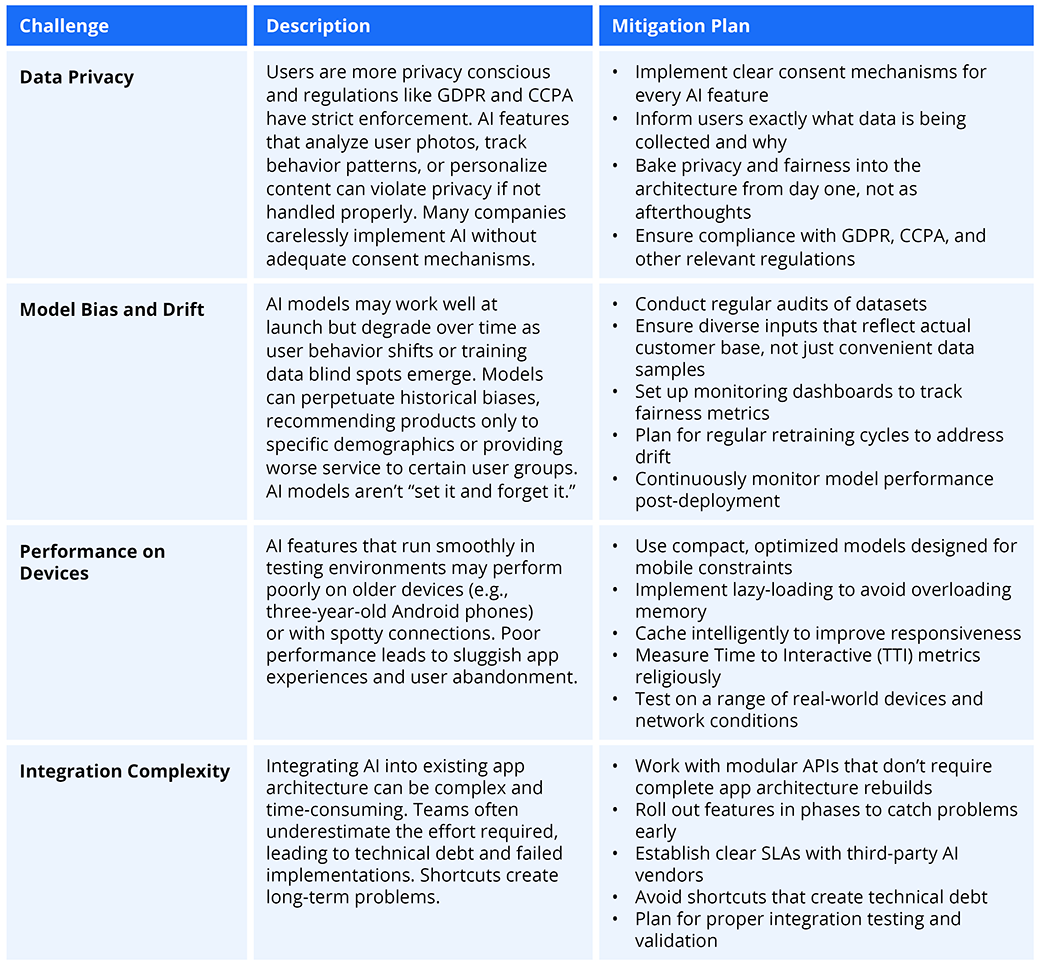
Let's be real—adding AI to your retail mobile app isn't just a matter of flipping a switch. There are some genuine headaches you'll need to work through, but the good news is that each one has practical solutions if you know where to look.
Table 2 summarizes the challenges and potential mitigation strategies.
AI Integration Roadmap for Mobile Retail Apps
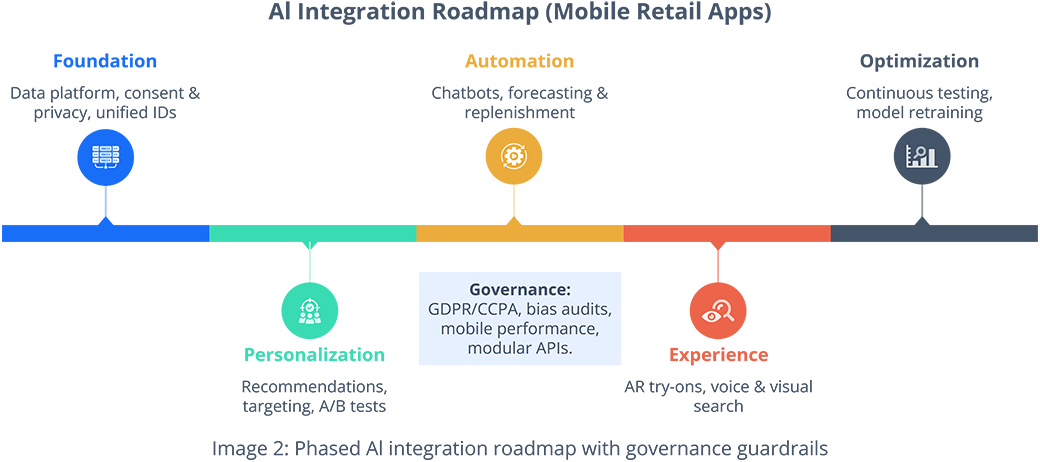
Figure 2 gives a birds-eye view of an AI integration roadmap for your mobile apps.
8 Step Strategy to Operationalize AI in Your App
So where do you actually start? The good news is that you don't need to boil the ocean. Here's a practical roadmap that won't require you to rebuild everything from scratch.
- Pick your battles. Identify two or three high-value use cases that tie directly to measurable KPIs—think conversion rates, return reduction, or support costs. Chasing every shiny AI feature is how projects die. Focus on what actually moves the needle for your business.
- Get your data house in order. Stand up a unified customer data platform with proper consent management baked in and instrument your app to capture the events you'll actually need. Without clean, compliant data flowing through, your AI models will be garbage-in, garbage-out.
- Start testing the basics. Pilot personalized recommendations and smarter search functionality, A/B testing different placements and messaging to see what resonates.
- Automate your most common support questions with a retrieval-augmented chatbot that knows when to escalate to humans.
- Deploy demand forecasting for your top-selling products and set up automated replenishment with sensible guardrails.
- Add one immersive experience that makes sense for your category—AR try-on works brilliantly for eyewear, cosmetics, and furniture.
- Operationalize your delivery with dynamic routing and real-time ETAs that actually reflect what's happening on the ground.
- Don't skip governance. Establish regular privacy reviews, schedule bias audits, and build model performance dashboards so you catch problems before customers do. AI isn't a "launch and forget" technology—it requires ongoing attention.
Conclusion
The retailers winning with AI aren't chasing every flashy feature—they're strategically targeting high-impact use cases that directly improve customer experience and operational efficiency. From Sephora's AR try-ons driving 90% better conversions to Amazon's recommendation engine generating 35% of total revenue, the evidence is clear: thoughtfully implemented AI transforms mobile apps from static catalogs into responsive shopping companions.
Success requires clean data foundations, phased rollouts, rigorous A/B testing, and ongoing governance around privacy and bias. The opportunity is massive—mobile commerce will hit 63% of online retail by 2028—but execution separates winners from those drowning in technical debt and abandoned pilots.
Implementing AI in mobile retail apps isn't a DIY weekend project. Between navigating data privacy regulations, avoiding model bias, optimizing performance across devices, and integrating complex APIs, the technical and strategic challenges multiply quickly. Leading global consulting and IT services firms such as GSPANN specialize in translating AI ambition into measurable business results, bringing proven frameworks, vendor relationships, and battle-tested governance models.
They help you avoid expensive mistakes—like launching features customers don't use or creating compliance nightmares—while accelerating time-to-value. The AI consulting market exceeded $15 billion in 2025 precisely because smart retailers recognize that expert guidance turns promising technology into competitive advantage. Don't go it alone.
References
[1]: Braze. "Sephora Case Study | Boosting Engagement with AR."
[2]: LinkedIn. "Sephora's AI Virtual Artist boosts conversion rates."
[3]: BrandXR. "How Beauty Brands Are Using AR Mirrors to Increase Sales."
[4]: Braze. "Top Brands Drive High Engagement and Conversions With Smart Segmentation."
[5]: Firney. "AI Product Recommendations: From Amazon's 35% to Your E-Commerce Platform."
[6]: Rejoiner. "The Amazon Recommendations Secret to Selling More."
[7]: Amazon Science. "The history of Amazon's recommendation algorithm."
[8]: Articsledge. "Machine Learning in Retail: Walmart & Target Case Studies."
[9]: OnRamp Funds. "AI in Real-Time Demand Forecasting for eCommerce."
[10]: Avahi AI. "AI in Retail: The Smart Way to Prevent Stockouts and Overstock."
[11]: Google. "Build generative AI features directly into your mobile and web apps."
[12]: Google. "Get started with the Gemini API using the Firebase AI Logic SDKs."
[13]: Miguel Ramos. "React Native Support and Gemini Live APIs for Vertex AI in Firebase."
[14]: AWS. "Amazon Personalize - Recommender System.”
[16]: AWS Documentation. "Real-time item recommendations in Amazon Personalize."
[19]: VNet Academy. "TensorFlow Lite: Bringing AI to Mobile and Embedded Devices."
[20]: Viso.ai. "Optimize AI Models with TensorFlow Lite on Edge."
[21]: Apple Developer. "Core ML - Machine Learning."
[22]: F22 Labs. "What Is On-Device AI? A Complete Guide for 2025."
[23]: Zignuts. "Future of On-Device AI in iOS with Core ML & Create ML."
[24]: Buzzi.ai. "AI Mobile App Development: On-Device vs Cloud Choice."
[25]: Appinventiv. "AI Visual Search in Retail & Fashion."
[26]: Eluminous Technologies. "On-Device AI: The Smart Shift Happening Inside Your Phone."
[27] Google Cloud. "Conversational Agents and Dialogflow."
[28]: QSS Technosoft. "Building A Conversational AI Chatbot with Dialogflow."
[29]: Cobalt Sign. "We built an AI Chatbot for Customer Service into our App."
[30]: OpenAI Platform. "Voice agents | OpenAI API."
[31]: DevRev. "Chatbot vs Conversational AI: 5 Key Differences Revealed."
[32]: SmartDev. "Chatbot vs Conversational AI: Key Differences, Use Cases."
[33]: HackerNoon. "The Role of Context Memory in AI Chatbots."
[34]: Wildnet Edge. "Implementing GDPR & CCPA Compliance in Apps."
[35]: Secure Privacy. "Mobile App Consent Management SDK."
[36]: Securiti. "Mobile App Consent Management: Global Compliance."
[37]: Medium - The Modern Scientist. "Bias Drift in Machine Learning: Challenges and Mitigation."
[38]: Galileo AI. "How to Detect and Prevent AI Bias Before Damage Occurs."
[40]: Web.dev. "Time to Interactive (TTI)."
[41]: TechAhead. "AI-Driven Predictive Optimization in Cross-Platform Apps."