
So far, enterprises and leaders believed that a better AI model meant better results. Today the differentiator is not the model, it is the strategy, governance, and the data strategy behind it.
Here’s us demystifying the common misconceptions around usage of the best frontier models.
Won’t a Newer, More Powerful AI Model Deliver the Business Results?
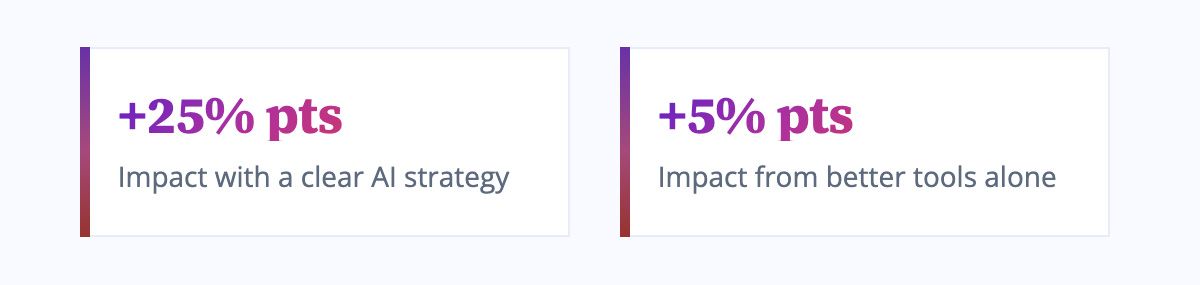
Not worth the investment. On June 3, 2026, BCG quantified the shift: companies with a clear AI strategy saw 25% points more business impact, while those who just bought better tools saw only 5%. That 5:1 gap explains why the company boards have moved from asking which model to buy to asking why the last upgrade did not deliver. The reality of AI ROI in customer experience tells the same story.
McKinsey calls it the GenAI paradox, nearly 80% of companies have deployed generative AI, and of those nearly 80% see no earnings impact. The newer model is an easy purchase but it may not be the one that pays.[1] [2]
Isn’t the Safer Bet Just to Wait for the Next, More Powerful AI Model?
Not at all. The Model capability is no longer the differentiator.
Even Microsoft and OpenAI now focus on orchestration and governance, where enterprise value is created.
The advantage is no longer the model an organization runs, it is what the organization builds on top of it, including secure, compliant enterprise AI systems.[3] [4]
Major Companies Pull Back or Cancel AI Tools in 2026
The biggest pullbacks came from the companies with the deepest AI investments.
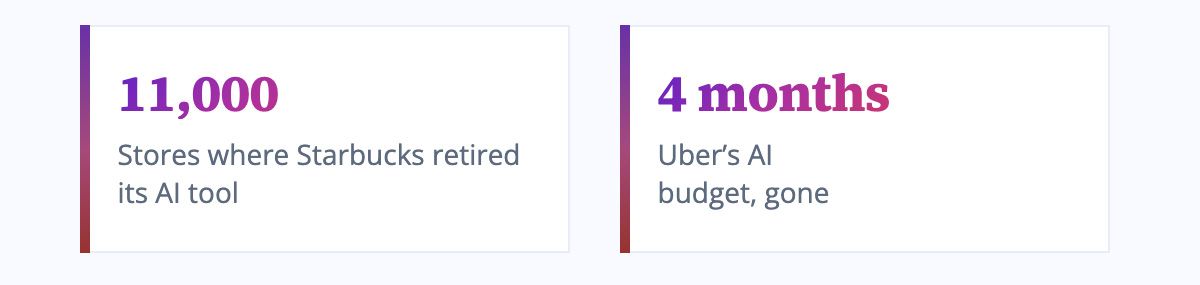
In May 2026, Starbucks retired an AI inventory tool across more than 11,000 stores after nine months, because baristas had to recount every scan by hand.
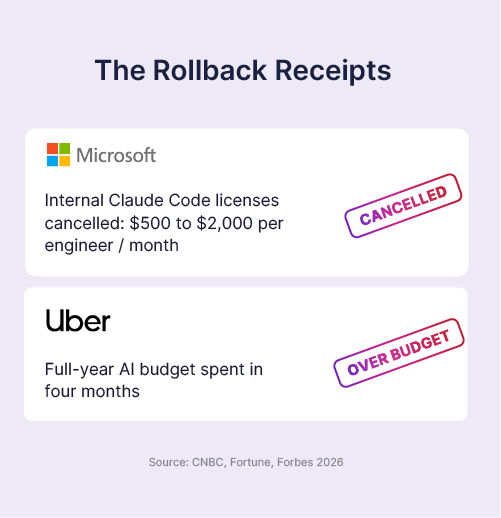
Microsoft then cancelled internal Claude Code licenses for the division that builds Windows and Office, after per-engineer costs ran to $500 to $2,000 a month with no proof the teams were faster.
Uber deployed the same tool to 5,000 engineers and burned through its AI budget in four months.[5] [6]
Does Enterprise AI Spending Create Tool Sprawl
AI purchases often outpace governance.
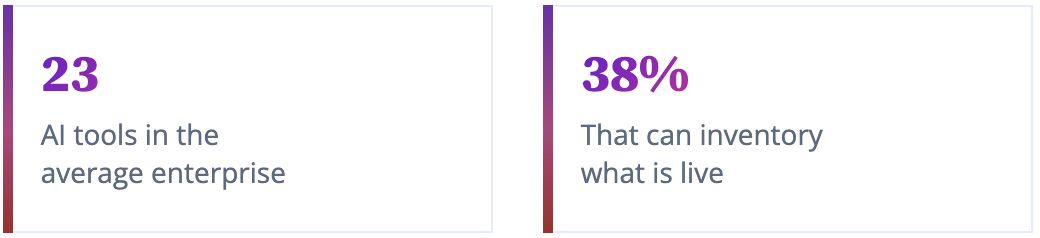
The average enterprise now runs 23 different AI tools, and only 38% enterprises can produce a complete inventory of what is live.
Roughly 40% of AI spend goes to duplicated shadow tools and another 30% to licenses that sit unused.
Buying 500 Copilot seats is easy, but getting value from them is the hard part, which is why governing the AI agents you deploy matters more than adding them.[7] [8]
How Many Enterprise AI Projects Actually Fail?
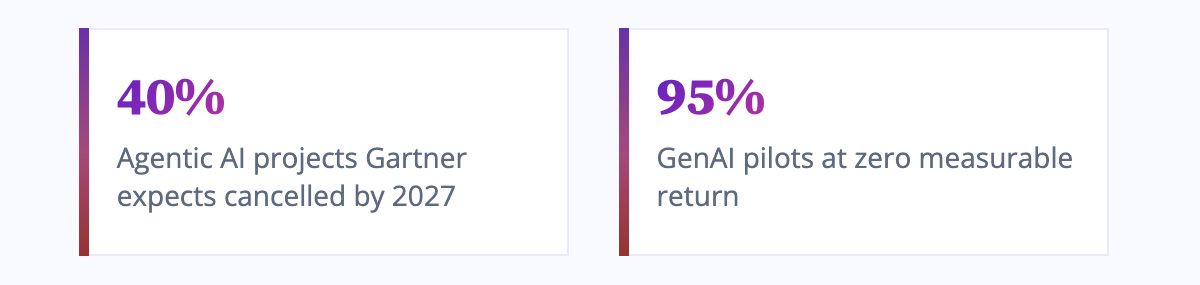
Gartner expects over 40% of agentic AI projects to be cancelled by the end of 2027, on escalating cost, unclear value, and weak governance.
MIT's NANDA study already put 95% of enterprise generative AI pilots at zero measurable return after $30 to $40 billion in spend.[9] [10]
The 10-20-70 Rule for AI
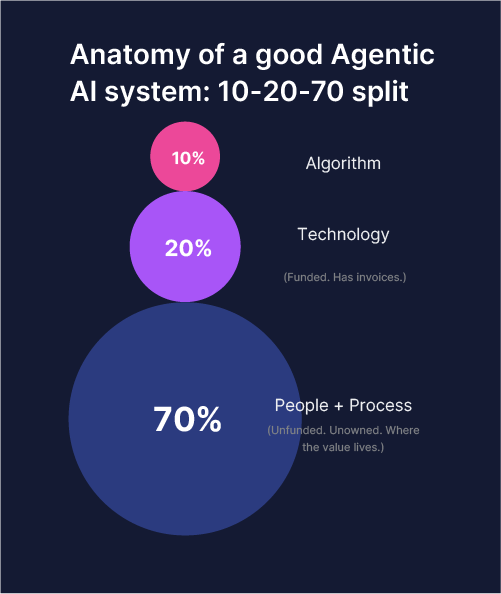
BCG's 10-20-70 rule says AI success depends on 10% on the algorithm, 20% on the technology, and 70% on the people and processes.
Most companies fund the 10 and the 20 but underinvest in the 70 that drives adoption and business value.[11] [12]
How Do You Turn AI Adoption Into Actual ROI?
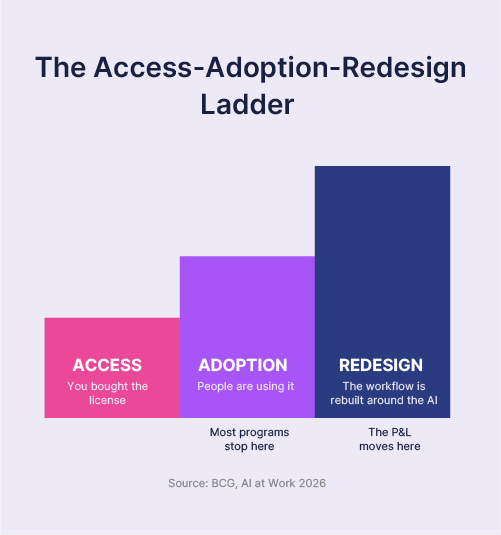
AI ROI comes from three stages: Access (buying the license), Adoption (people using it), and Redesign (rebuilding the workflow so AI fits how the work is done).
Most companies stop at adoption. McKinsey found the biggest gains come from redesigning workflows so AI becomes part of how work gets done.[13] [14]
Does Using AI Every Day Actually Make a Team More Productive?
Not necessarily. High usage does not guarantee higher productivity.
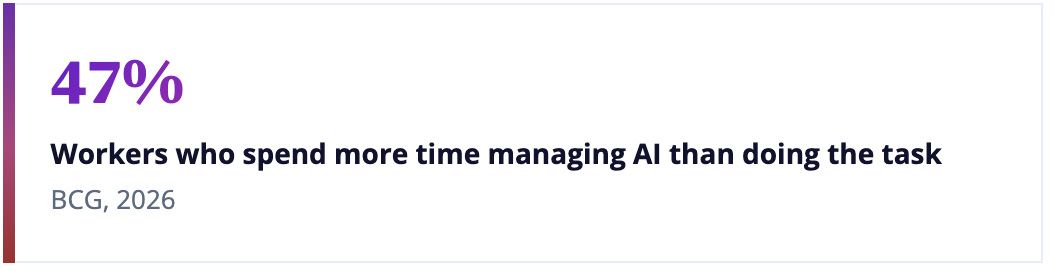
BCG found 47% of workers now spend more time managing and directing AI than doing the underlying task.
The Starbucks experience showed that when employees have to verify every AI output, the tool adds work instead of removing it.[15] [16]
What Results Do Companies Get from Redesigning Workflows Around AI
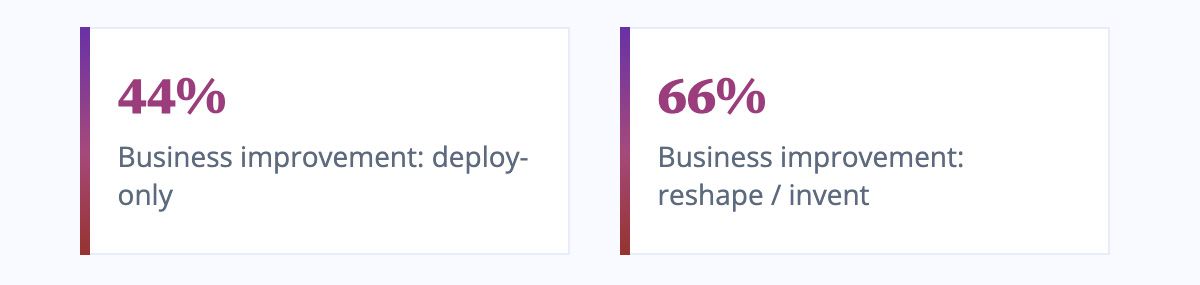
In BCG's data, companies that reshape workflows or invent new ones, rather than just deploy tools, report measurable business improvement 66% of the time versus 44% for deploy-only, and time savings of 53% versus 31%.
Pushed to the enterprise level, McKinsey's set of companies that rewired around AI averaged a 20% EBITDA lift. The differentiator was not the AI, it was the workflow.[17] [18]
Are the Biggest AI Gains Concentrated in a Few Companies?
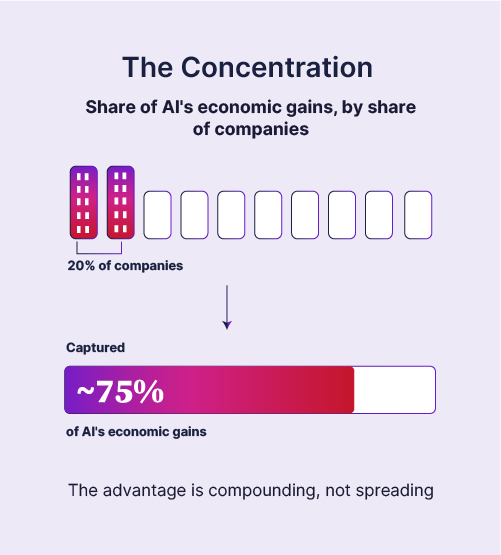
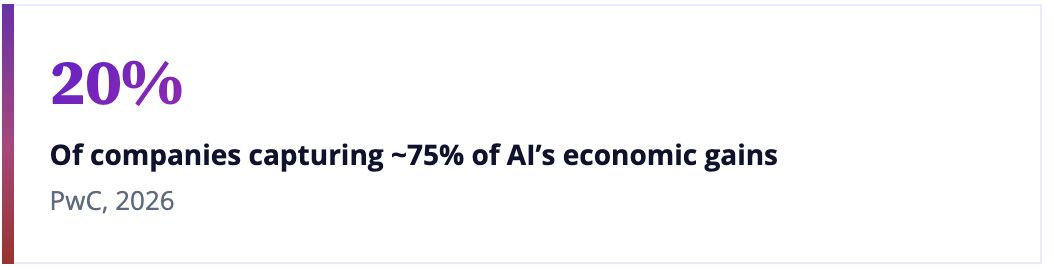
Yes. PwC's 2026 study found that 20% of companies capture nearly three-quarters of AI's economic gains.
The leaders are not just cutting costs, they are accelerating growth.
The redesign gap compounds because every AI-powered workflow makes the next transformation easier.[19] [20]
What Does Redesigning a Workflow Around AI Look Like in Practice
Companies like BlackRock, KKR, and Carlyle redesigned their workflows to incorporate Hebbia, an AI tool for financial and legal research.
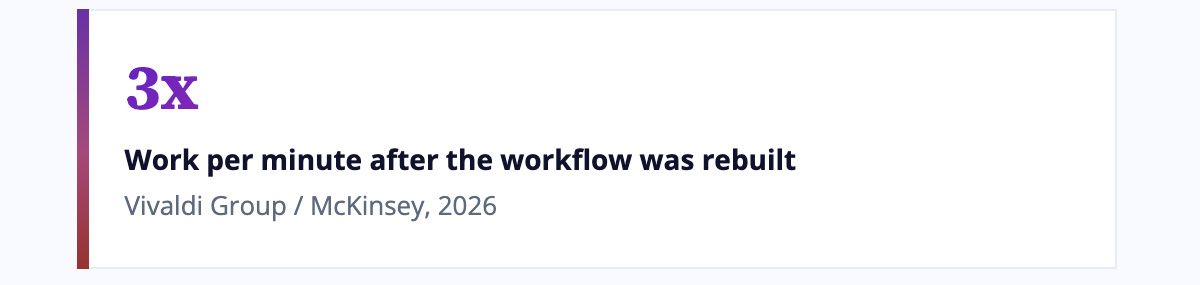
Analysts who spent days reading a 1,500-document data room now get a cited answer across all of it in minutes, with teams reporting roughly 3X more work per minute.
The same pattern appears when agentic AI automates reconciliation inside a finance workflow.[21] [22]
Where Should a Company Start With Its AI Strategy?
Start with one P&L-critical workflow and rebuild it end to end, rather than sprinkling a copilot across forty teams.
BCG found that the real value comes from Reshape and Invent initiatives, which also improve employee experience.
One rebuilt process beats forty assisted ones.[23] [24]
What Should an Enterprise AI Budget Prioritize?
Fund workflow transformations before AI licenses.
The highest-performing companies invest primarily in people and process, turning AI into a new way of working rather than another tool.[25] [26]
What Do Companies That Succeed with AI Do Differently?
Three things, leadership, adoption, and outcomes.
Successful companies have CEOs who own the AI transformation, embed AI into everyday work with continuous feedback, and measure business impact, not tool usage. Strategy is what turns AI into results.[27] [28]
What Changes When a Company Gets Its AI Strategy Right?
The saved time becomes business value.
When workflows are redesigned, saved hours translate into higher productivity, faster delivery, and measurable business growth.[29]
GSPANN's Take
- Read your own dashboard first. If your AI scorecard counts seats, logins, or messages sent, you are still at Adoption. You reach Redesign the day the metric becomes cost per case, cycle time, or revenue per head.
- Choose the metric before the tool. Name the P&L number you intend to move, then the one workflow that owns it, then pick the tool last. Most programs run that order backwards and buy first.
- Give the redesign one owner who can change the process. AI stalls wherever no one is allowed to delete a step. A committee cannot redesign a workflow. A named owner can.
- Spend the 70% on the work, not the training. The 70% is redrawing who does which step and removing the ones the AI makes redundant. Teaching people the tool is not the 70%. That is still the 20%.
- Decide where the freed hours go before you free them. Saved time defaults to slack unless it is reassigned to higher-value work on purpose. Unrouted, the gain shows up in the engagement survey and never in the P&L.
Here is the uncomfortable part for the budget season ahead. The next AI purchase order will be the easiest thing on your desk to sign, and the least likely thing to move your numbers. The work that actually pays has no vendor, no demo, and no line item, which is exactly why almost everyone skips it. The companies pulling away in 2026 are not the ones with the best tools. They are the ones who did the work the tool cannot do for them.
All References
Ref 1: https://www.bcg.com/publications/2026/ai-at-work-why-strategy-matters-more-than-tools
Ref 5: https://www.cnbc.com/2026/05/21/starbucks-scraps-ai-inventory-tool-across-north-america.html
Ref 7: https://zapier.com/blog/ai-sprawl-survey/
Ref 9: https://fortune.com/2025/08/18/mit-report-95-percent-generative-ai-pilots-at-companies-failing-cfo/
Ref 11: https://www.bcg.com/press/3june2026-ai-reshaping-jobs-faster-than-companies-reshaping-work
Ref 12: https://www.bcg.com/publications/2026/ai-at-work-why-strategy-matters-more-than-tools
Ref 15: https://www.bcg.com/press/3june2026-ai-reshaping-jobs-faster-than-companies-reshaping-work
Ref 17: https://www.bcg.com/publications/2026/ai-at-work-why-strategy-matters-more-than-tools
Ref 19: https://www.pwc.com/gx/en/news-room/press-releases/2026/pwc-2026-ai-performance-study.html
Ref 20: https://www.bcg.com/publications/2026/ai-at-work-why-strategy-matters-more-than-tools
Ref 21: https://vivaldigroup.com/from-workflows-to-systems-competing-in-the-ai-systems-economy/
Ref 23: https://www.bcg.com/publications/2026/ai-at-work-why-strategy-matters-more-than-tools
Ref 25: https://www.bcg.com/press/3june2026-ai-reshaping-jobs-faster-than-companies-reshaping-work
Ref 26: https://www.bcg.com/publications/2026/ai-at-work-why-strategy-matters-more-than-tools
Ref 27: https://www.bcg.com/publications/2026/ai-has-made-work-reinvention-a-ceo-mandate
Ref 28: https://www.bcg.com/publications/2026/ai-transformation-is-a-workforce-transformation