
Who this is for: CMOs, CTOs, and VPs of Digital Commerce at retailers, consumer brands and manufacturers above roughly $500M in annual revenue, particularly those running multi-market operations and large product catalogs. If your category is decided by a buyer asking an assistant rather than browsing a shelf or a search page, this is your problem.
For a century, being recommended meant two things: pay for the shelf (visibility), pay for the airtime (advertisement). Then buyers started asking an assistant instead of walking the aisle, and the inputs changed without anyone repricing for them.
In May 2026, a study of 25 grocery brands across five AI engines ranked them by how often each got named in an answer, and the retailer own-label products beat the household names by nearly two to one. Some brands are already closing that gap deliberately. Most do not yet know which lever to pull, or which team owns it.
What follows is what a VP of Digital is asking this quarter, answered with the data.
1. Does AI Even Know Who We Are?
It knows exactly who you are.
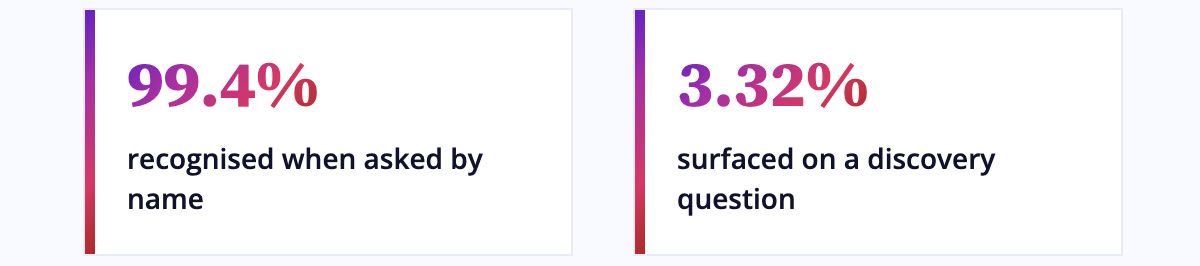
A study of 112 companies across ChatGPT and Perplexity, run over 2,240 queries, found models identified them correctly 99.4% of the time when asked by name. Ask the same models a discovery question instead, and those companies surfaced 3.32% of the time.
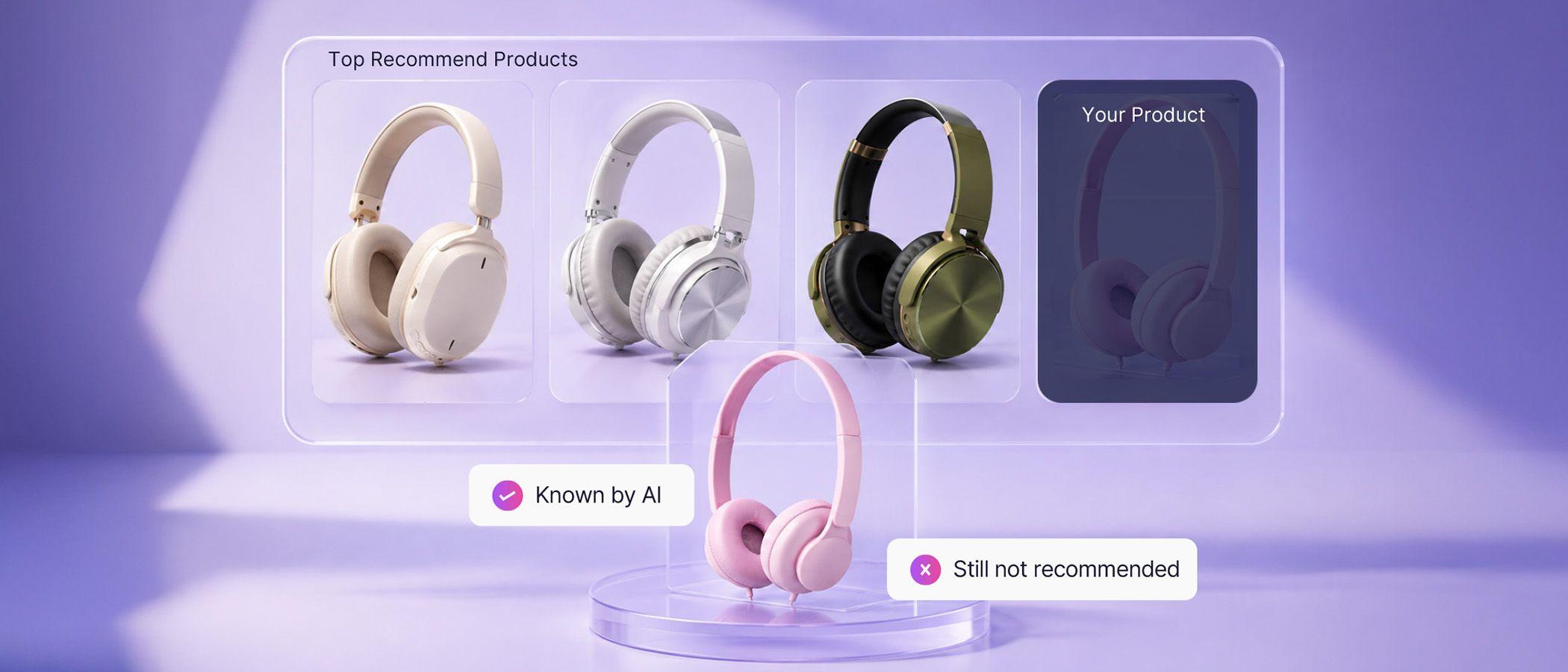
Recognition is solved, but recommendation is not. Clearly the two run on different machinery. [1]
2. Which Brands Are Really Winning in Our Category?
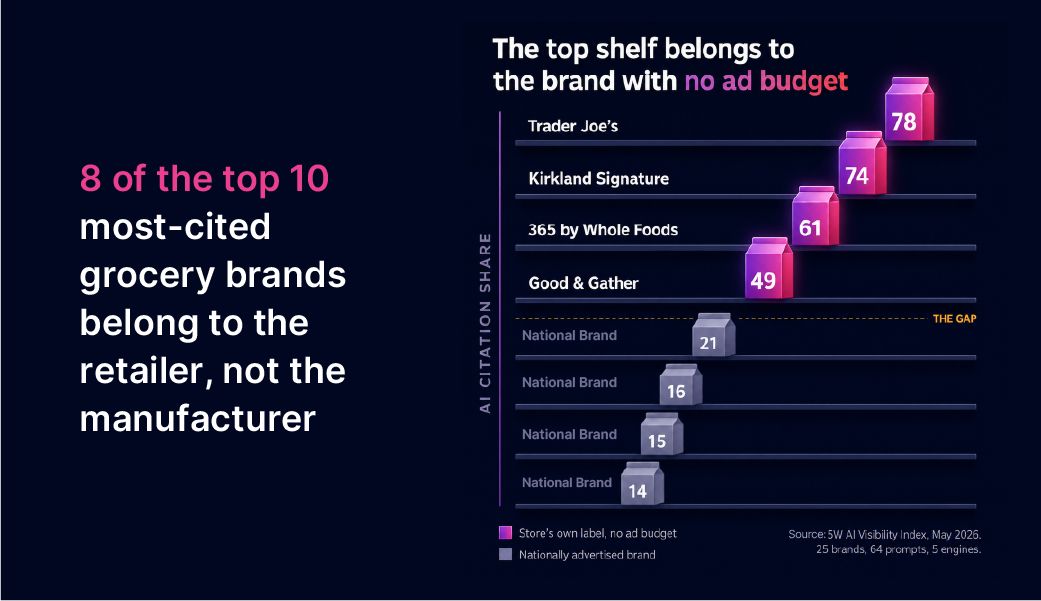
The brands with a working AEO/GEO strategy that may have zero ad spend are winning the recommendation race.
- Trader Joe's was recommended 78 times.
- Kirkland Signature 74.
- 365 by Whole Foods 61.
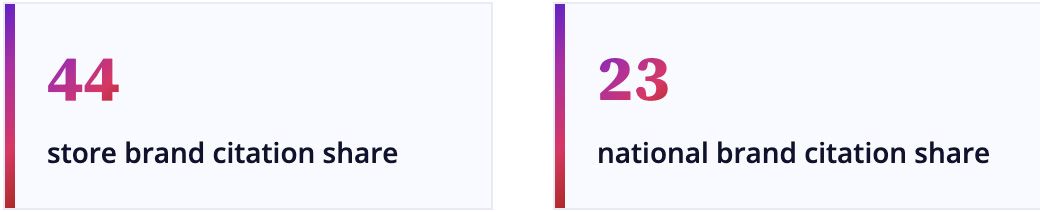
The lowest scoring national brands clustered between 14 and 21, several of them names with more than fifty years of advertising behind them.
Eight of the ten most-cited grocery brands are owned by the retailer, not the manufacturer. [2]
3. Is This Just a Consumer Packaged Goods (CPG) Problem, or Does It Hit Retailers Too?
It hits retailers harder, because the gap is measurable against market share.
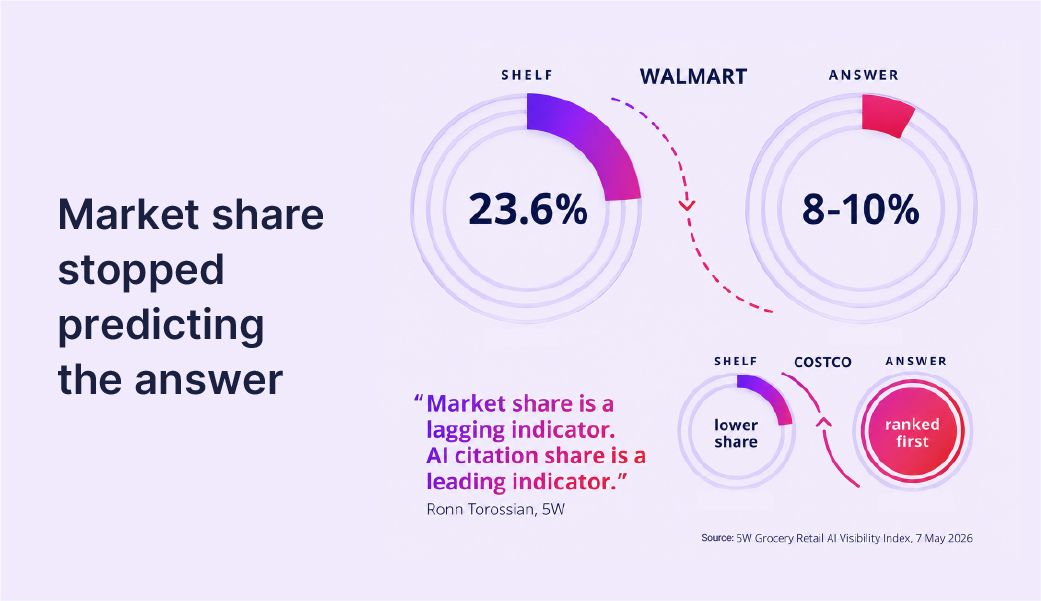
A companion index published on 7 May 2026 ranked the top ten US grocery retailers by AI citations and put Costco first, Trader Joe's second, Whole Foods third, and Walmart fourth.
Walmart holds 23.6% of US grocery sales and only estimated 8 to 10% of AI citation share. [3]

4. How Does a Brand with No Advertising Beat One That Has Been on Television Since the 1940s?
Because the engine cannot see advertising.
Target launched Good & Gather in 2019 and it scores 49, roughly three times the lowest scoring national brands in the study and ahead of cereal names that predate the moon landing.
When the same study ranked which sources actually ground a grocery answer, Reddit and community forums scored 88, editorial and food publishers 74, independent taste tests 70, YouTube 58, and expert and trade publications came last at 33. [4]
5. We Spent a Year on AI Content Optimization. Did Any of It Work?
Almost none of it worked.
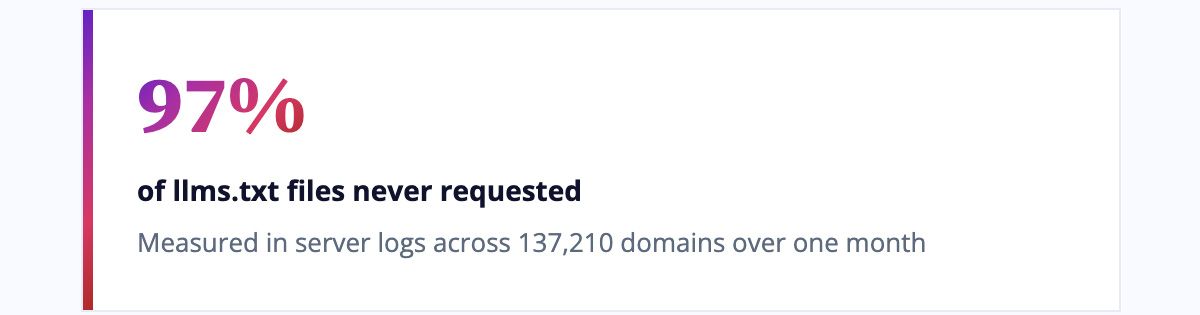
Server logs across 137,210 domains show 97% of llms.txt files received zero requests in a month, with SEO audit tools generating more of the remaining traffic than AI bots did.
A matched-control test on 1,885 pages that added JSON-LD schema moved ChatGPT citations 2.2% and moved Google AI Overviews negative 4.6%.
The tactics that sold hardest are the ones with the least evidence behind them. [5] [6]
6. Then What Really Decides Whether Our Product Shows Up?
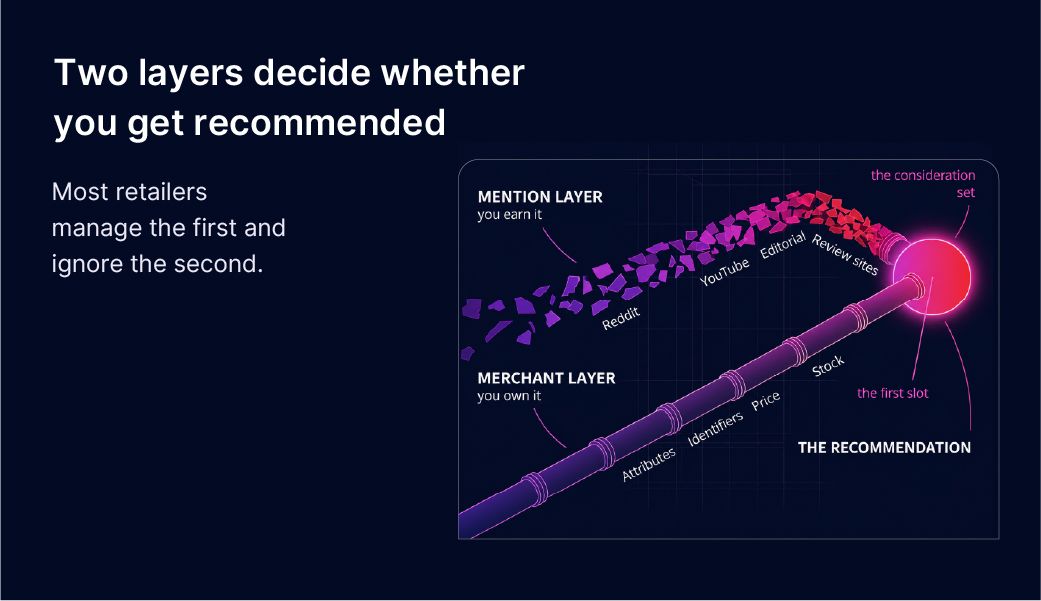
Two systems: the Mention Layer and the Merchant Layer.
The Mention Layer is the open web an engine crawls: Reddit threads, review sites, YouTube, editorial roundups. It decides whether your brand enters the conversation, you do not own it, and you earn your way in.
The Merchant Layer is your structured product feed, and it decides which specific item wins the slot. You own that one completely, and it reports to paid media. [7]
7. Which of Those Two Layers Wins the Sale?
The Mention layer helps with recommendations.
The Merchant Layer takes the position that converts.
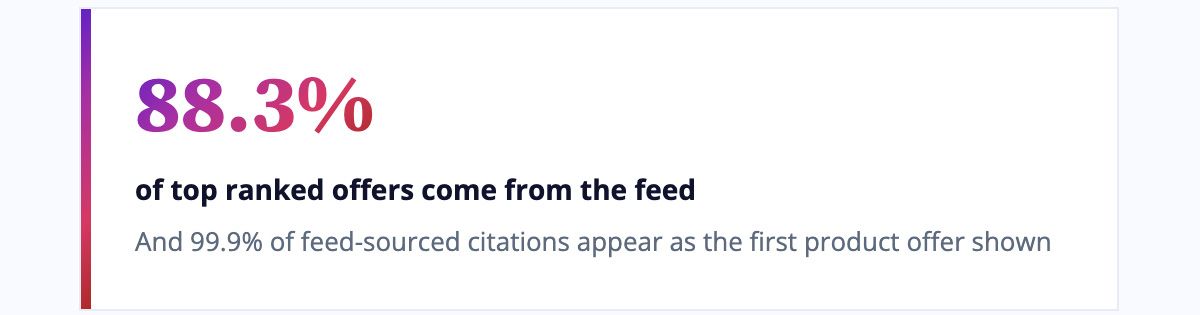
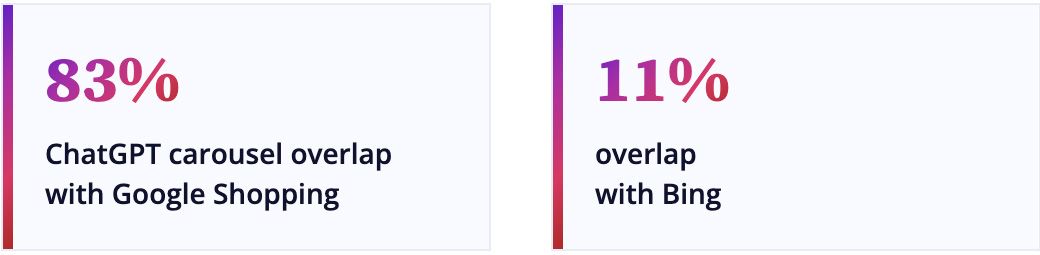
Analysis of ChatGPT shopping responses found that while 88% of product-offer instances are pulled from crawled product pages while 88.3% of top-ranked offers originate from the feed, and 99.9% of feed-sourced citations appear as the first product offer shown.
Content gets you into the consideration set. The feed wins the first slot. [8]
8. What Silently Removes a Product from an AI Answer?
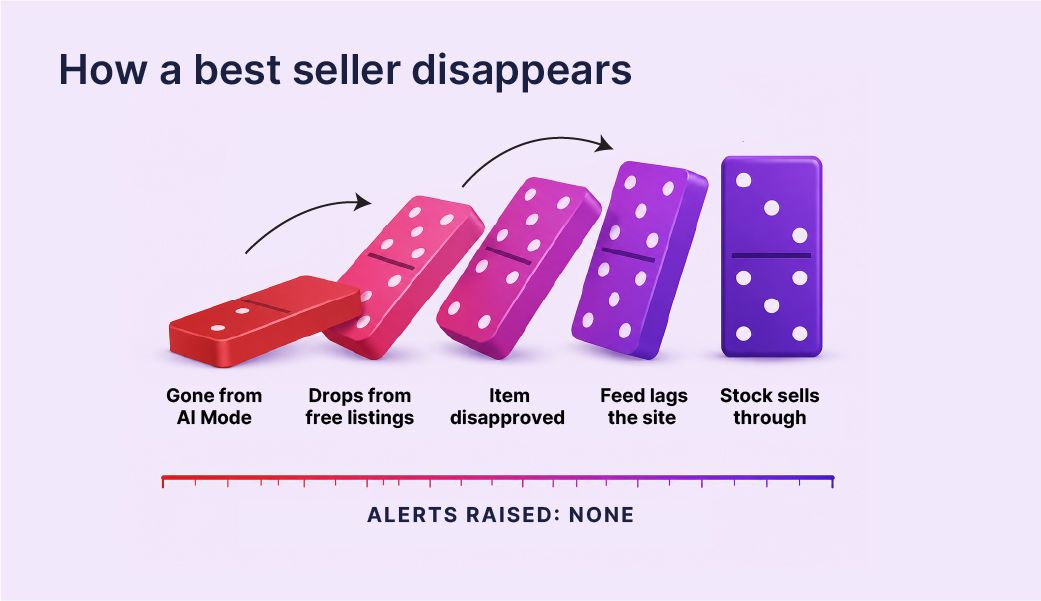
Stale price and inventory data, and the failure is silent.
A Stock Keeping Unit (SKU) sells through, the feed lags the site by a few hours, and Google's documentation is explicit about what happens next: warnings about "price and availability mismatch between the feed and the landing pages result in preemptive item disapproval."
A disapproved item leaves free listings, free listings populate the Shopping Graph, and the Shopping Graph is what AI Mode queries.
Your best-selling item stops being recommended and no dashboard reports it anywhere. [9]
9. Is AI Already Influencing Our Orders?
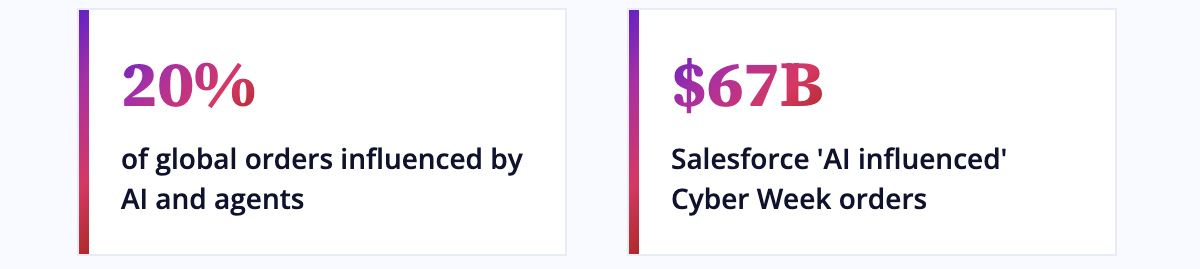
It may be. Salesforce reported AI and agents influenced 20% of global orders during Cyber Week 2025, worth $67 billion, and defined it as "personalized product recommendations and conversational customer service."
That is the on-site recommendation engine and the support chat widget on your own properties. [10]
10. How Big is This Channel, Honestly?
It is currently small but it is growing with every quarter.
Similar web measured AI platforms generating 1.13 billion monthly referral visits against Google Search's 191 billion, under 1% of referral scale.
Adobe's Analytics own year-on-year recorded a growth in AI traffic by 758% last November, then 693%, then 393%, then 269%, then 138% in May. [11] [12]
11. Who Inside Our Company Owns Any of This?
Usually nobody, and that is concerning.
The product feed sits with the paid media team, tuned for bidding efficiency rather than organic discovery, so the file that decides your AI shelf position is optimized for a different job entirely.
When teams have run feeds as an organic asset, reported results include 10% month-on-month lift in organic listing click-through and 92% growth in free-listing revenue at product level.
The work is not new but its owner is missing. [13]
12. What Can We Do Before the Next Peak Season?
Five things (four of them are free).
- Fix price and availability accuracy in the feed first, because Google disapproves items on feed-to-page mismatch and disapproved items leave the Shopping Graph.
- Run the attribute completeness score already sitting in Merchant Center.
- Check what your CDN returns to AI crawlers rather than trusting robots.txt.
- Move feed ownership out of paid media, since a file tuned for bid efficiency is not tuned for being recommended.
- Then, earn your way into the sources engines read, which is the only slow one on the list. [14] [15]
| Move | Effort | Who owns it |
|---|---|---|
Feed price and availability accuracy | 2 to 3 weeks | Engineering and commerce ops |
Attribute completeness audit | Under 1 week | One analyst in Merchant Center |
CDN and WAF crawler check | 1 day | Infrastructure |
Move feed ownership off paid media | 4 to 6 weeks | Organizational, not technical |
Earn third-party presence | 2 to 3 quarters | Comms and category marketing |
GSPANN's Take
The industry sold retailers a content problem, because content is easy to brief and easy to invoice. The documented mechanism is less glamorous than that.
GSPANN through PIM partnerships and ContentHubGPT can help with your Merchant Layer how complete your product records are, whether every item is identified consistently, and whether the price and stock you publish match the page a shopper lands on.
- Refreshed in full, every fifteen minutes, for every destination that wants it in a different shape. That is a data engineering job sitting in a marketing budget line.
- It is the discipline GSPANN keeps returning to in its work on data context engineering: a system can only recommend what it can verify.
- Your product feed is now the most widely read thing you publish, and almost nobody is editing it.
Peak season will not wait for the evidence base to mature. The uncomfortable part of the grocery data is what it says about the losing side. Those brands did nothing wrong by the old rules. They kept buying the shelf, kept buying the airtime, and finished at the bottom of a table nobody had told them existed. The brands beating them are not outspending them. They are legible to the machine doing the recommending, and legibility can be engineered.
Legibility is the new distribution.
The evidence behind this piece, including what has actually been tested under controlled conditions, why AI visibility measurement is unreliable, the full product feed specification across four platforms, and what the manipulation research shows, is set out in the companion white paper, "The Recommendation Layer."
All References
Ref 1: https://arxiv.org/abs/2601.00912
Ref 2: https://www.5wpr.com/ai-visibility-index/private-label-ai-advantage/grocery/
Ref 4: https://www.5wpr.com/ai-visibility-index/private-label-ai-advantage/grocery/
Ref 5: https://ahrefs.com/blog/llmstxt-study/
Ref 6: https://ahrefs.com/blog/schema-ai-citations/
Ref 7: https://searchengineland.com/product-feeds-organic-strategy-ai-search-473793
Ref 8: https://www.tryprofound.com/blog/chatgpt-shopping-deep-dive
Ref 9: https://support.google.com/merchants/answer/13693497
Ref 11: https://www.similarweb.com/blog/insights/ai-news/ai-referral-traffic-winners/
Ref 13: https://searchengineland.com/product-feeds-organic-strategy-ai-search-473793
Ref 14: https://support.google.com/merchants/answer/17117204
Ref 15: https://vidern.com/blog/top-1000-websites-ai-crawler-study