
Ask Gemini for a waterproof hiking boot in a wide fit and it can only use the information the retailer shares. It may not know your loyalty points adjusted price, local stock available, or purchase history.
Amazon and Walmart have their own shopping agents. On October 21, Walmart also announced a gateway for other AI agents to shop on its site. That means shoppers could interact with both their own AI assistant like ChatGPT Dot, Meta Muse, and the Walmart’s agent - Sparky.
The question is: would a retailer’s own agent add value by offering information a third party agent cannot access?
Do retailers need their own AI shopping agent?
Only if it offers something outside AI assistants cannot, such as live stock, member pricing, product compatibility, or hyper personalization.
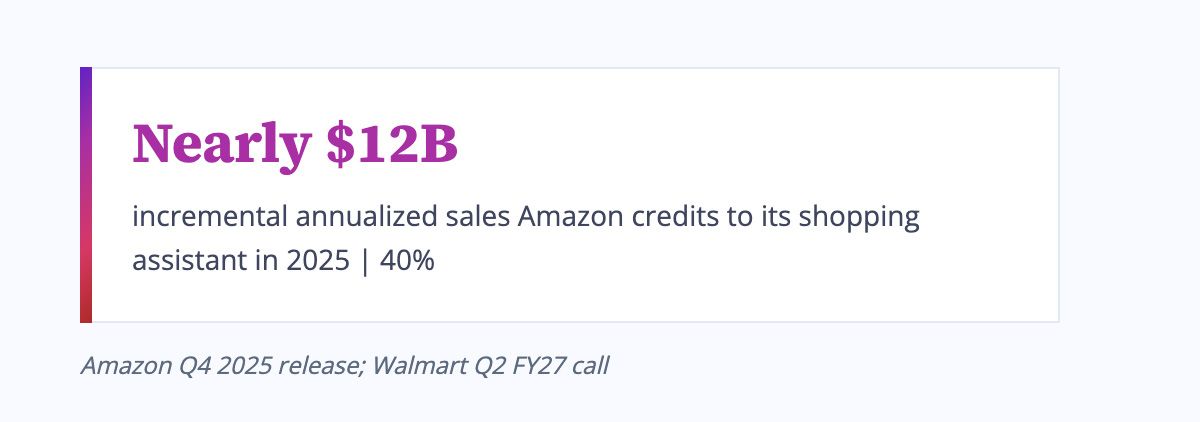
Amazon credits Alexa for Shopping with nearly $12 billion in annualized sales, while Walmart says Sparky users spend 40% more per order. But neither figure proves the agents caused the increase.
Users may already be ready to buy. The real question is whether a retailer’s own agent offers unique value, and whether shoppers will use it. [1][2][3][4][5]
Shoppers research with AI but prefer themselves to complete the purchase
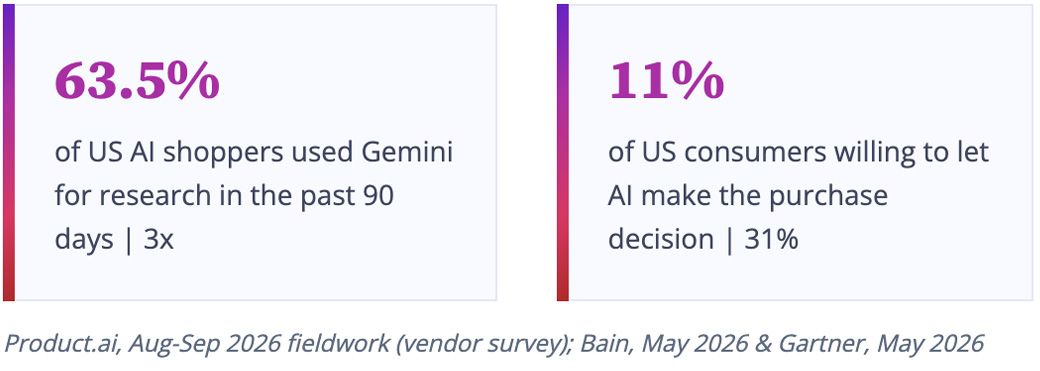
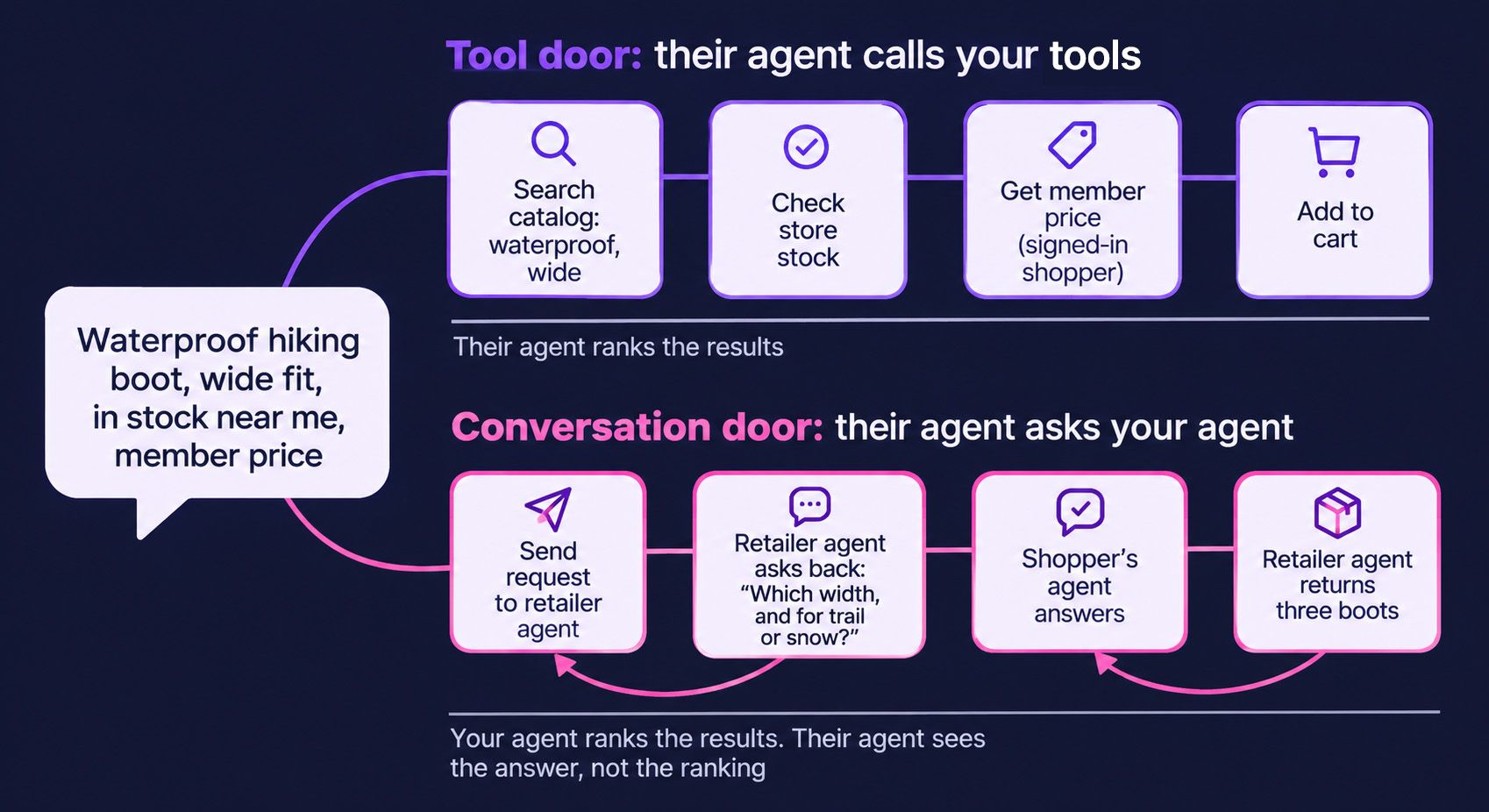
According to Product.ai, among 550 US shoppers who used AI to research a purchase, 63.5% used Gemini and 60% used ChatGPT. Only 28% and 23% used the two largest retailers’ AI assistants. Yet 89.9% checked recommendations elsewhere before buying.
Gartner found that only 11% of consumers were willing to let AI make purchase decisions, even for low value everyday products. Meanwhile, 54% of shoppers who recently used AI said they had to double-check all the information it provided.
Bain found shoppers trust retailers’ on-site agents three times more than third-party agents to complete a purchase, though that trust may change depending on the product.
Retailers don’t need AI to take over shopping. They need it to help customers make confident choices using accurate product information.[6][7]
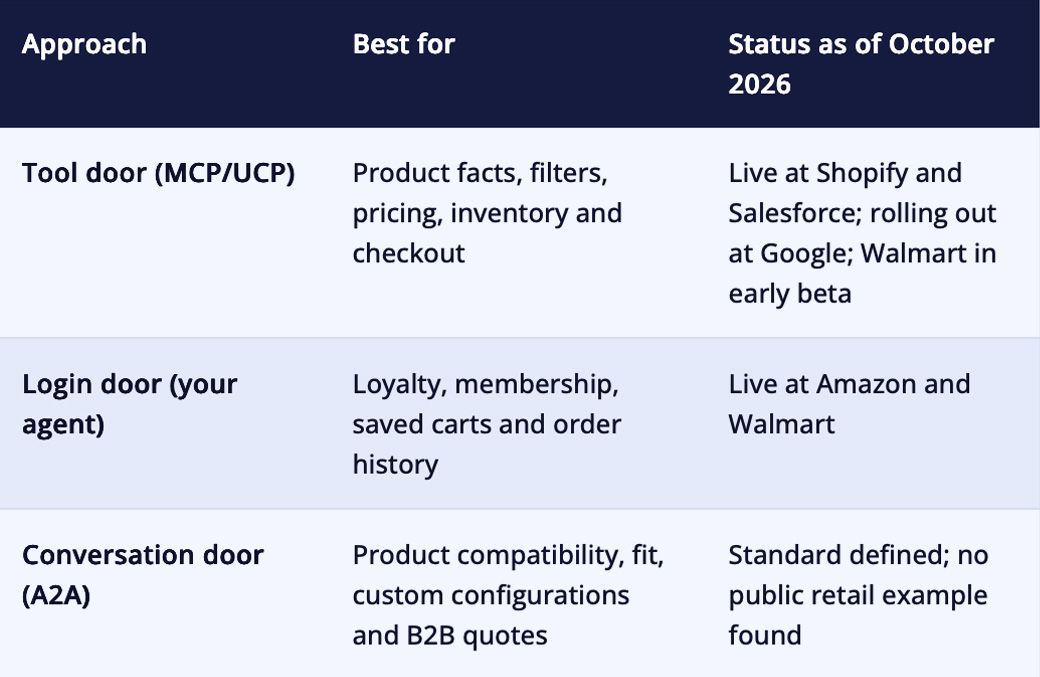
AI agents can shop your store through three doors
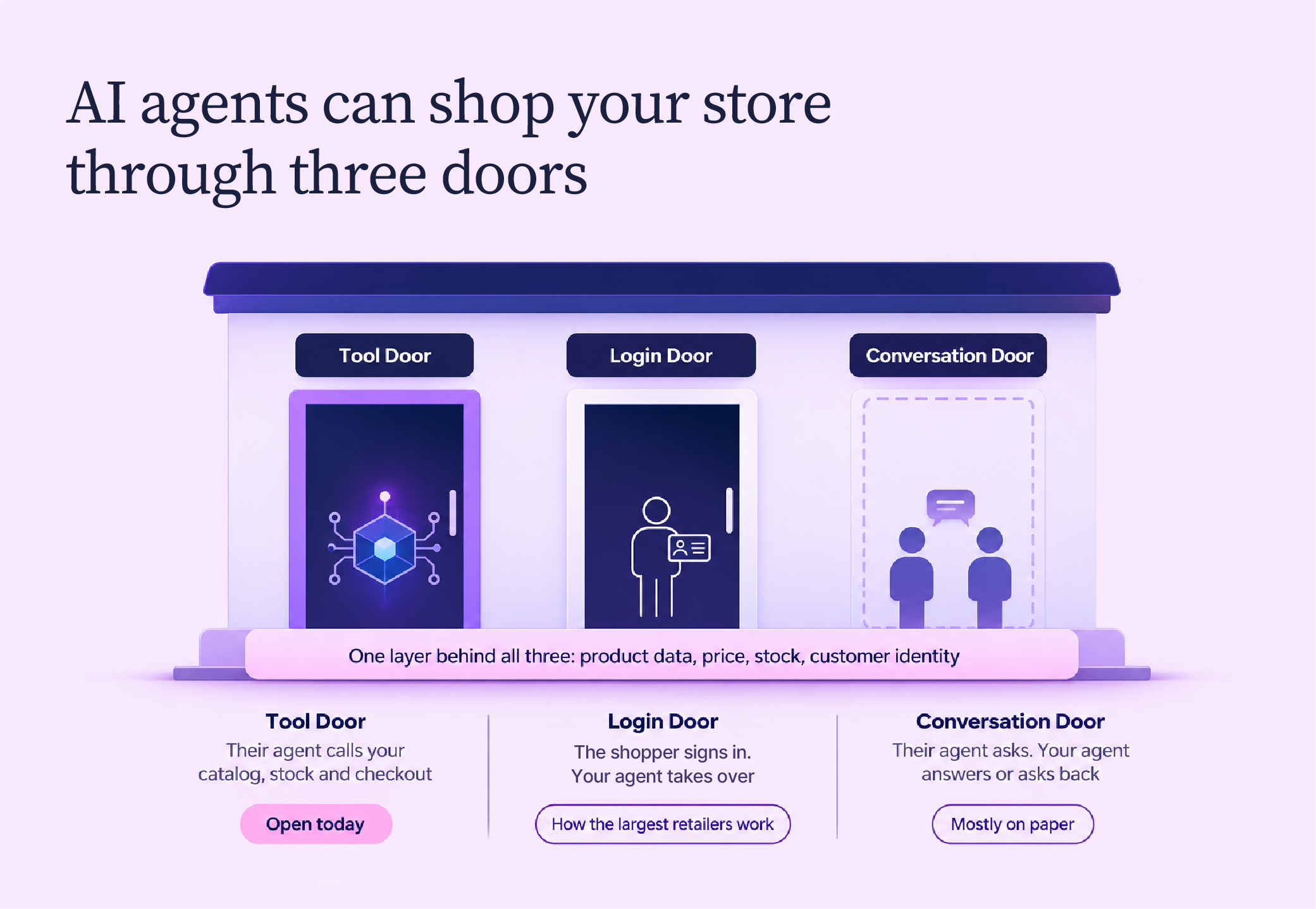
The tool door: AI assistants connect directly to your catalog, inventory, cart and checkout through MCP or Google's UCP.
The login door: Shoppers sign in to your AI agent, either on your website.
The conversation door: Your agent talks to the shopper's AI assistant through A2A (Agent to Agent).
The first is already possible, the second is used by major retailers, and the third is still taking shape.[8]
Can AI shopping agents connect to my store?
Yes. Shopify, Google and Salesforce rolled out tools in October that let AI agents browse products, build carts and support checkout. Walmart is also developing its own agent gateway.
The bigger question is who gets access and on what terms. Making your store accessible to AI is one thing. Giving shoppers a personalised experience is another. [9] [10] [11] [12] [13]
Recognition happens behind the login
A retailer’s own AI shopping agent can do things an outside AI assistant cannot.
Amazon combines memory, scheduled purchases, target-price buying for Prime members, and Buy for Me in one assistant. Walmart is taking a different approach, bringing its Sparky shopping agent into ChatGPT.
The next step? AI agents shopping directly with other AI agents. [14] [15] [16]
Can my website's AI agent talk to a customer's AI agent?
Yes, the technology exists, but we found no retailer publicly using it.
A2A lets AI agents discover each other, ask questions and exchange information. UCP also supports A2A for checkout, though Google’s checkout integration requires a REST API.
The benefit? Your agent could ask, “What width do you need?” before recommending a product. The trade-off is another AI layer between your customer and the facts.[17] [18] [19] [20]
AI agents talking to each other create new security risks
Researchers have shown how malicious agents and fake product reviews can trick AI shopping agents into unauthorized actions or product choices.
In one simulated shop, attacks redirected a GPT-4o agent 31.7% of the time, but the researchers’ defense stopped them all. OWASP also flags insecure communication between agents as a key risk.
It’s best to keep prices and discounts controlled by the server, not the AI conversation. [21] [22] [23]
Direct tools win most requests
For routine shopping, direct integrations are simpler and cheaper. A second AI agent adds cost and can obscure product rankings.
A2A enables agents to exchange selected information, but the customer's assistant may not see the full picture.
It’s best to use direct tools for routine shopping, your own agent for personalized services, and A2A when a decision needs your expertise.[24] [25] [26] [27]
How can AI shopping agents reward loyalty?
Link shoppers’ accounts to apply member prices and benefits.
Google’s UCP supports loyalty perks like discounts and free shipping. Walmart plans to bring Walmart+ and Sam’s Club benefits to Gemini, while Amazon offers Prime members auto-buy at a target price.
The key is to reward membership, not personalise prices based on personal data. Maryland’s grocery pricing law, effective October 1, prohibits certain personalised pricing but exempts loyalty benefits available through enrolment.[28] [29] [30] [31]
Test the agent you already run before Black Friday
Black Friday is November 27, and there’s little time to build and prove a new agent. Focus on testing the one you already have.
Gartner’s
Run these tests before the peak season:
- Accuracy: Check prices, stock, delivery promises and policies against live systems.
- Consistency: Repeat the same questions to catch answers that change between runs.
- Discounts and refunds: Test whether the agent can be tricked into offering unauthorized deals or making binding promises.
- Prompt injection: Check that hidden instructions in reviews, Q&A and seller listings are ignored.
- Regression: Keep the model version stable through peak and retest after any changes.
- Business impact: Compare shoppers who use the agent with a control group to measure its actual impact in January. [32] [33]
Five things to ensure before your AI agent speaks to your customers
You’re responsible for what your agent tells customers. Set these five rules with your legal team.
- Disclose it is AI before the first message. The EU AI Act's chatbot disclosure duty has applied to providers since 2 August 2026, and the CMA expects disclosure where knowing might affect a shopper's decision.
- Stick to approved policies. Base answers on official pricing, eligibility, returns and delivery records. Link to the relevant policy.
- Label paid placements inside answers as clearly as on a search results page.
- Get consent before recording conversations, and prevent vendors from using conversations to train their models.
- Keep health, allergen and children's-product answers to approved copy, and hand any other answers to a person. [34] [35]
GSPANN's Take
- Decide door by door: each kind of request has its own best route into the store.
- The tool door is the cheapest to open and the one the major assistants already use. It rewards a price and a stock figure that are right at the moment an agent asks.
- The login door is where a retailer's own agent pays for itself, because it knows the member's order history and nearest store.
- The conversation door is worth designing for in catalogs full of compatibility and B2B pricing questions, and worth waiting on everywhere else.
- GSPANN starts this work from the layer under all three doors: ContentHubGPT helps create product content designed for questions people ask, customer identity on the data platform, and tests that check every answer against the system of record.
- All three doors open onto the same shelves, and an agent can only recommend what those shelves confirm.
Shoppers are likely to keep researching in whichever assistant they already use. What a retailer controls is what an agent finds when it arrives: the right price and stock for the shopper in front of it, and a way to recognise one who has been there before. A retailer can get those right before the holidays, with or without an agent of its own.
All References
Ref 2: https://www.aboutamazon.com/news/retail/alexa-for-shopping-ai-assistant
Ref 4: https://retail-systems.com/rs/Do_AI_Shopping_Assistants_Really_Lift_Conversion.php
Ref 5: https://www.gspann.com/insights/blog/what-happens-when-site-searches-become-conversations
Ref 8: https://github.com/Universal-Commerce-Protocol/ucp
Ref 9: https://shopify.dev/changelog/add-shopping-and-shop-pay-checkout-to-any-agent-with-shop-mcp
Ref 10: https://blog.google/products-and-platforms/products/shopping/universal-cart-launch/
Ref 11: https://www.salesforce.com/blog/b2c-commerce-october-26-release/
Ref 13: https://www.walmart.com/cp/walmart-agent-gateway/1280482
Ref 14: https://www.aboutamazon.com/news/retail/amazon-rufus-ai-assistant-personalized-shopping-features
Ref 15: https://openai.com/index/powering-product-discovery-in-chatgpt/
Ref 17: https://a2a-protocol.org/latest/specification/
Ref 18: https://ucp.dev/specification/shopping/checkout/a2a/
Ref 19: https://developers.google.com/merchant/ucp/guides/overview/native-checkout
Ref 21: https://unit42.paloaltonetworks.com/agent-session-smuggling-in-agent2agent-systems/
Ref 22: https://arxiv.org/abs/2509.25926
Ref 24: https://a2a-protocol.org/latest/specification/
Ref 25: https://help.openai.com/en/articles/11128490
Ref 26: https://developers.openai.com/apps-sdk/app-submission-guidelines
Ref 27: https://claude.com/blog/the-anatomy-of-effective-commerce-agents
Ref 28: https://blog.google/products-and-platforms/products/shopping/ucp-updates/
Ref 29: https://developers.google.com/merchant/ucp/guides/overview/loyalty
Ref 31: https://mgaleg.maryland.gov/2026RS/Chapters_noln/CH_154_hb0895e.pdf
Ref 33: https://www.tricentis.com/news/tricentis-named-a-leader-2026-gartner-magic-quadrant