
Ask an AI shopping agent whether a frying pan works on an induction cooktop, and it looks for the answer in the retailer’s product data. If compatibility isn’t listed, the agent has to either guess or recommend another pan and your product loses out.
That gap reflects why product information management (PIM) systems were built. A PIM is a central system where businesses organize, approve and distribute product information across websites, marketplaces and other sales channels. Traditionally, it structured details such as size, colour, material and price into fields that platforms could use, while shoppers worked out the rest. AI agents, however, rely on that data to answer specific questions, making missing attributes a barrier to recommendations. [1]
Google now shows brands how they rank inside AI answers
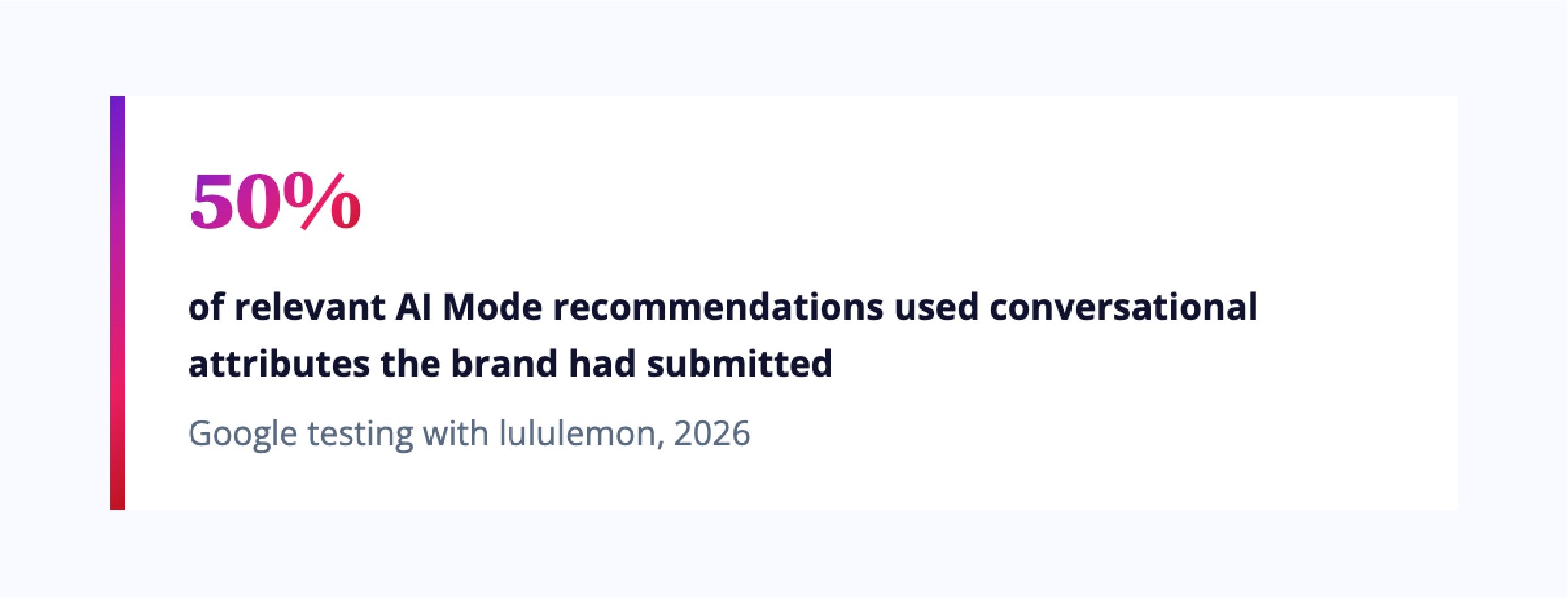
In testing with a global apparel brand, Google found that brand-submitted conversational attributes were incorporated 50% of the time in relevant AI Mode product recommendations. That result is specific to one brand and Google’s own test. While the scorecard helps identify missing fields, choosing a PIM for your e-commerce now requires looking beyond traditional website and marketplace requirements to whether product data can give AI agents the complete, structured information they need to guide shoppers.[2] [3]
Product data was built for filters. AI needs answers
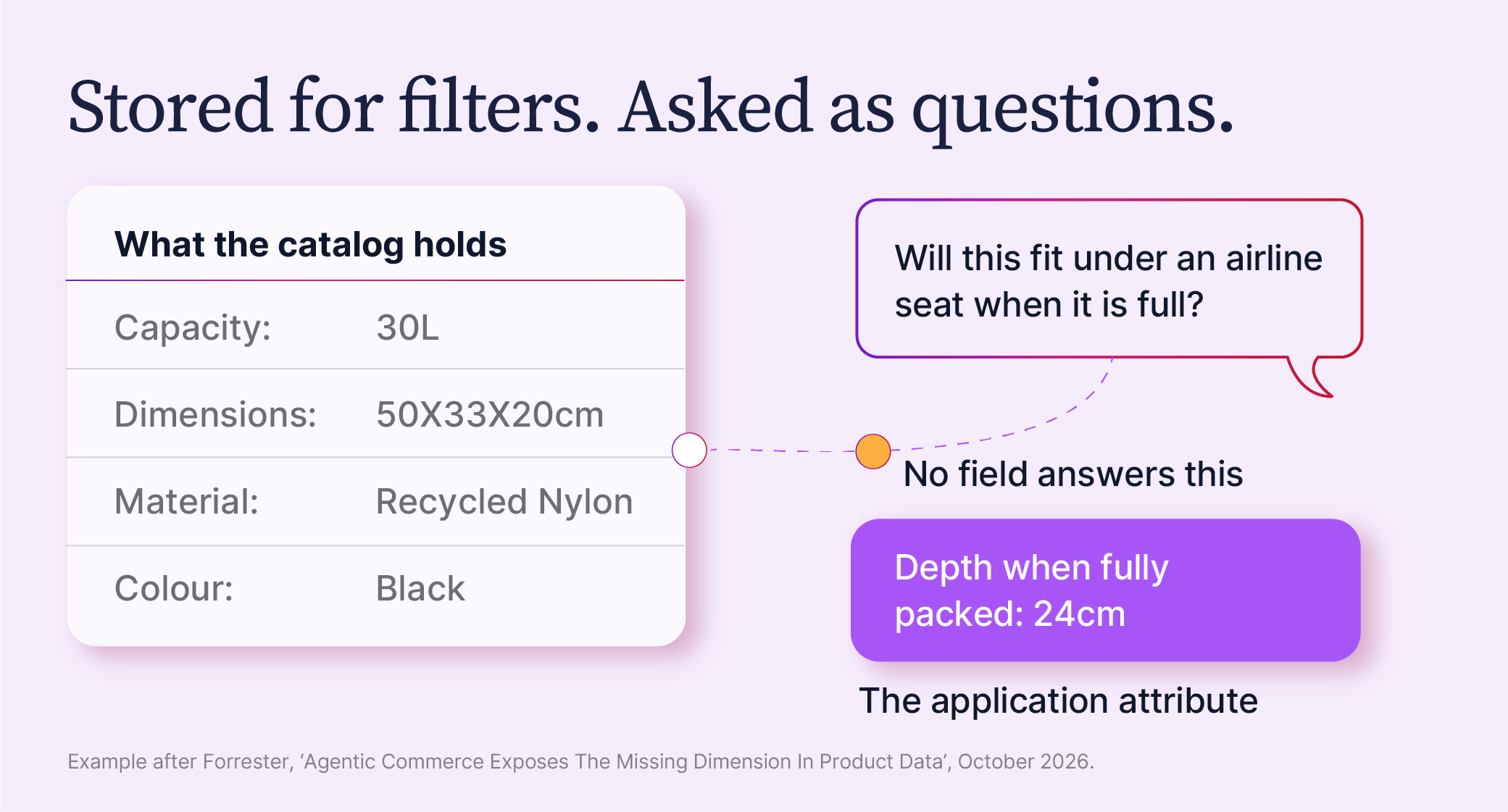
On 6 October, Forrester analysts Emily Pfeiffer and Tony Plec summed up the challenge: product data “was built for filters, not questions.” A backpack’s catalog may list dozens of attributes, including height and width, but without its depth when fully packed, an AI agent cannot confidently tell a shopper whether it will fit under an airplane seat.
Forrester recommends adding product-use context and testing data against the answers AI needs to deliver. The need is clear: 89% of consumers who had used answer engines for retail had used them to research products or services. PIM systems must go beyond storing attributes to help AI answer real shopper questions. [4]
Can I trust Gartner’s Magic Quadrant for PIM?
Yes, Gartner's Magic Quadrant for Product Information Management Solutions, dated 12 October 2026, marks a shift from its January 2025 Market Guide, which listed vendors without ranking them.
Gartner’s category definition now includes SEO, AEO and GEO attributes and content, reflecting the growing role of AI-driven discovery. The Magic Quadrant assesses vendors on ability to execute and completeness of vision, but it cannot tell you which platform best fits your catalog. Use it to build a shortlist, then evaluate vendors against your specific data and business needs. [5] [6] [7]
What product data do AI agents need?
AI shopping platforms demand structured, accurate and frequently updated product data, often beyond what a standard product page provides.
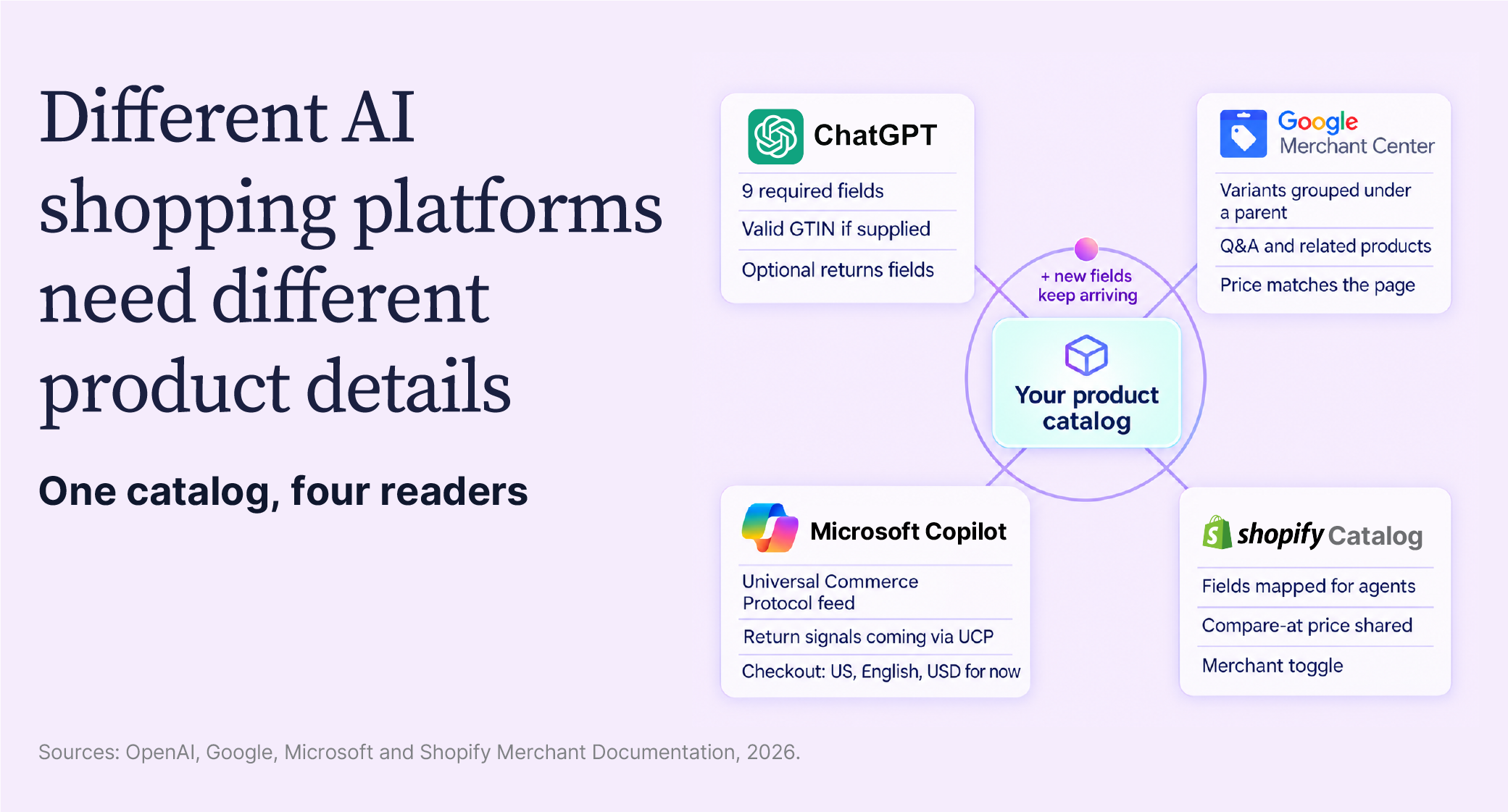
OpenAI’s ChatGPT product feed requires nine fields, including product ID, title, price and availability. Google requires grouped variants for eligible products and supports conversational attributes such as Q&As, related products and document links. Microsoft’s Copilot Checkout uses feeds compliant with the Universal Commerce Protocol, while Shopify began sharing compare-at prices with AI agents through its Catalog on 9 October.
Each platform has its own schema, and the requirements keep evolving. [8] [9] [10] [11] [12]
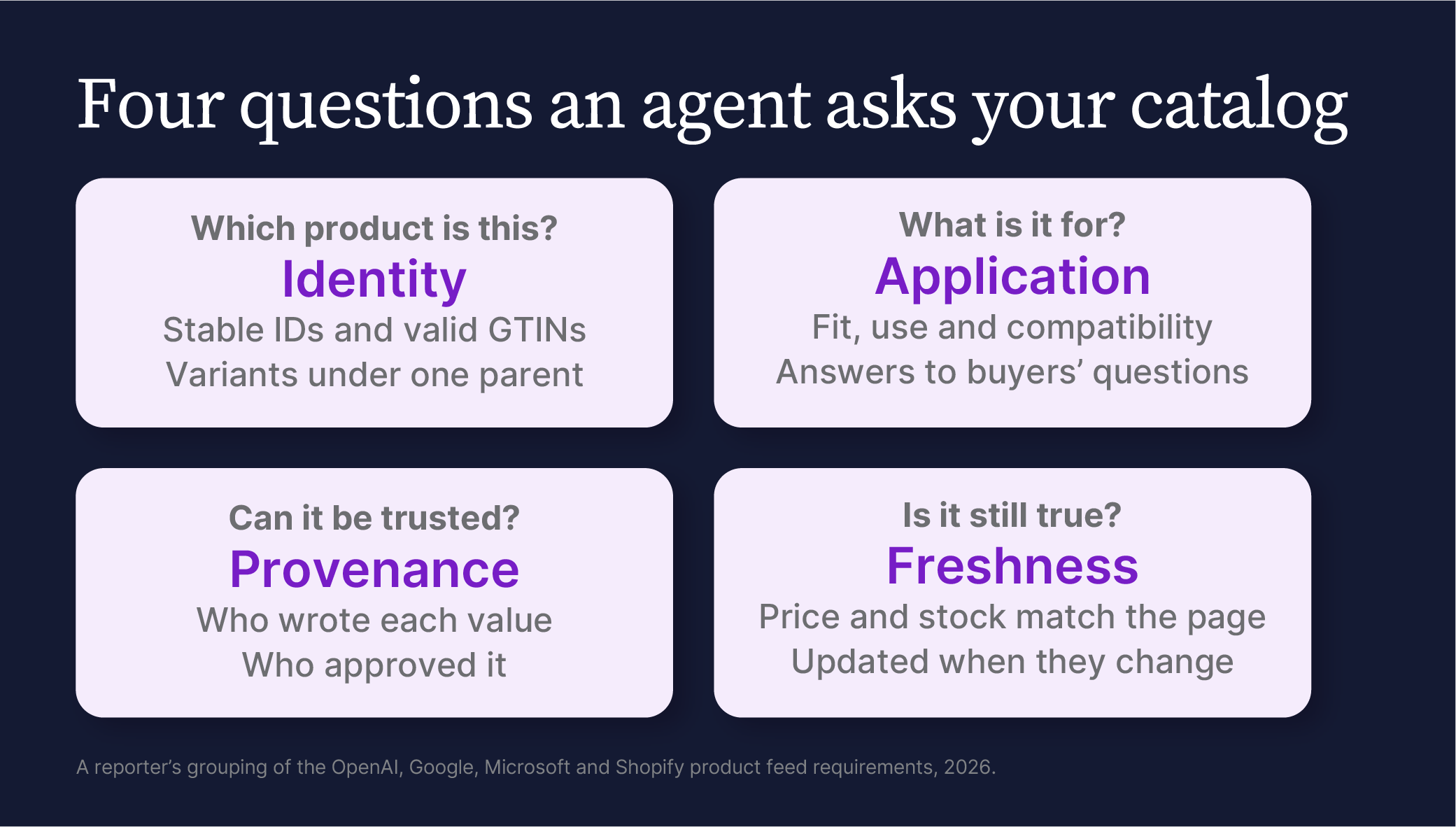
Four questions an AI agent asks before recommending a product
Which product is it? Stable IDs, valid GTINs and grouped variants help agents identify the same item across listings.
What is it for? Fit, use and compatibility details help answer real shopper questions.
Can it be trusted? Source records and human approvals establish credibility.
Is it still accurate? Prices and availability must match the landing page and stay current.
These four questions offer a practical framework, not a validated model. They capture requirements found across OpenAI and Google’s documentation, yet many catalogs still fall short despite appearing complete. [13] [14] [15] [16]
Most businesses think they’re AI-ready. Their product data says otherwise.
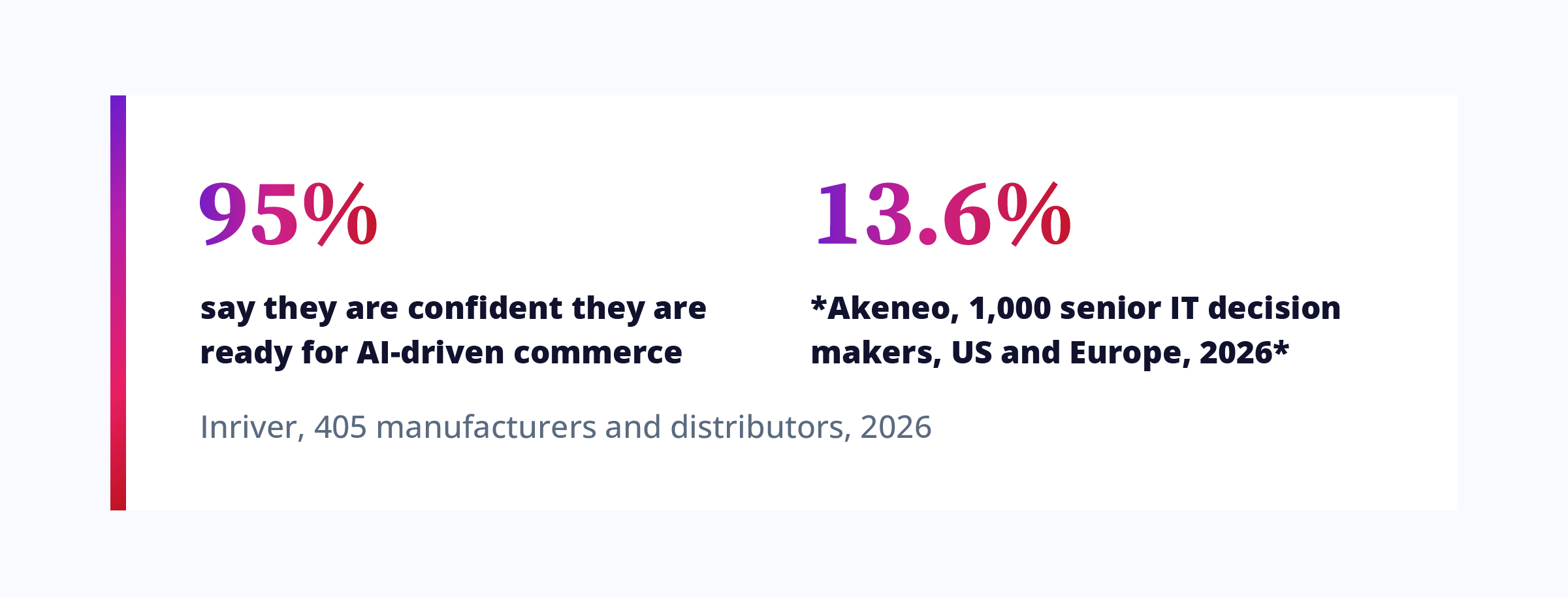
An Akeneo survey found that 95% of 1,000 senior IT decision-makers were confident their organizations were ready for AI-driven commerce, yet 44% of US organizations spend more than half their AI project effort preparing the right data.
Inriver’s survey of 405 manufacturing and distribution leaders revealed a similar gap: just 13.6% had end-to-end product data automation with an audit trail. None of the 117 respondents who considered themselves fully prepared for agentic commerce met Inriver’s operational benchmark.
The consequences reach shoppers, too. In a Syndigo-commissioned YouGov survey, 83% of online shoppers said they were likely to abandon a site that lacked the information they needed, while 26% had returned a product because its content didn’t match reality.
The starting point for choosing a PIM isn’t the vendor shortlist. It’s auditing the product data you already have. [17] [18] [19]
Do I need a new PIM for AI agents?
Not necessarily. Start by auditing your best-selling category across five areas: GTIN validity, variant grouping, publish-ready SKUs, attribute completeness, and price and stock freshness.
If the gaps stem from data entry or process, your existing PIM may be enough. A migration could simply carry those problems into a new system. But if your platform cannot capture contextual product attributes or track who supplied each value, better data entry won't solve the problem.
Put shortlisted vendors to the test. Give each ten real customer questions, from whether a product will fit to compatibility, durability and returns. Ask them to model the answers live using category-specific attributes, structured Q&As, compatibility links and documents, without custom code. The system should support new fields quickly and link every answer to the correct product.
Test your PIM against real shopper questions before deciding to replace it. [20] [21]
AI needs to know which product it’s talking about
Accurate product information starts with accurate product identity. OpenAI requires stable item, group and offer IDs even when product details change, while Google warns that products submitted without an available GTIN may have limited visibility. Variants also need consistent grouping so AI can distinguish between sizes, colours and other options.
When evaluating a PIM, ask how it maintains identifiers across product updates, supplier changes and platform migrations. If the same product appears under inconsistent IDs, or variants are incorrectly grouped, even complete product data can lead to poor matches and recommendations. [22] [23]
How often should product feeds update for AI agents?
Daily for the full catalog, and whenever prices or availability change. OpenAI recommends daily catalog snapshots and real-time updates to price and availability. Products missing from a snapshot may remain listed for up to 14 days. Google requires feed prices and availability to match the product page.
Since price and stock typically sit outside the PIM, businesses need to ensure updates reach AI agents quickly, potentially through event-driven feeds. But speed alone isn't enough. The data must be accurate and trustworthy, especially when AI generates product content. [24] [25]
Every AI-written attribute should carry its source and an approver
In a 2025 Inriver survey, 97% of 317 executives had moved beyond AI pilots, but human oversight remained uneven. In its 2026 survey of manufacturers and distributors, just 13.6% had end-to-end audit trails.
An AI-generated attribute can be plausible but wrong. Ask vendors to show the source of each value, whether it came from a supplier, a person or a model, and who approved it. As AI agents gain direct access to PIM systems, these controls will also determine what they can change. [26] [27] [28]
Can AI agents connect directly to a PIM?
Yes. Model Context Protocol (MCP) servers let AI agents access PIM data, and vendors including Stibo Systems and Akeneo now offer support. But access, permissions and licensing vary by platform.
When evaluating a PIM, check whether agent access is read-only or read-write, can be restricted by attribute and channel, is logged, and is included in the licence. Connecting an agent to product data is one decision; determining which system owns each master record is another. [29] [30] [31]
Buying master data management (MDM) Will not fix a product content problem
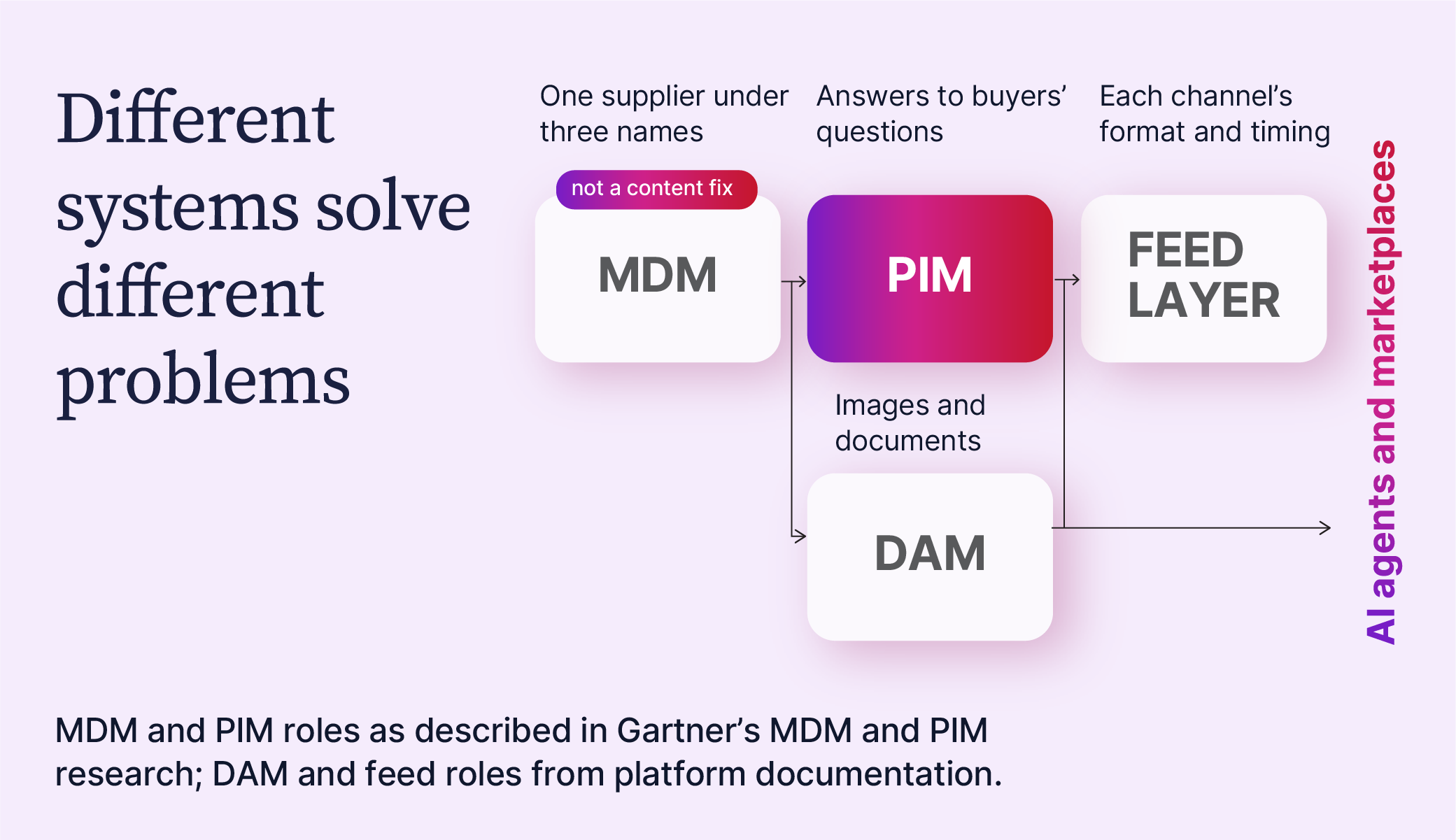
MDM creates consistent master records across customers, suppliers and products. PIM turns product data into channel-ready content, while DAM manages assets and feed tools distribute the output. If the problem is inconsistent records, MDM may be the answer. If product data cannot answer shopper questions, the fix lies in the PIM and how it enriches and distributes content. The real test is whether AI agents can use that data to give better answers. [32] [33]
Test AI answers, not just feature lists
Forrester warns that counting completed attributes can leave critical gaps. Test the same shopper questions across ChatGPT, Gemini and Copilot before and after a PIM pilot, using Google’s share-of-voice insights where available. Compare results, not just data completeness. Also price AI enrichment, agent access and channel connectors separately, as these may cost extra or depend on the vendor’s package. With reliable PIM cost benchmarks scarce, buyers need to assess both performance and total cost before choosing a platform. [34] [35] [36] [37]
What question-ready product data looks like in a live catalog
A global retailer’s loyalty business managed 40,000+ products from hundreds of vendors, with inconsistent attributes and no way to enforce completeness. Implementing Stibo Systems PIM with approval workflows and automated data delivery cut time to market from up to six weeks to an average of three.
At Bimbo Bakeries USA, ContentHubGPT connects to the PIM to update product copy when packaging changes, with brand teams reviewing and approving updates across 1,300+ SKUs and 30+ brands sold through Amazon, Walmart and Kroger. As PIM and digital shelf lead Beto Martinez-De Anda noted, product copy now influences both shoppers and AI agents. Watch our on-demand webinar with Bimbo Bakeries USA to learn more.
Both examples show the value of consistent data and controlled content updates. But evidence that these improvements directly increase AI recommendations remains limited. [38] [39] [40]
GSPANN's Take
- PIM selection has been scored on what a merchandiser can do in a demo. The new reader is an agent, and it asks four questions: which product is this, what is it for, can it be trusted, and is it still true.
- Most AI-readiness talk in this category stops at filling fields. Google's test and Forrester's backpack both point to answers a brand writes on purpose.
- Identity, provenance and freshness are integration and governance work, and they decide whether an agent can use those answers at all.
- GSPANN implements PIM and PXM across platforms and writes the answer layer with ContentHubGPT, which connects to several of them, so its selection work starts with the catalog's four questions and names a platform last.
- The PIM worth buying can tell an agent, for every value it holds, where that value came from and who signed it off.
A PIM is a long purchase, and the agents it will feed keep changing, along with the specs they read. An agent will still recommend only what it can check. The system worth choosing holds an answer to the buyer's question and can show the agent where that answer came from.
EARLY ACCESS
GSPANN is building a tool that helps brands create product data for the questions buyers and AI agents ask. It works with ContentHubGPT and the PIM platforms ContentHubGPT connects to.
Request early access (Mail to: marketing@gspann.com)
All References
Ref 1: https://www.gartner.com/reviews/market/product-information-management-solutions
Ref 3: https://support.google.com/merchants/answer/17200695
Ref 4: https://www.forrester.com/blogs/agentic-commerce-exposes-the-missing-dimension-in-product-data/
Ref 6: https://www.gartner.com/en/documents/6100727
Ref 7: https://www.gartner.com/reviews/market/product-information-management-solutions
Ref 8: https://developers.openai.com/commerce/specs/file-upload/products
Ref 9: https://support.google.com/merchants/answer/7052112
Ref 10: https://about.ads.microsoft.com/en/solutions/technology/agentic-commerce
Ref 11: https://changelog.shopify.com/posts/compare-at-prices-now-displayed-to-agentic-channels
Ref 12: https://support.google.com/merchants/answer/17085370
Ref 13: https://developers.openai.com/commerce/specs/file-upload/products
Ref 14: https://support.google.com/merchants/answer/17085370
Ref 15: https://www.forrester.com/blogs/agentic-commerce-exposes-the-missing-dimension-in-product-data/
Ref 16: https://support.google.com/merchants/answer/7052112
Ref 18: https://www.inriver.com/about/news/product-data-blind-spots/
Ref 19: https://syndigo.com/news/state-of-product-experience-2026-proof-beats-price/
Ref 20: https://developers.openai.com/commerce/specs/file-upload/products
Ref 21: https://www.inriver.com/about/news/product-data-blind-spots/
Ref 22: https://developers.openai.com/commerce/specs/file-upload/products
Ref 23: https://support.google.com/merchants/answer/7052112
Ref 24: https://developers.openai.com/commerce/specs/file-upload/products
Ref 25: https://support.google.com/merchants/answer/7052112
Ref 26: https://www.inriver.com/about/news/inriver-research-reveals-widespread-ai-deployment-in-pim/
Ref 27: https://www.inriver.com/about/news/product-data-blind-spots/
Ref 28: https://developers.openai.com/commerce/specs/file-upload/products
Ref 30: https://api.akeneo.com/mcp/getting-started.html
Ref 31: https://www.stibosystems.com/platform/mcp-server
Ref 32: https://www.gartner.com/reviews/market/product-information-management-solutions
Ref 33: https://www.gartner.com/en/documents/7683461
Ref 34: https://www.forrester.com/blogs/agentic-commerce-exposes-the-missing-dimension-in-product-data/
Ref 35: https://support.google.com/merchants/answer/17200695
Ref 36: https://api.akeneo.com/mcp/getting-started.html
Ref 37: https://www.plytix.com/pricing
Ref 40: https://www.gspann.com/insights/event/genai-and-the-future-of-product-content-in-digital-commerce