
Marketing has long assumed customers on your product page or your aisle are ready to buy and are deciding only what to buy and from whom. But the most recent survey of 2,338 US adults found that 57.5% of AI users have rejected a purchase based on a chatbot’s advice, nearly matching the share who bought something a chatbot recommended.
Suddenly, ”buy nothing” has become a real competitor. Upgrades, renewals, add-ons and repeat purchases are especially vulnerable, and AI is giving customers more reasons to say no.
Let’s look at the factors driving these decisions.
The AI that talked a customer out of a phone upgrade
A customer asked ChatGPT to compare two Android flagships with their existing Galaxy S24. After nearly six minutes of analysis, the assistant found that the current phone already met their camera needs, flagged misleading zoom claims, weighed battery and charging improvements, and noted Samsung’s software support timeline. Its verdict: “Keep your S24 for now.”
The phone maker lost the sale, not to a competitor, but to AI’s advice. The customer chose not to buy at all.
For an upgrade, the strongest alternative is the product your customer already owns
The survey captured people who decided against buying, not those who switched brands. For upgrade purchases, the biggest competitor may be the product already in the customer’s hands.
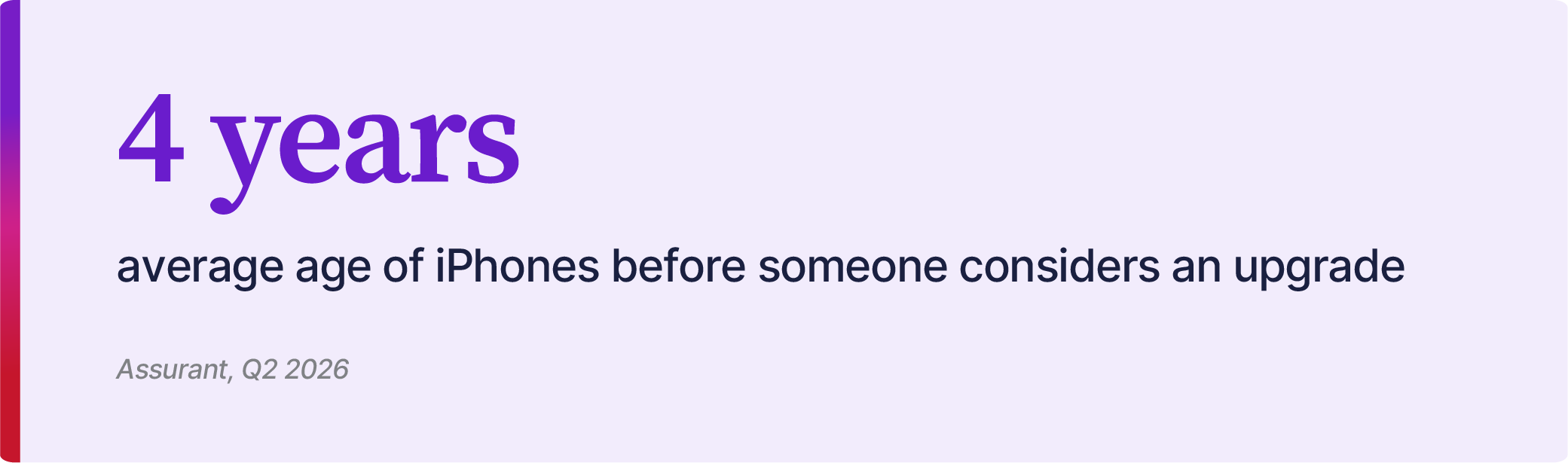
Counterpoint Research expects the global smartphone replacement cycle to reach about four years in 2026, up from 3.5 in 2025. Assurant also reported that for the first time, an average iPhone had passed four years old threshold for any upgrade.
Rising prices and incremental improvements have delayed upgrades. AI now adds another layer when it compares a new product against the one a customer owns, bringing an alternative into the decision that no brand is actively selling. [1][2]
It’s not limited to just phone or tech products
Increasingly, AI is asking people to review their subscription renewals. Accenture’s survey of 25,000+ consumers in 16 countries found 72% expect AI to influence at least half of their insurance shopping within 12 months. Meta’s personal AI agent, Muse, finds subscriptions that users have forgotten about or abandoned because cancelling was a hassle, and cancels them on their behalf. [3][4]
AI makes brand loyalty more conditional
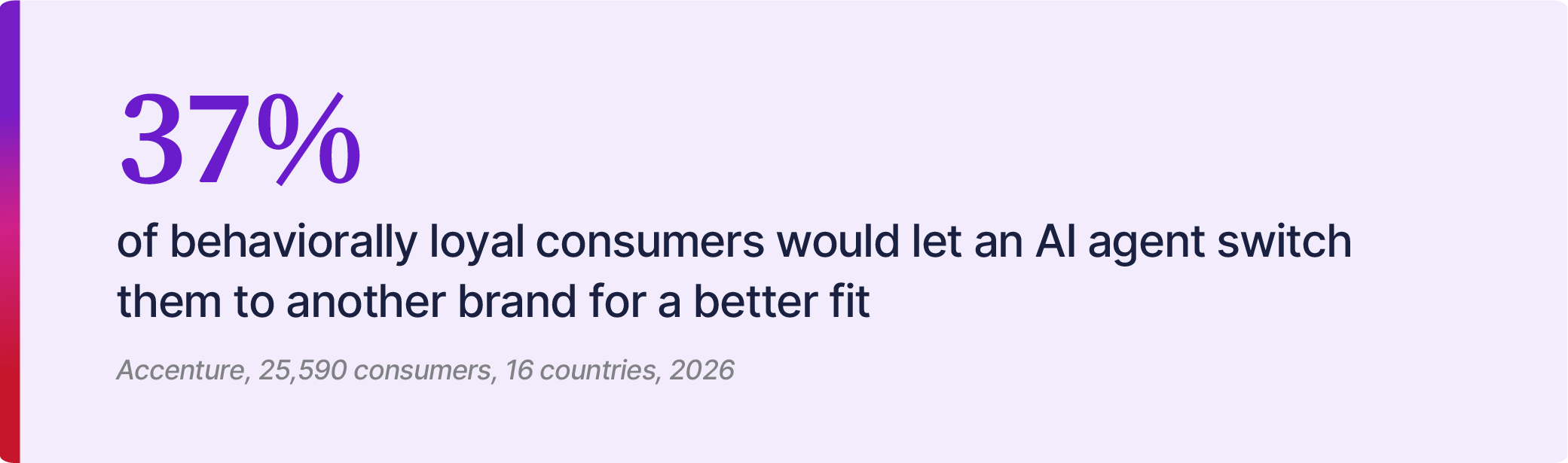
Brand loyalty has long relied on habit, familiarity and emotional connection. AI adds a more evidence-based test, weighing price, reviews, specifications and past performance. Accenture found that 37% of behaviorally loyal consumers would let an AI agent switch them to another brand for a better fit, while Snipp reported that 32.1% of US adults would leave their usual brand if AI found a better price or promotion elsewhere.
Yet loyalty is not disappearing. Research by Zac and Gal found that AI assistants favored established brands, and nearly a quarter of Snipp’s respondents said AI recommendations could strengthen their loyalty. A study of 1,536 answers also found that ChatGPT expressed a first-person product preference in 79% of responses recommending a product, compared with 7% for Gemini.
The takeaway: repeat purchases can no longer rely on habit alone. When customers turn to AI for advice, every purchase becomes another opportunity for a brand to prove its value. [5][6]
Loyalty breaks the fastest when the brand's own assistant gets it wrong
A Synchrony and Oxford Economics survey of 2,000 US consumers found that 56% would trust an AI shopping assistant from a retailer or brand.
But trust comes with risk: three-quarters said they would shop less with a brand, or stop altogether, after an AI recommended a poor product. A brand-owned AI shopping assistant gets a chance to influence the purchase decision directly, but a misleading recommendation can damage the relationship just as quickly. [7][8]
In the UK and EU, AI recommendations come with regulatory accountability
UK guidance holds businesses responsible for their AI agents’ advice, with DMCC Act breaches carrying fines of up to 10% of global turnover. EU rules effective 2 August 2026 require customer-facing AI systems to disclose their AI nature. Meanwhile, 38% of consumers surveyed in France, Germany and the UK use AI to research products or guide purchases.
Trust is fragile: six in ten UK consumers say one mistake would make them stop using an AI shopping agent. Misleading advice can cost brands more than a sale. It can damage trust and invite regulatory scrutiny.
Try this today
- Ask ChatGPT, Gemini, Claude and Perplexity: "I own [last year's model]. Should I buy [this year's model]?" Log each verdict and the reason it gives.
- Open the pages those answers cite, and check whether your current price, trade-in value and a plain "what's new since the last model" sit on a page you own.
- Pull the last 90 days of reviews and return notes, and find the reason customers most often give for waiting or sending the product back. [9][10][11][12]
In B2B, AI is challenging vendor claims and contract renewals
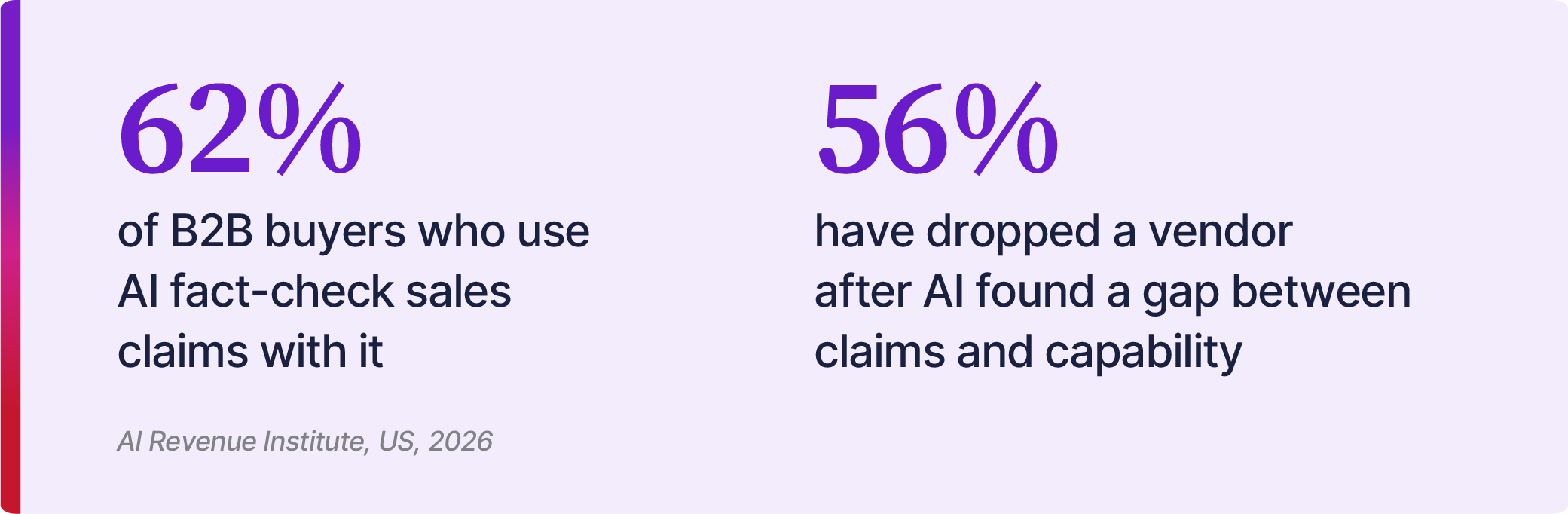
AI is becoming a buyer-side evaluator. In a survey of 521 US B2B buyers, 62% used AI to fact-check sales claims, while 56% dropped a vendor after AI exposed gaps between claims and capabilities. Meanwhile, 91% expect to use AI during contract renewals, when buyers may choose to spend less or stay with their existing solution. That matters when 40% to 60% of B2B deals are already lost to inaction. Buyers now have an assistant that weighs the decision from their budget and business needs, not the seller’s targets. [13][14]
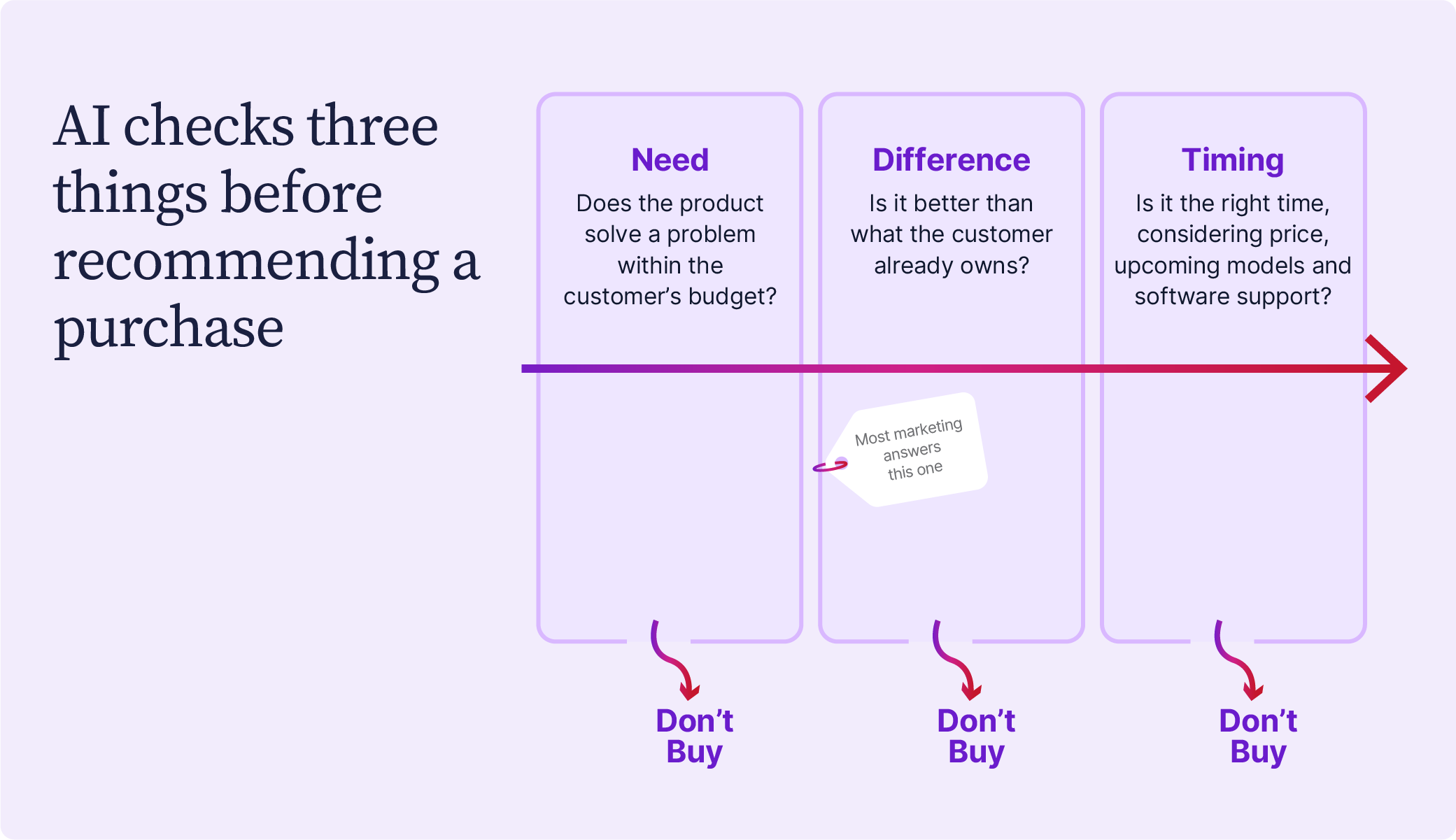
AI evaluates a user’s needs, cost and value difference, and timing before recommending a purchase
An AI assistant weighs three factors before recommending a purchase.
Need: does the product solve a customer’s problem within budget;
Difference: what it offers over the product the customer already owns;
Timing: including price history, upcoming models and remaining software support
Most product pages focus on how a product compares with competitors. AI broadens the evaluation to whether the purchase makes sense at all, drawing on whatever information it can find. When brands leave gaps, other sources fill them. [15][16]
An inaccurate answer can end a deal outright
AI advice doesn’t have to be correct to influence a buying decision. In 2025, Minnesota solar contractor Wolf River Electric sued Google after an AI Overview falsely linked it to an attorney general’s lawsuit. The company alleged that one customer cancelled a $150,000 contract and a nonprofit ended a relationship worth about $174,000 after seeing the claim.
The case remains unresolved. Less dramatic errors can have similar consequences: outdated prices, expired offers or discontinued products presented as facts can turn customers away before sellers get a chance to respond. [17][18]
How do you know if AI is costing you sales?
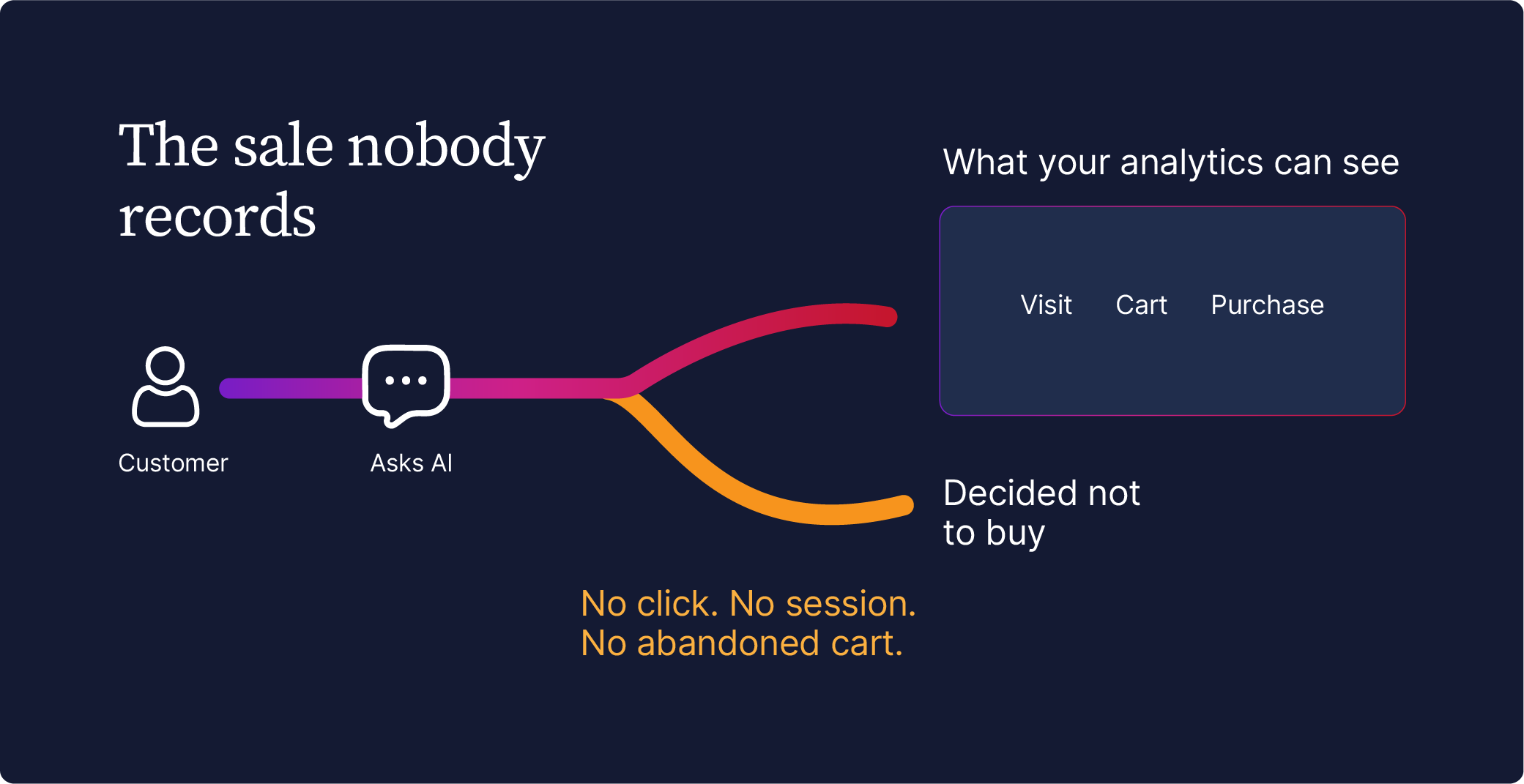
Mostly you do not, because a sale the assistant talked someone out of leaves nothing behind: no click, no session, no abandoned cart. Analytics can only report the customers who came to your page. Potential customers who asked their AI first never appear on any dashboard. 39.28% of AI users say chatbots have replaced most or all of their product-related Google searches, so the decision now happens where neither your analytics nor your search data can see it. [19][20]
The same assistant can also talk people into spending more
AI doesn’t always discourage purchases. In a lab experiment involving 265 shoppers, researchers from ETH Zurich and the University of Haifa found that people using ChatGPT or Gemini spent more on clothing, mainly on established brands, without better product ratings. A 2026 Marketing Letters paper, based on eleven studies, also found that voice-assistant users were more likely to choose expensive upgrades than screen-based shoppers.
Whether AI recommends an upgrade or sticking with an existing product depends on the question asked and the information it finds. Brands can’t control every answer, but they can shape the product information AI draws on. [21][22]
Can brands pay to change what AI tells customers?
Paid placement can buy visibility, but at the cost of trust. In the Semrush survey, 66.05% of consumers who disliked chatbot ads said they questioned the integrity of the answers.
More respondents said ads made them view a product less favourably (23.12%) than more favourably (20.36%). An ad beside an AI recommendation not to buy may only make that advice seem more credible. [23]
Five actions you can take today
- Ask the upgrade questions before your customers ask. Run "should I upgrade from," "is it worth it" and "do I need" prompts about your top products on ChatGPT, Gemini, Claude and Perplexity every month, and log the verdict and the reason each gives.
- Publish the honest comparison, with your own last model in it. Current prices, terms, trade-in values and a plain "who should wait" section on pages you own. In the Dutch audit, the brand's own site supplied 28.6% of the sources behind correct answers and only 18.2% of those behind wrong ones.
- Fix the deserved "don't buy" at its source. When the assistant's reason is a pattern in the reviews, the fix is in the product, the service or the returns policy, and the review data shows which.
- Let your own assistant say "not yet." If you run a shopping assistant, it keeps the repeat customer only by answering the upgrade question honestly; three-quarters of shoppers say a poor AI recommendation would make them shop less with that brand.
- Write the renewal case before the buyer's AI writes it. For B2B accounts, keep a checkable record of what was delivered against what was promised, because 62% of buyers who use AI will test the claims against public sources.
Where to start. If you sell upgrades or repeat purchases to consumers, begin with the first two moves this month, and add the fourth if you run your own shopping assistant. If you sell to businesses, begin with the renewal case, because that is where "keep what we have" is decided. Everyone should fix the deserved "don't buy" within the quarter: no page you publish will outlast a pattern in the reviews, and a business that has to test its own claims before buyers do needs the record straight first. [24][25]
GSPANN's Take
- Marketing measured itself against competitors, because a competitor shows up in a share report. A customer who decides to buy nothing, or quietly stops coming back, shows up nowhere.
- An assistant now weighs need, value and cost difference, and timing. Most product content answers only the middle one, and only against rivals.
- Answering the other two is product content, pricing and customer-insight work: what changed since the last model, who should wait, what the reviews keep saying and whether the price on every page is current.
- Most AI visibility work stops at getting a brand named. GSPANN's work on Answer Engine Optimization, agentic commerce readiness and AI-readable product content with ContentHubGPT goes after what the assistant says next, and it works from one premise: an assistant can only recommend what it can verify.
- The sale you can still win is the one where your own page gave the honest answer before the assistant went looking for it elsewhere.
For most of retail history, "don't buy" was an argument that didn’t exist. It is now something a customer can hear about any product, at the moment of decision, from an advisor they trust more than the seller, and the seller never even learns it happened. The companies that keep those sales will be the ones that answered the customer's real question first: not why this is better than a rival, but why anyone should buy it at all.
All References
Ref 2: https://www.assurant.com/news-insights/news_releases/mobile-trade-in-programs-trends-Q2-2026
Ref 3: https://www.accenture.com/gb-en/insights/consulting/talk-my-ai-agent
Ref 4: https://axios.com/2026/09/24/meta-muse-subscription-stocks
Ref 5: https://www.accenture.com/us-en/insights/consulting/talk-my-ai-agent
Ref 6: https://www.snipp.com/blog/survey-ai-and-the-modern-shopper-journey
Ref 7: https://www.synchrony.com/contenthub/newsroom/2026-ai-in-commerce-study.html
Ref 8: https://www.synchrony.com/contenthub/newsroom/2026-ai-in-commerce-study.html
Ref 10: https://www.legalithm.com/en/blog/eu-ai-act-what-applies-2-august-2026
Ref 15: https://www.timmermansmedia.com/research/ai-hallucinations-dutch-brands/
Ref 16: https://www.tryprofound.com/blog/where-do-inaccurate-ai-claims-come-from
Ref 18: https://minnlawyer.com/2025/06/13/wolf-river-electric-google-ai-defamation-lawsuit/
Ref 19: https://finance.yahoo.com/technology/ai/articles/research-llm-scout-reveals-chatgpt-112000606.html
Ref 20: https://www.tryprofound.com/blog/where-do-inaccurate-ai-claims-come-from
Ref 21: https://www.promarket.org/?p=44783
Ref 22: https://bear.warrington.ufl.edu/sela/Park_Han_Sela_Splurging_with_Alexa.pdf
Ref 23: https://www.semrush.com/blog/ai-chatbots-talk-ai-users-out-of-buying/
Ref 24: https://www.timmermansmedia.com/research/ai-hallucinations-dutch-brands/