
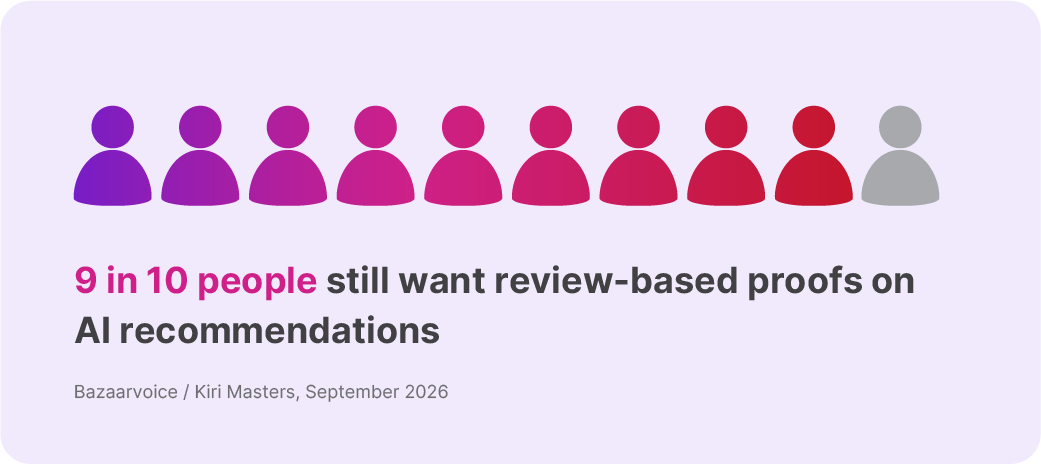
For years, customer reviews were simply a trust signal for shoppers. Now AI search is reading them too. Research from Bazaarvoice and Kiri Masters shows that shoppers still want real reviews behind AI recommendations, and many need extra proof before trusting an unfamiliar brand.
An AI recommendation may get you noticed, but reviews help get you trusted. AI engines are also adapting and including reviews as a key signal to recommend the right products. The reviews therefore now serve two audiences: shoppers and AI.
AI can now put unfamiliar brands on the shortlist
9 in 10 shoppers want real reviews behind AI product recommendations. For unfamiliar brands, many still look for robust trustworthy reviews or discounts before buying. AI can spark consideration, but reviews build trust.[1]
How AI recommend products?
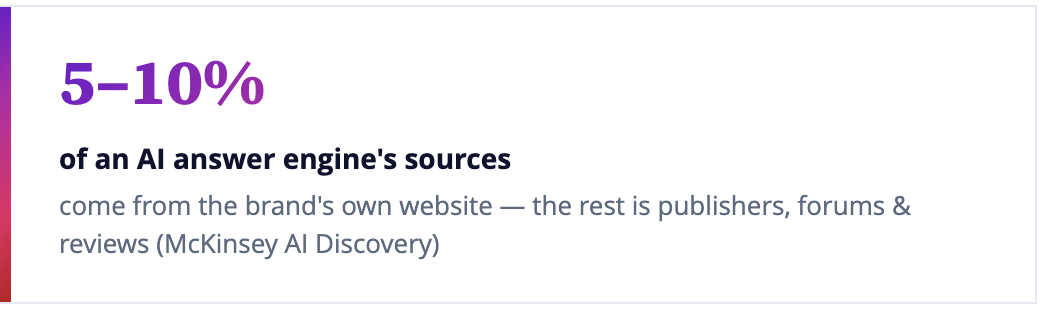
Not on their own. McKinsey's AI Discovery research found that a brand's own website supplies only 5 to 10% of the sources an AI search platform draws on when it answers a shopping question. The rest comes from publishers, forums, and reviews the brand does not control.
That outside content builds the trust behind the recommendation, making reviews especially important for unfamiliar brands.[2]
The trust gap is worst for unknown brands
A known brand carries reputation the AI answer can lean on. New brands rely much more on reviews to build trust. AI can surface a challenger brand, but reviews are what can help shoppers trust it.[3]
The fix is not more content. It's more verified reviews
More product pages and brand stories won’t replace what shoppers actually want: real experiences from other people. Those same reviews also help AI to draw from more credible sources.
Reviews already outrank brand content as AI citation fuel
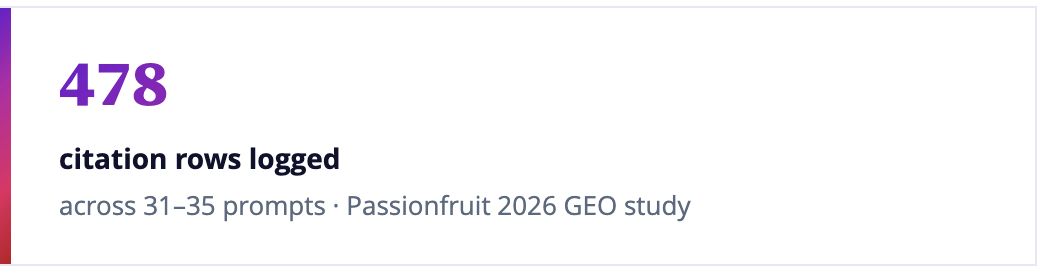
AI answer engines increasingly pull from user-generated content, including reviews and Reddit discussions. Passionfruit's 2026 GEO study logged 478 citation rows across 31 to 35 prompts for the site.
Reviews are no longer just a trust signal for shoppers. They can also influence what AI says about a brand.[4]
How does ChatGPT decide which reviews to trust?
Not all reviews carry the same weight. ChatGPT tends to trust credible third-party roundups and “best of” lists from Wired or Business Insider, roughly 8 to 20 times higher than an equivalent volume of raw customer reviews. In other words, one trusted mention can matter more than thousands of five-star reviews.[5]
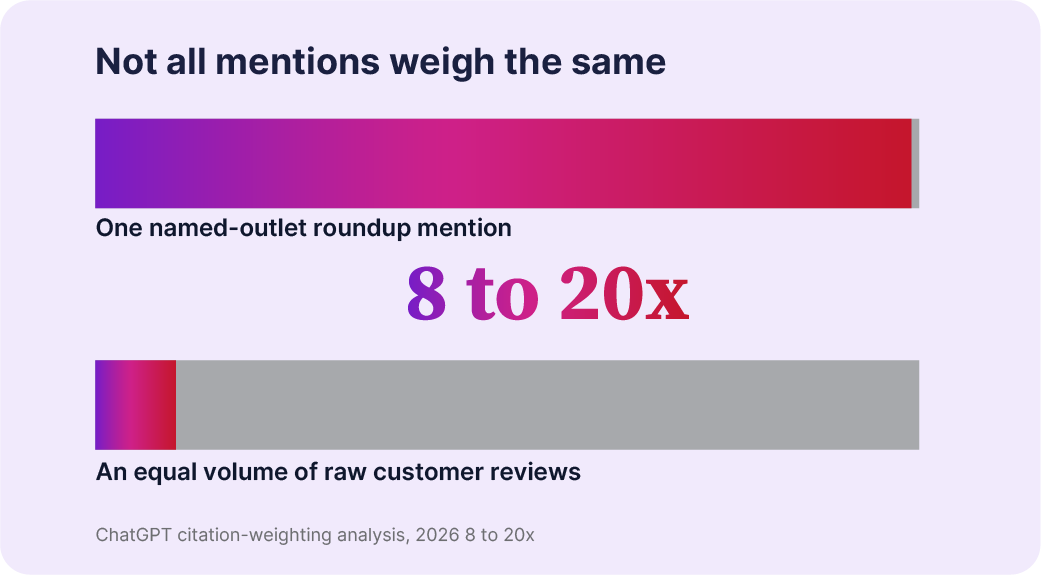
Not All Reviews are trusted by AI
Deepfake-detection firm Pindrop estimates 3 in 10 retail fraud attempts are now AI-generated.
Fake reviews are growing, and AI-generated fraud is making them harder to spot. Platforms are fighting back, but the reviews shaping shopper and AI decisions are still under attack.[6] [7]
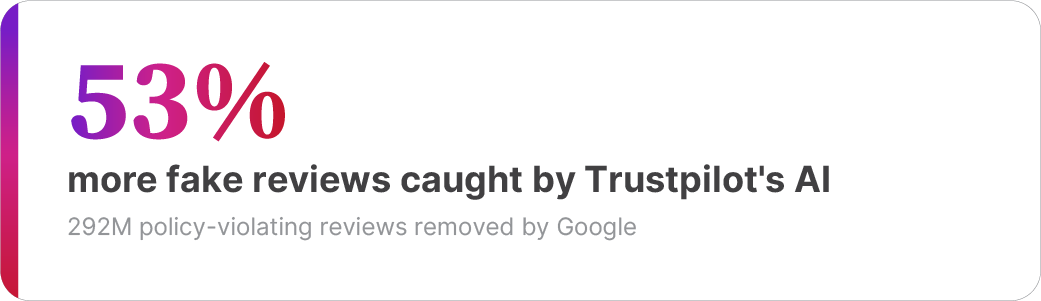
Is it illegal to post AI-written reviews?
Yes, if the review doesn't reflect a real person's honest experience. The Federal Trade Commission (FTC) is actively enforcing this, with penalties reaching $18 million in a March 2026 settlement. Some platforms understand this too, but implementation varies: Yelp bans AI-assisted reviews, while Amazon and Trustpilot allow AI help if the underlying opinion is genuine.[8]
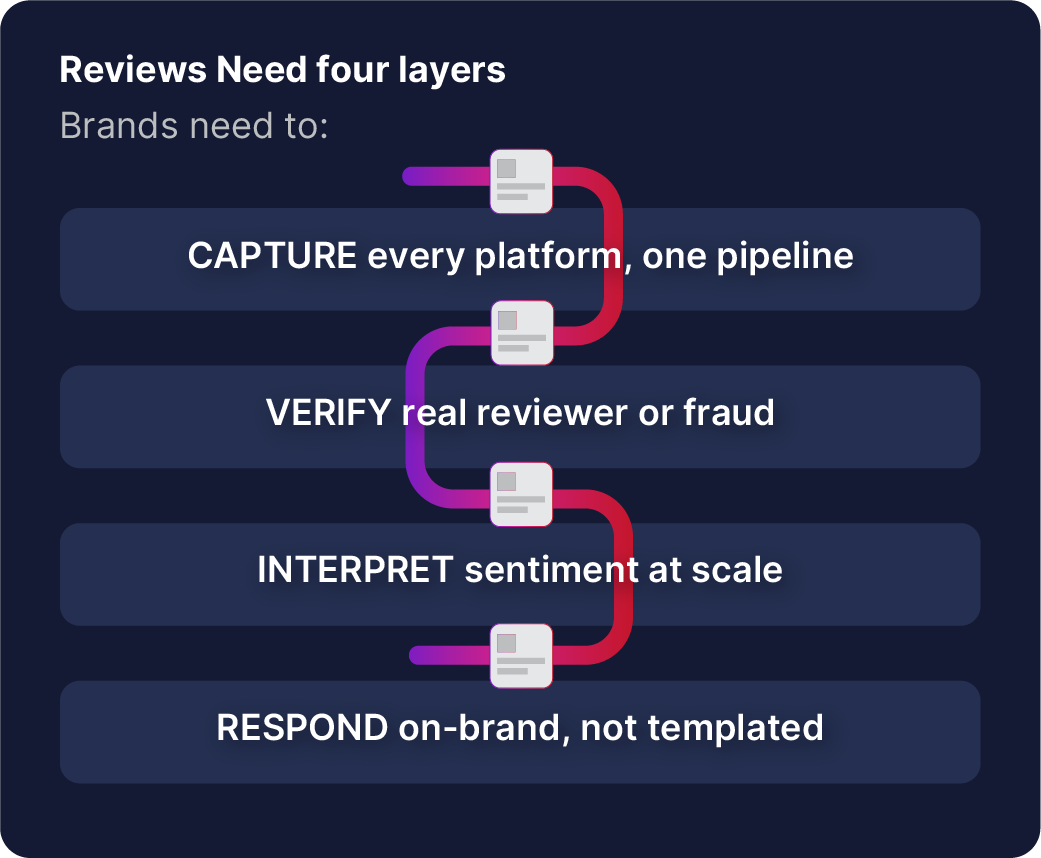
Reviews now need four layers, not one
Managing reviews used to mean checking the star rating once a week. That no longer works.
Today, reviews need to serve shoppers, AI systems, and fraud teams at the same time. That means retailers need to continuously:
- Capture reviews from every platform
- Verify which ones are real
- Analyze what customers are actually saying at scale
- Respond in a way that feels human
Miss one layer, and the rest are working with incomplete or unreliable data.
A generic AI reply to a review does more harm than no reply
Responding to reviews at scale is easy, but BrightLocal’s 2026 survey found that 50% of consumers are put off by generic or templated responses. AI needs context and specificity, or automation can quickly feel like indifference. [9][10]
The next review battle is AI interpretation
The review market is shifting from collecting reviews to interpreting them with AI. Platforms like Yotpo and Bazaarvoice are competing on how quickly they can analyze and distribute review insights at scale. Collection is largely solved. AI-ready interpretation is the next challenge. [11]
Case Study Example: Turning Reviews Into Merchandising Intelligence
A global athletic apparel brand had hundreds of thousands of reviews across Bazaarvoice, Gladly, and Sierra, but no easy way to turn them into merchandising insights. GSPANN built a daily AI-powered pipeline that analyzes every review for sentiment and makes the data searchable in plain English.
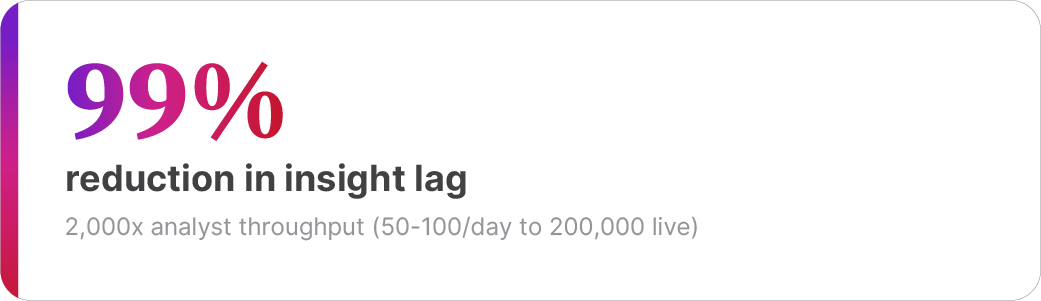
The result: insight lag dropped by ~99%, analyst throughput increased 2,000x, from 50–100 reviews a day to 200,000 processed live, with full sentiment coverage.
The interpret layer is already here. And it’s built for the scale AI search demands.[12]
GSPANN's Take
- The industry treated an AI citation as the finish line, because a citation is easy to chase and easy to report on. The data says it's the starting gun. Trust still has to be earned from the reviews sitting behind it.
- The mechanism is simple and easy to miss: reviews now serve two audiences reading the same corpus for different reasons, a shopper deciding whether to buy and an AI engine choosing its next citation, and most review operations are staffed for the first audience only.
- It's the discipline GSPANN's own Voice of Customer work keeps coming back to: capture, verify, interpret, and respond have to run as one continuous pipeline, not four disconnected tools, because a gap in any layer corrupts what the other three are working from.
- Your review corpus is now read by more machines than people, and almost nobody has audited it the way they'd audit a product feed.
- The brands winning the discount-free sale are the ones whose reviews were already structured for a machine to read, long before the AI conversation started.
Retailers spent a decade with reviews as a widget on the product page, something to display and occasionally moderate. That widget is now read by two audiences that don't forgive the same mistakes: a shopper who wants proof before trusting an unfamiliar name, and an answer engine that will cite a stranger's forum post over your own marketing copy without a second thought. The reviews were the asset the whole time. Most companies can no longer ignore them.
All References
Ref 5: https://ultrascout.ai/article/how-chatgpt-decides-which-brands-to-recommend
Ref 6: https://whitespark.ca/blog/fake-ai-reviews-are-ruining-google-what-can-we-do/
Ref 7: https://www.pindrop.com/ai-fraud-spike/
Ref 8: https://www.aipolicydesk.com/blog/ftc-ai-enforcement-actions-2026
Ref 9: https://www.digitalapplied.com/blog/ai-assisted-review-response-reputation-at-scale-2026-playbook
Ref 10: https://www.vendasta.com/blog/ai-review-response/
Ref 11: https://www.yotpo.com/blog/yotpo-vs-bazaarvoice-vs-powerreviews/