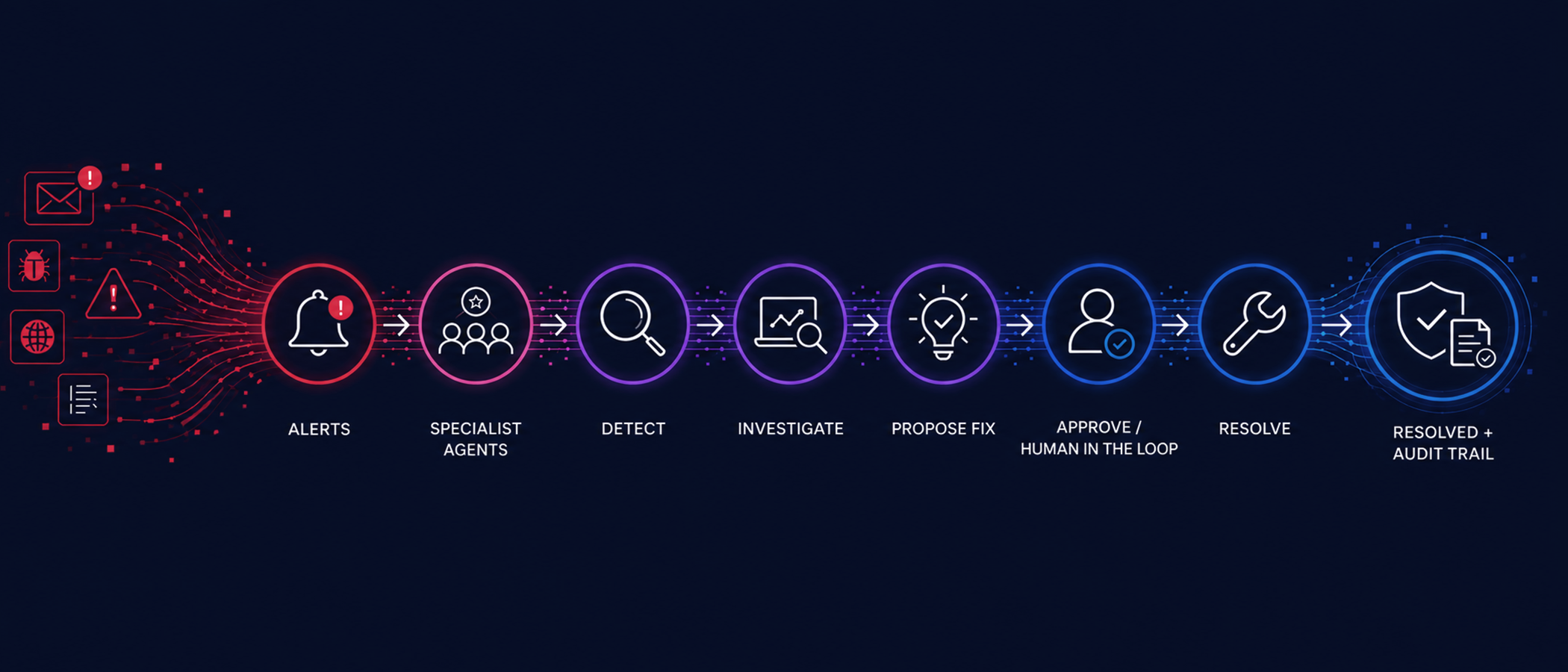

For 25 years, enterprise access control assumed every login belonged to a person. Then, over 18 months, AI agents started accessing the same systems.
In July 2026 the bill started arriving. Nearly two-thirds of organizations report AI agent security incidents, and one in eight reported AI breaches.
What follows is what a VP or CTO is asking this quarter, answered with the data.
How Bad is the AI Agent Security Problem Right Now?
Bad enough that it stopped being theoretical.
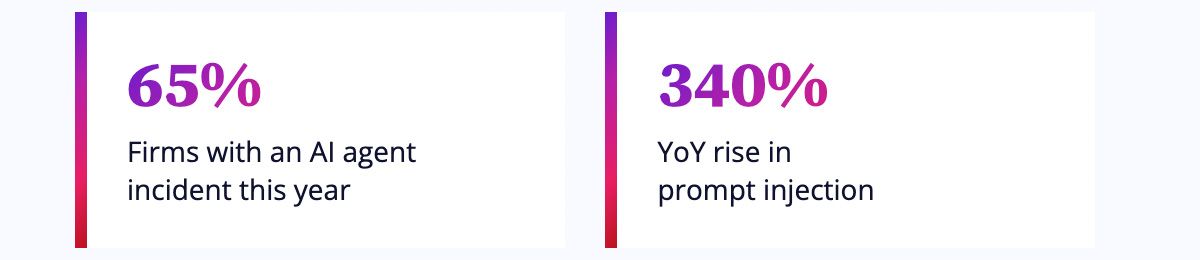
Nearly 65% of organizations reported an AI agent security incident in the past year, and autonomous agents already make up more than 12% of reported AI breaches.
Prompt injection, the attack that turns an agent against its own instructions, sits at number one on OWASP's LLM risk list and is reported up 340% year over year, the fastest-growing category of cyberattack.[1] [2] [3]
Are These Real Breaches, or Just Vulnerabilities Somebody Found in a Lab
Real, named, and shipped.
The Vercel breach disclosed on April 21, 2026 started with a compromised third-party AI tool and pivoted into internal systems through the access an employee had granted it.
Microsoft patched CVE-2026-21520 in Copilot and Salesforce fixed data-leak flaws in Agentforce, both of which would have let an outside attacker exfiltrate sensitive data. [4] [5]
What Does an Agent Breach Really Cost Us?
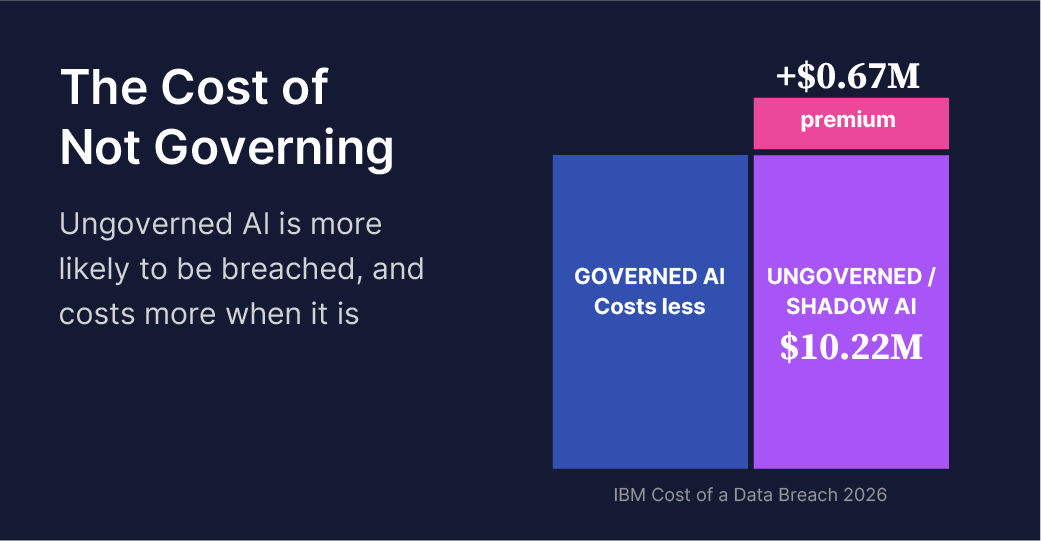
The US average breach cost hit an all-time high of $10.22 million in 2026, and ungoverned shadow AI carries a documented $0.67 million premium on top.
IBM's finding is blunt: ungoverned AI systems are both more likely to be breached and more expensive when they are.
The gap between a governed and an ungoverned deployment is now a seven-figure line on your risk register.[6] [7] [8]
Why is an Agent Riskier than the Apps We Already Secure?
Because an agent bundles four things a normal app never had at once: an identity, standing access to data, the ability to use tools, and the autonomy to act with no human clicking the button.
That combination is the whole attack surface. You secured your apps for a user who reads the screen, but the agent reads the instructions, and the instructions can be poisoned. [9] [10]
How Common Are Agent Vulnerabilities?
Common enough to assume yours has one.
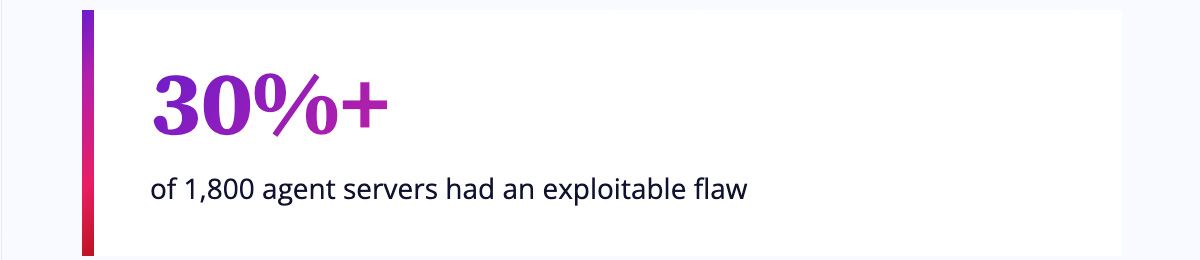
A scan of 1,800 deployed agent servers found over 30% carried at least one exploitable flaw.
Researchers have already demonstrated a working tool-poisoning chain against a live finance agent, feeding it malicious instructions through the very tools it was told to trust.[11] [12]
Is This a Security Team Problem to Solve?
No, and treating it as one is the mistake.
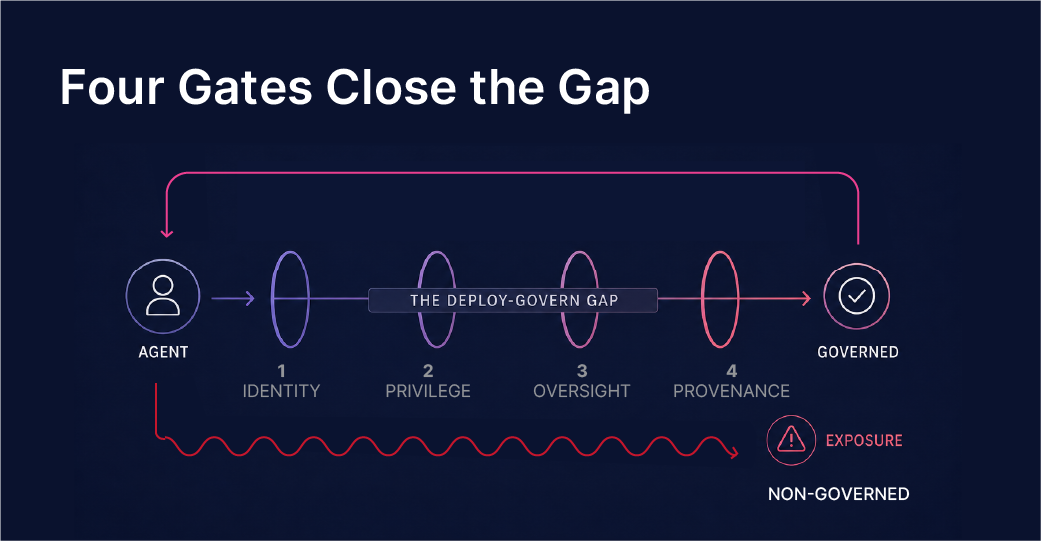
This is a Deploy-Govern Gap: the distance between what an agent is able to do and what the business can actually see, approve, and revoke.
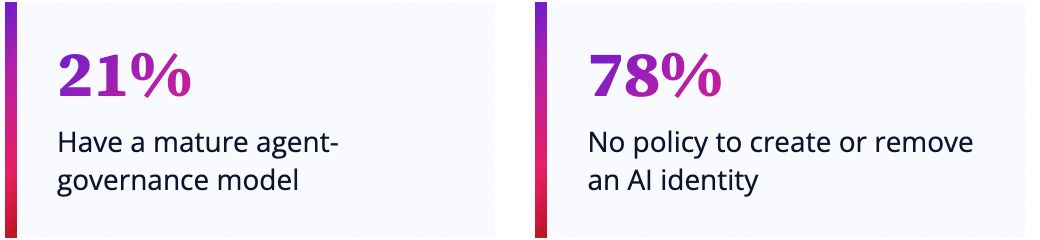
74% of companies plan to run agentic AI within two years, yet only 21% have a mature governance model for it, and 78% have no documented policy for even creating or removing an AI identity. [13] [14] [15]
Why Didn’t Our Existing Identity and Access Management (IAM) Not Catch Any of This?
Because your IAM was built for people, and agents are not people.
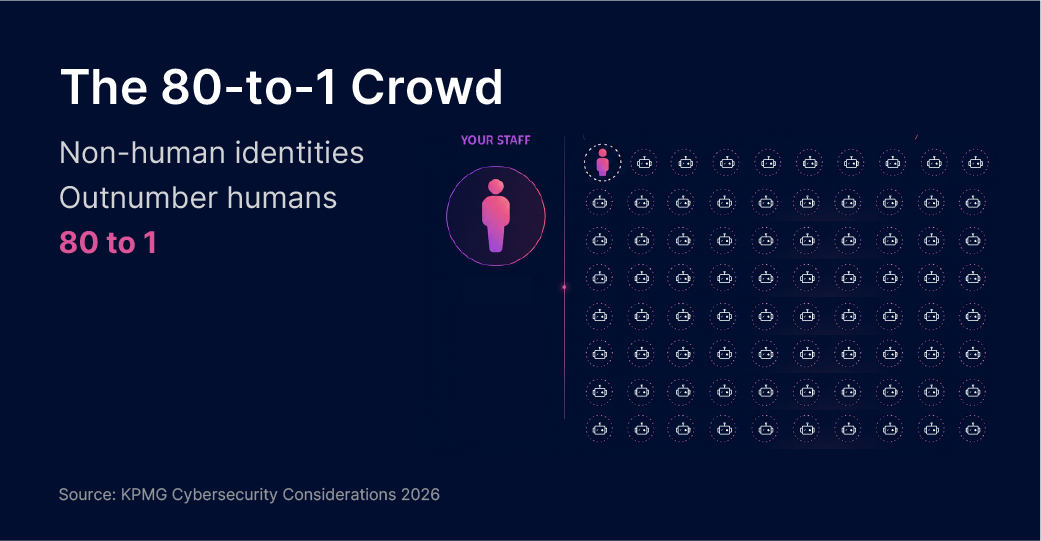
Non-human identities now outnumber human ones by roughly 80 to 1 in the average enterprise, and that population grew 44% in a single year.
70% of identity-related incidents are already tied to autonomous activity. The login-based model never anticipated a workforce that never logs in and never sleeps. [16] [17] [18]
So What Does Governing an Agent Look Like?
Four controls, in order: Identity, Privilege, Oversight, Provenance.
- Give every agent its own identity instead of a shared credential, so every action traces back to a name.
- Grant the minimum access needed and nothing persistent.
- Route the high-impact moves through a human.
- And log every action to a record you cannot alter after the fact. [19] [20]
What Does Least Privilege Even Mean for Something That Acts on Its Own?
It means access that shows up for one task and disappears when the task is done.
Just-in-time access grants the right on demand and revokes it automatically, so the exposure window shrinks from months to minutes.
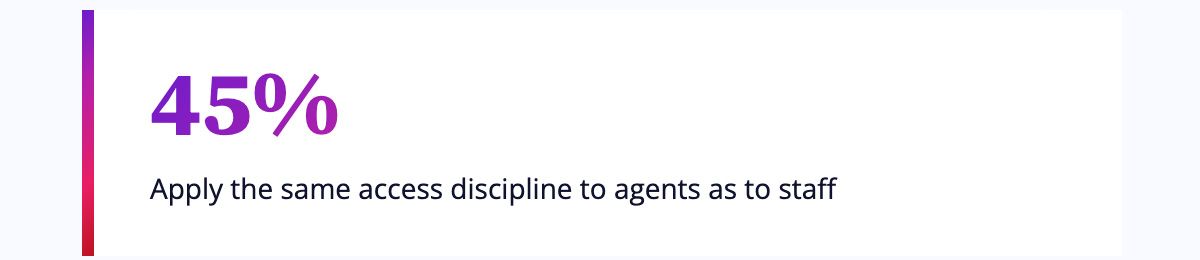
Today, only 45% of organizations apply the same privileged-access discipline to agents that they apply to employees. [21] [22]
Where Does a Human Still Have to Stay in the Loop?
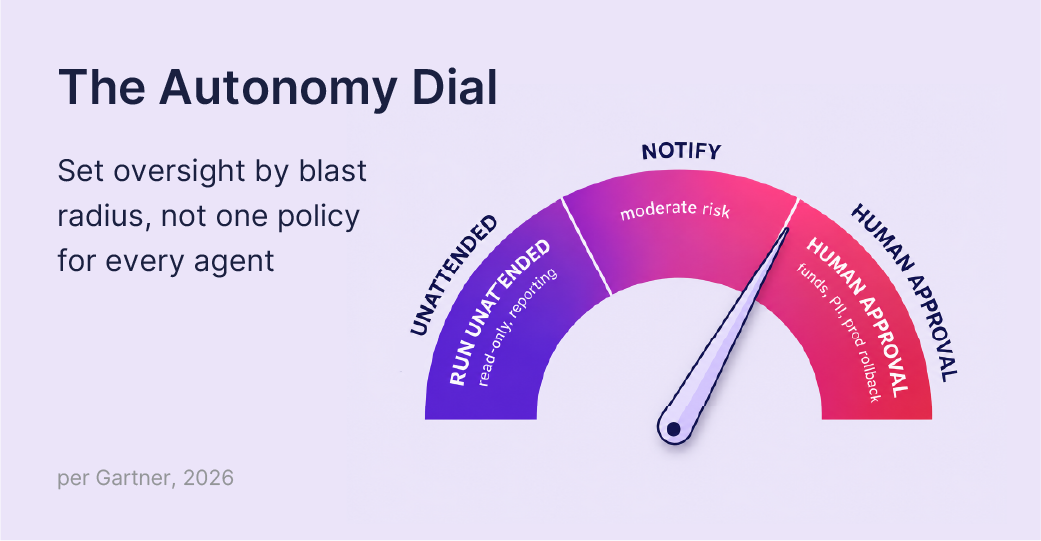
On the moves that are expensive to undo: moving funds, touching customer PII, rolling back production.
Stage autonomy in tiers, let low-risk actions run unattended, and put a human approval node in front of anything that would hurt if it went wrong.
The rule is simple: the bigger the blast radius, the earlier a human sees it. [23] [24]
Why Does One Governance Policy for All Agents Fail?
Because a read-only reporting agent and a payments agent do not carry the same risk, so the same rulebook cannot fit both.
Gartner is explicit that applying one uniform governance policy across every agent will itself cause failure.
Set the oversight by blast radius and turn the dial up as the stakes climb, rather than governing every agent as if it were the most dangerous one you run. [25] [26] [27]
Isn’t Regulation About to Force Our Hand Anyway?
Yes, and from three directions at once.
The EU AI Act's high-risk obligations phase in through 2026, requiring documented human oversight, record-keeping, and logging.
The UK takes a principles-based route with no standalone AI law, but accountability and governance is one of its five core principles, so the audit trail still lands on you.
And the US is widening state patchwork rather than a single law: Texas's TRAIGA took effect in January 2026, California's transparency rules are live, and Colorado's replacement statute arrives in 2027, all reaching any company doing business in-state.
Provenance stops being hygiene and becomes the evidence every one of these regimes asks to see. [28] [29] [30]
What Do We Do Before the Next Agent Goes Live?
Run the four-control gate before the agent goes live.
- Give every agent its own identity,
- Strip its standing credentials for just-in-time access,
- Put approval nodes on funds, PII, and production,
- And log every action to a record you cannot edit.
[31] [32]
How Do We Move Fast Without Stalling Every Deployment for a Security Review?
By making the guardrails structural instead of manual.
When identity, least privilege, oversight, and provenance are built into how agents get deployed, a new agent inherits its controls on day one and ships without a bespoke security review each time.
Governance done right is the thing that lets you ship faster, because the controls travel with the agent. [33]
GSPANN's Take
The agent failures making headlines are not model failures. They are governance failures wearing a model's face. The four controls only hold if you put them where agents are actually born, and where most enterprises actually run.
- Put the controls where agents are built: the pipeline. GSPANN wires Identity, Privilege, Oversight, and Provenance into the CI/CD path, so every new agent inherits its guardrails at deploy time, the way code inherits its tests. Ship governance as code and a new agent goes live in hours with its controls attached, instead of waiting on a manual review it will eventually skip.
- The gate has to travel across clouds. Most enterprises run agents on AWS, Azure, GCP, and on-prem at once, and a control that only holds in one of them leaves the gaps between clouds wide open. The four gates are enforced identically across multi-cloud and hybrid, so the seams do not become the attack path.
- Scale is the real test. One agent is easy to watch. The discipline that matters is the one that still works at the eightieth agent, and the eight-hundredth, when no human is reading every trace.
The discipline is old. What is new is pointing it at a workforce that never logs in.
How GSPANN Helps
GSPANN maps the four-control model onto capabilities enterprises already invest in, so agent governance ships as an engineering deliverable rather than a slide.
- Identity and Access (IAM): per-agent identities, just-in-time and least-privilege access, and clean revocation workflows. This is Identity and Privilege made real, so every agent is named, scoped, and switch-off-able.
- DevOps and Platform Engineering: the four gates embedded into CI/CD and multi-cloud pipelines, enforced the same on AWS, Azure, GCP, and on-prem, so a new agent inherits its controls at deploy time.
- Data and Analytics: the Oversight and Provenance layer. Immutable action logs, agent-activity telemetry, and anomaly detection that flags an agent doing something it never did before, turning "you cannot govern what you cannot see" into a dashboard you can actually watch. This is the control the rest of this piece builds toward.
- Managed Services: all of it run day to day, continuous monitoring, incident response, and the audit-evidence pack the EU, UK, and US regimes ask to see.
What makes the tooling accountable is the operating model around it. That is the part GSPANN builds.
All References:
Ref 1: https://www.kiteworks.com/cybersecurity-risk-management/ai-agent-security-incidents-2026/
Ref 2: https://www.practical-devsecops.com/mcp-security-statistics-2026-report/
Ref 3: https://genai.owasp.org/llm-top-10/
Ref 4: https://blueradius.io/ai-cybersecurity-incident-report-2026
Ref 5: https://www.darkreading.com/cloud-security/microsoft-salesforce-patch-ai-agent-data-leak-flaws
Ref 6: https://www.ibm.com/reports/data-breach
Ref 7: https://databreachcost.com/
Ref 8: https://deepstrike.io/blog/cost-of-a-data-breach
Ref 10: https://unit42.paloaltonetworks.com/agentic-ai-threats/
Ref 11: https://www.practical-devsecops.com/mcp-security-statistics-2026-report
Ref 12: https://adversa.ai/blog/top-mcp-security-resources-july-2026/
Ref 13: https://www.deloitte.com/us/en/insights/topics/emerging-technologies/ai-agents-scaling-faster.html
Ref 14: https://askmeidentity.com/resources/state-of-ai-agent-identity/
Ref 15: https://www.ibm.com/think/news/think-2026-identity-recap
Ref 16: https://kpmg.com/xx/en/our-insights/ai-and-technology/invisible-access-visible-risk.html
Ref 17: https://nhimg.org/nhi-news/non-human-identity-sprawl-enterprise-security-2026
Ref 18: https://askmeidentity.com/resources/state-of-ai-agent-identity/
Ref 19: https://neuraltrust.ai/blog/ai-agent-security-enterprises-complete-guide
Ref 20: https://www.okta.com/newsroom/articles/ai-agents-at-work-2026-agentic-enterprise-security/
Ref 21: https://www.miniorange.com/blog/least-privilege-ai-agents/
Ref 22: https://askmeidentity.com/resources/state-of-ai-agent-identity/
Ref 23: https://www.miniorange.com/blog/least-privilege-ai-agents/
Ref 24: https://www.okta.com/newsroom/articles/ai-agents-at-work-2026-agentic-enterprise-security/
Ref 27: https://nhimg.org/nhi-news/non-human-identity-sprawl-enterprise-security-2026
Ref 28: https://obot.ai/blog/ai-governance-trends-2026/
Ref 29: https://www.rpclegal.com/thinking/artificial-intelligence/ai-guide/part-1-uk-ai-regulation/
Ref 31: https://neuraltrust.ai/blog/ai-agent-security-enterprises-complete-guide
Ref 32: https://www.miniorange.com/blog/least-privilege-ai-agents/
Ref 33: https://www.okta.com/newsroom/articles/ai-agents-at-work-2026-agentic-enterprise-security/