
Until recently, app discovery meant keywords, ratings, downloads, and rankings. That old app discovery playbook is changing.
In less than a month, three developments showed how much app discovery is moving beyond the app store: OpenAI began ranking plugins by continued use, Apple introduced Siri actions inside apps, and a study of 10 AI models found that they often disagree on which apps to recommend.
Your customers are now asking AI which app to use. And AI is choosing based on signals traditional app store optimization rarely tracks, while increasingly completing the task inside the app itself.
The platforms are also revealing more about how those choices are made.
How does ChatGPT decide which mobile apps to recommend?
ChatGPT looks at the descriptions you publish and, since 21 August 2026, whether people keep using your app after installation. OpenAI’s developer guide says ChatGPT and Codex decide when to call a tool based on its metadata.
The Plugin Directory now prioritizes plugins with strong real-world utility and continued use, rather than simply downloads. It can also suggest relevant plugins during conversations.
Download volume is no longer the only signal. Continued usefulness matters too. [1][2][3]
How do you track whether AI recommends your app?
Track mention rate, not rank. Measure how often your app appears across real prompts, repeated runs, and multiple AI engines. In SparkToro’s headphone test, four brands appeared in 55% to 77% of 994 answers, even as their order changed. AppTweak found that 39.2% of 1,000 US adults had used ChatGPT and 30.9% Gemini to choose an app, showing why one-engine tracking isn’t enough.
Mention rate tells you whether AI includes your app in the answer. [4][5]
Is app store optimization still relevant?
Yes. The store listing now does two jobs: it feeds the AI answer and closes the sale.
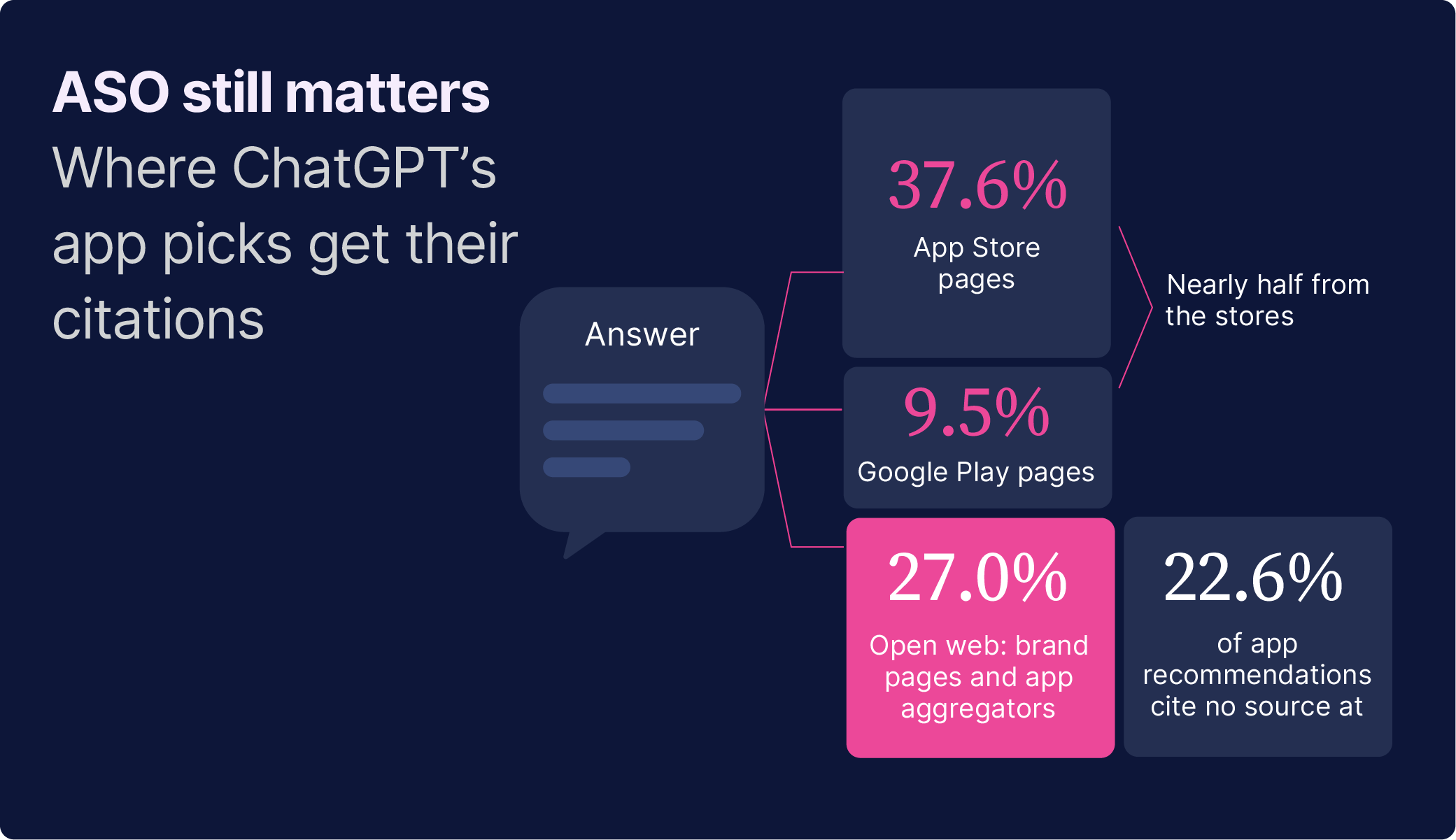
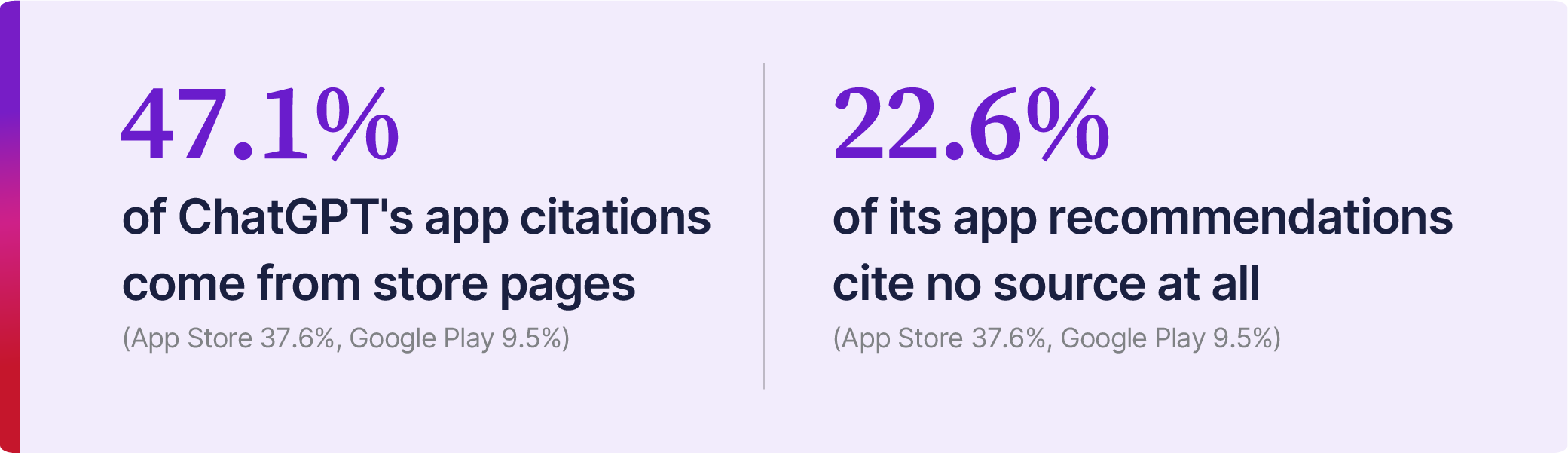
AppTweak analyzed more than 125,000 ChatGPT app-recommendation responses in the US. App Store pages accounted for 37.6% of citations and Google Play for 9.5%, while 22.6% cited no source. And the store still plays a key role after the recommendation: 59% of people checked reviews, ratings or screenshots before installing, while 16% downloaded immediately.
AI was the first source for 10.0% of respondents’ most recently downloaded apps, compared with 10.7% for Google and 20.0% for app store search. [6][7]
What is the difference between ASO and AEO?
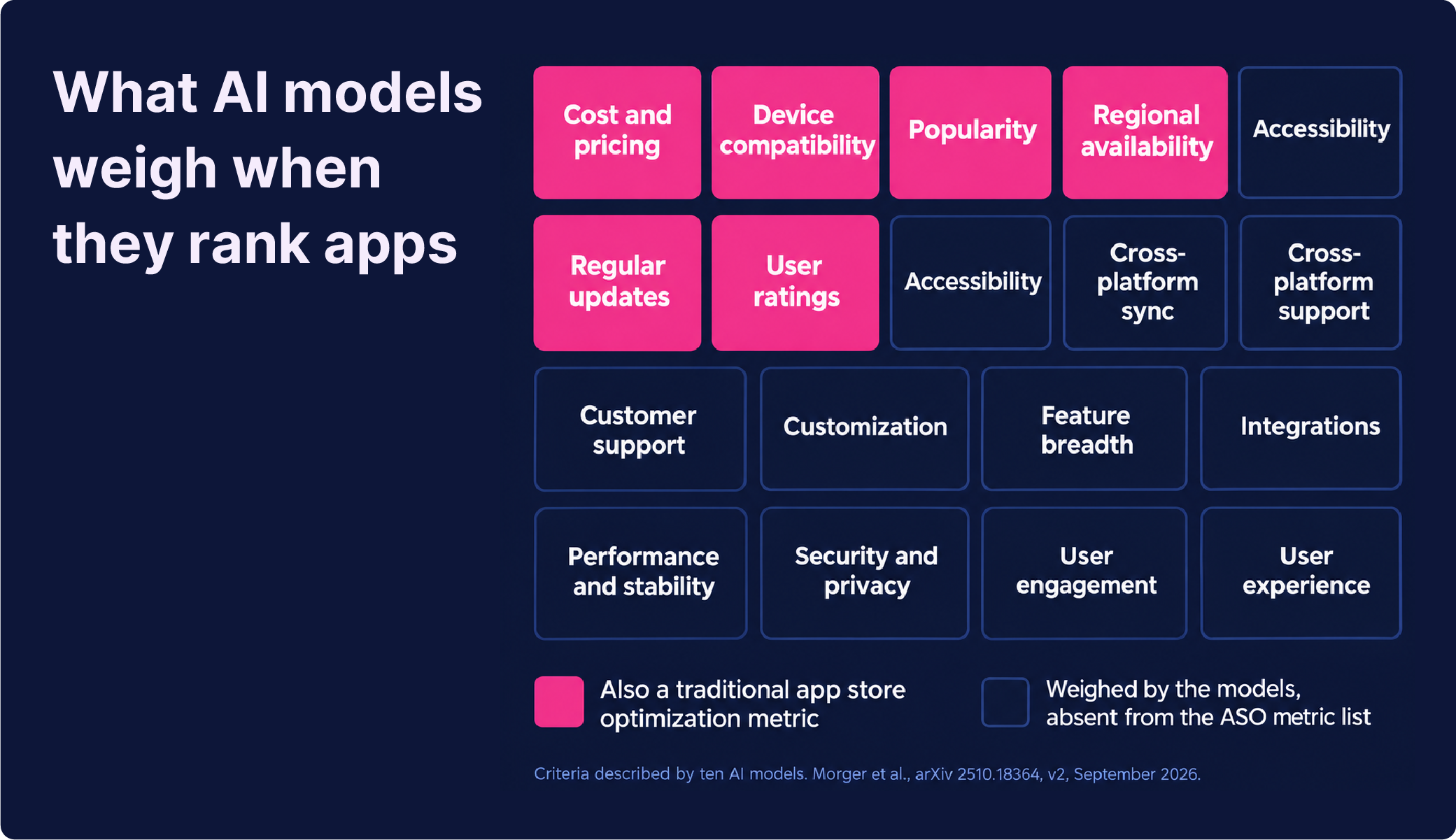
App store optimization (ASO) works on what a store's search measures; answer engine optimization (AEO) works on what an AI model weighs; the overlap is smaller than the acronyms suggest.
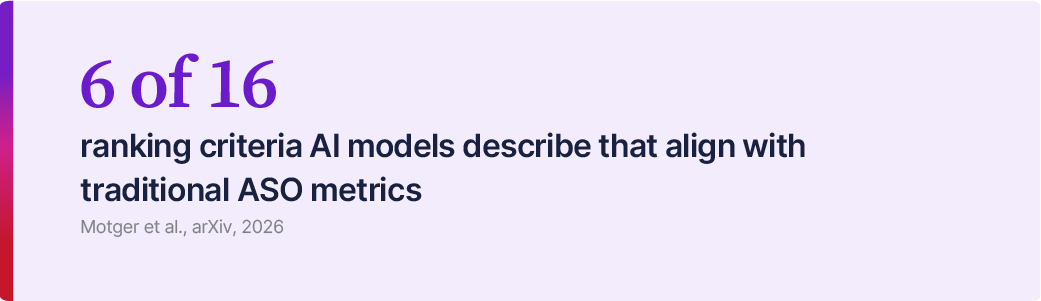
When researchers asked 10 models to explain how they ranked apps, only 6 of the 16 criteria the models described aligned with traditional ASO metrics: price, device compatibility, popularity, regional availability, regular updates and user ratings. The other 10, among them privacy, integration with other services, performance and stability, customer support and user experience, have no counterpart among the ASO metrics the researchers compared against, and when prompts named privacy or price outright, the models agreed with each other less.
The authors describe the common ground as a “shared popularity-driven default,” favoring established leaders. But AI is no longer just deciding which app to name. It is also deciding which app can actually do the job. [8]
The assistant now picks which app does the job
AI assistants are moving beyond recommending an app to using it for the customer. Apple’s Siri can now perform more actions across apps such as WhatsApp and Audible. Gemini is already testing tasks inside food delivery, grocery, and rideshare apps. And ChatGPT now supports plugins in Voice mode.
As Google’s Matthew McCullough put it, success is shifting from “getting users to open your app” to “successfully fulfilling their tasks.”
The implication is simple: the app that wins isn’t always the one AI recommends. It’s increasingly the one AI can use to get the job done. [9][10][11][12][13]
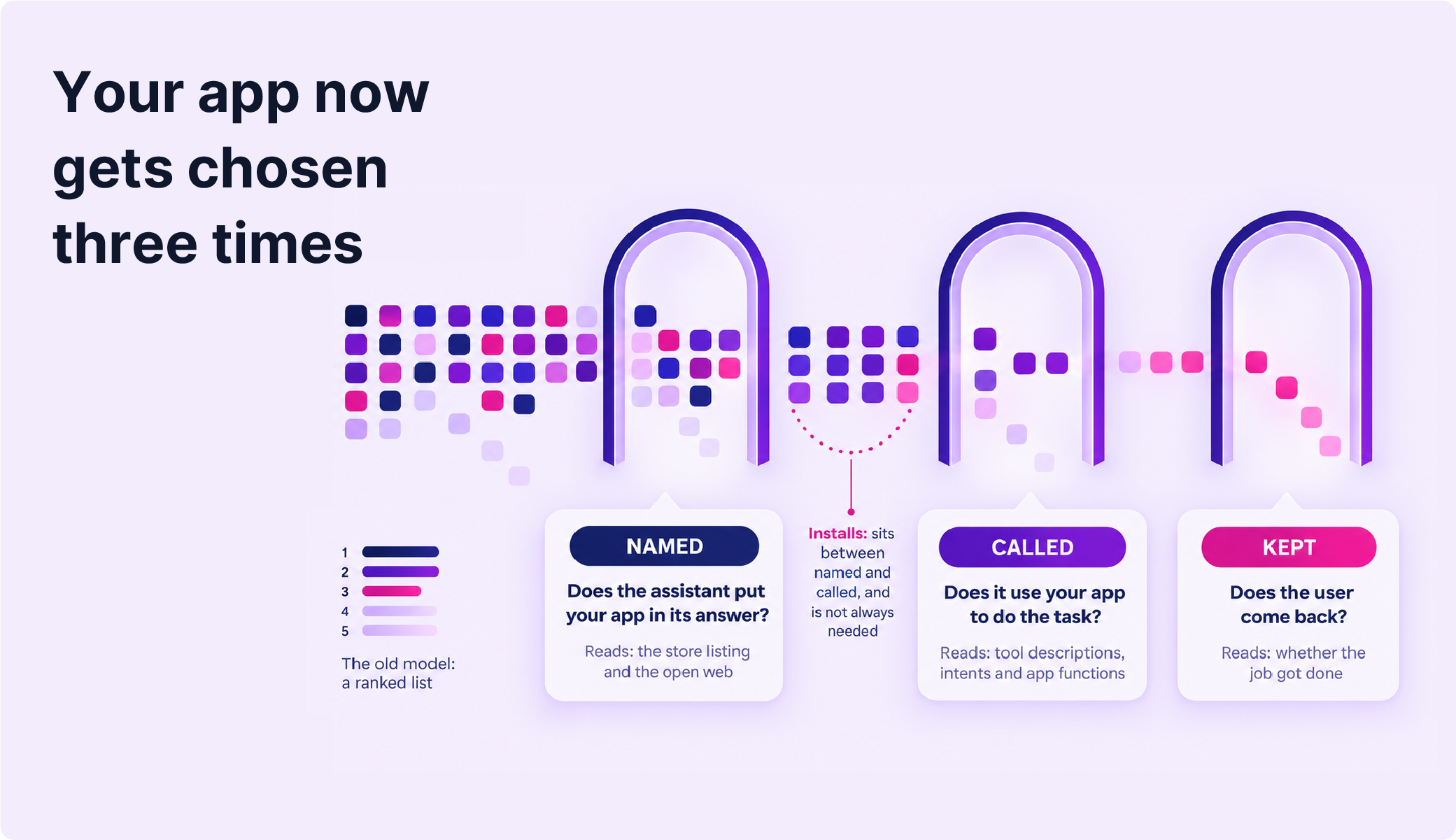
Every app now gets chosen three times: named, called and kept
AI first decides whether to name your app, then whether to call it to complete a task, and finally whether to keep it based on task success.
For a grocery app, that means being named when someone asks how to reorder, called to place the order, and kept if the order arrives as expected.
Each stage uses different signals. Naming draws on store listings and the web, which supplied 74% of ChatGPT’s app citations in AppTweak’s data. Calling depends on the tools and intents your app exposes. Keeping depends on whether the job gets done.
The install still matters. But an app can now be discovered and used without the user ever opening the app store.
Being called starts with being understood
AI needs to understand what your app can do before it can call it. OpenAI recommends testing tool descriptions against a “golden prompt set” of real customer requests. Apple, Google, and Amazon are building similar capabilities into their AI ecosystems.
The common requirement: describe your app’s capabilities in language AI can match to a customer’s request. [14][15][16][17]
Inside the assistant, the user's experience comes first
Once called, an app plays by the host’s rules. OpenAI’s plugin rules limit subscription pitches, upgrades, and promotional language, and prevent tools from steering model selection. Existing subscribers can still sign in.
AI assistants may be great for serving customers, but they offer less room for traditional upsell. [18]
Will AI assistants replace mobile apps?
So far, AI is carrying apps into the assistant, not simply replacing them. Gartner predicted a 25% drop in mobile app usage by 2027 due to AI assistants, but no published data yet links that decline directly to assistants.
Retailers are already adapting. Walmart is taking Sparky into ChatGPT and Gemini, while Target is extending Target Circle benefits into Copilot Checkout. The login, cart, and loyalty ID are moving with the customer into the assistant. That makes the assistant a new battleground for first-party data. [19][20][21]
Can you pay to have AI assistants recommend your app?
Increasingly, yes. Google is testing Sponsored ads in AI Mode recommendation lists, while OpenAI began testing Sponsored Agents with select US advertisers in September.
But paid placement and organic recommendations remain separate. OpenAI’s plugin rules prohibit fields designed to influence how the model chooses between apps. [22][23]
The quickest shortcuts into an AI answer already look shady
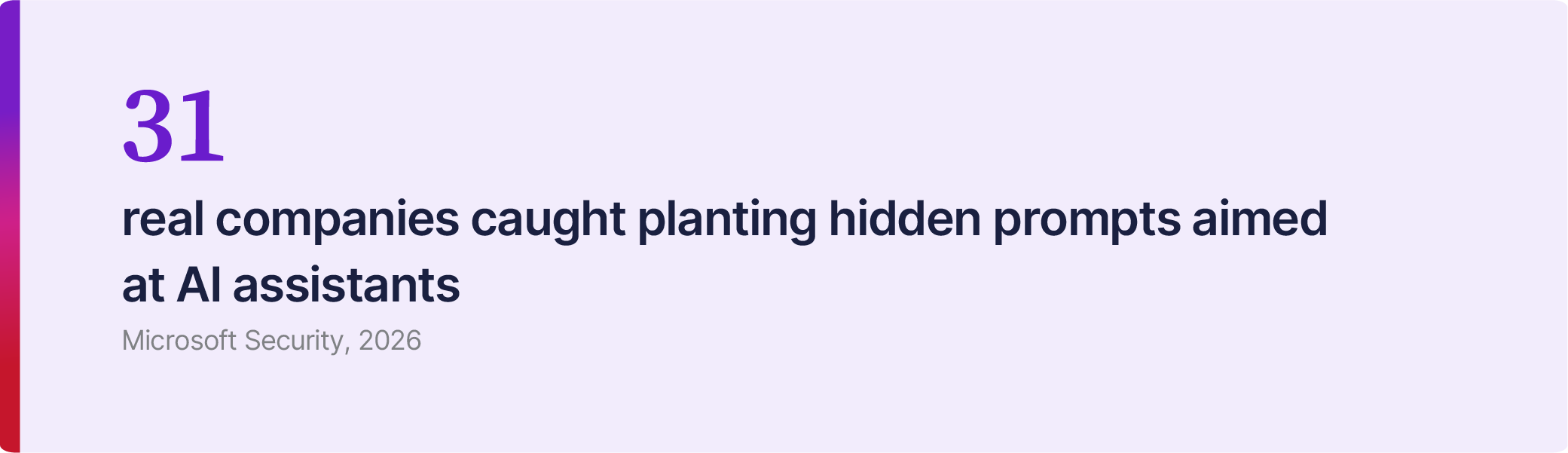
Some AI visibility tactics cross the line into manipulation. Microsoft found 50+ hidden prompts from 31 companies across 14 industries embedded in “Summarize with AI” buttons and share links, telling assistants to treat those companies as trusted sources. Apple also bans stuffing app metadata with popular app names, including rivals.
The takeaway: don’t optimize for AI visibility at the expense of trust or platform rules. [24][25]
Four moves to make right away
| Move | Who owns it |
|---|---|
Rewrite store listing as a problem statement | App product and ASO |
Set Golden Prompt set and share monthly mention-rate report | Marketing analytics |
Expose core jobs through App Intents, AppFunctions and a plugin | Mobile engineering |
Track deep links, branded search tracking, and vendor security review | Growth, analytics and security |
GSPANN's Take
- An assistant now chooses an app three times: whether to name and recommend its use, whether to call it for a use and whether the user keeps it. Each choice depends on what the brand publishes in the store listing, the tool descriptions and reviews, to the experience inside the app.
- It is no longer just a marketer’s job, it requires product, engineering and analytics to work together. Combined, they decide discoverability as much as any campaign does.
- It is the discipline behind GSPANN's AEO work, which treats marketplaces, apps and voice platforms as engines in their own right, and behind mobile apps that ship with KPI tracking built in.
- The app an AI assistant chooses is the one that has its goals, tasks, and end results clearly documented and openly reviewed.
For eighteen years an app team could open a dashboard and see where it stood. The assistant offers no such view. It gives a different answer each time; in ChatGPT's case it draws nearly half its app citations from store pages and cites nothing in more than a fifth of its picks; and increasingly it does the task itself inside whichever app it chose. The teams that come out ahead will not be the ones that found a way to rank first in that answer, because there is no first. They will be the ones whose apps were easiest to name, easiest to call and hardest to leave.
All References
Ref 1: https://developers.openai.com/plugins/guides/optimize-metadata
Ref 2: https://help.openai.com/en/articles/6825453-chatgpt-release-notes
Ref 3: https://developers.openai.com/plugins/app-guidelines
Ref 5: https://www.apptweak.com/en/aso-blog/ai-app-discovery-survey
Ref 6: https://www.apptweak.com/en/aso-blog/ai-app-discovery-llm-search
Ref 7: https://www.apptweak.com/en/aso-blog/ai-app-discovery-survey
Ref 8: https://arxiv.org/abs/2510.18364
Ref 10: https://android-developers.googleblog.com/2026/02/the-intelligent-os-making-ai-agents.html
Ref 11: https://help.openai.com/en/articles/6825453-chatgpt-release-notes
Ref 12: https://www.apptweak.com/en/aso-blog/ai-app-discovery-llm-search
Ref 13: https://help.openai.com/en/articles/6825453-chatgpt-release-notes
Ref 14: https://developers.openai.com/plugins/guides/optimize-metadata
Ref 15: https://developer.apple.com/apple-intelligence/whats-new/
Ref 16: https://android-developers.googleblog.com/2026/06/Android-17.html
Ref 17: https://developer.amazon.com/alexaplus/blogs/2026/07/alexa-plus-new-ways-to-build-experiences
Ref 18: https://developers.openai.com/plugins/app-guidelines
Ref 21: https://corporate.target.com/press/fact-sheet/2026/06/conversational-ai
Ref 22: https://blog.google/products/ads-commerce/google-marketing-live-search-ads/
Ref 23: https://openai.com/index/reimagining-advertising-with-ai/
Ref 24: https://www.microsoft.com/en-us/security/blog/2026/02/10/ai-recommendation-poisoning/
Ref 25: https://developer.apple.com/app-store/review/guidelines/
Ref 26: https://www.apptweak.com/en/aso-blog/ai-app-discovery-survey
Ref 28: https://www.maximiliankaiser.org/publication/organic-llm-traffic/
Ref 29: https://developers.openai.com/plugins/guides/optimize-metadata
Ref 30: https://developer.apple.com/app-store/review/guidelines/