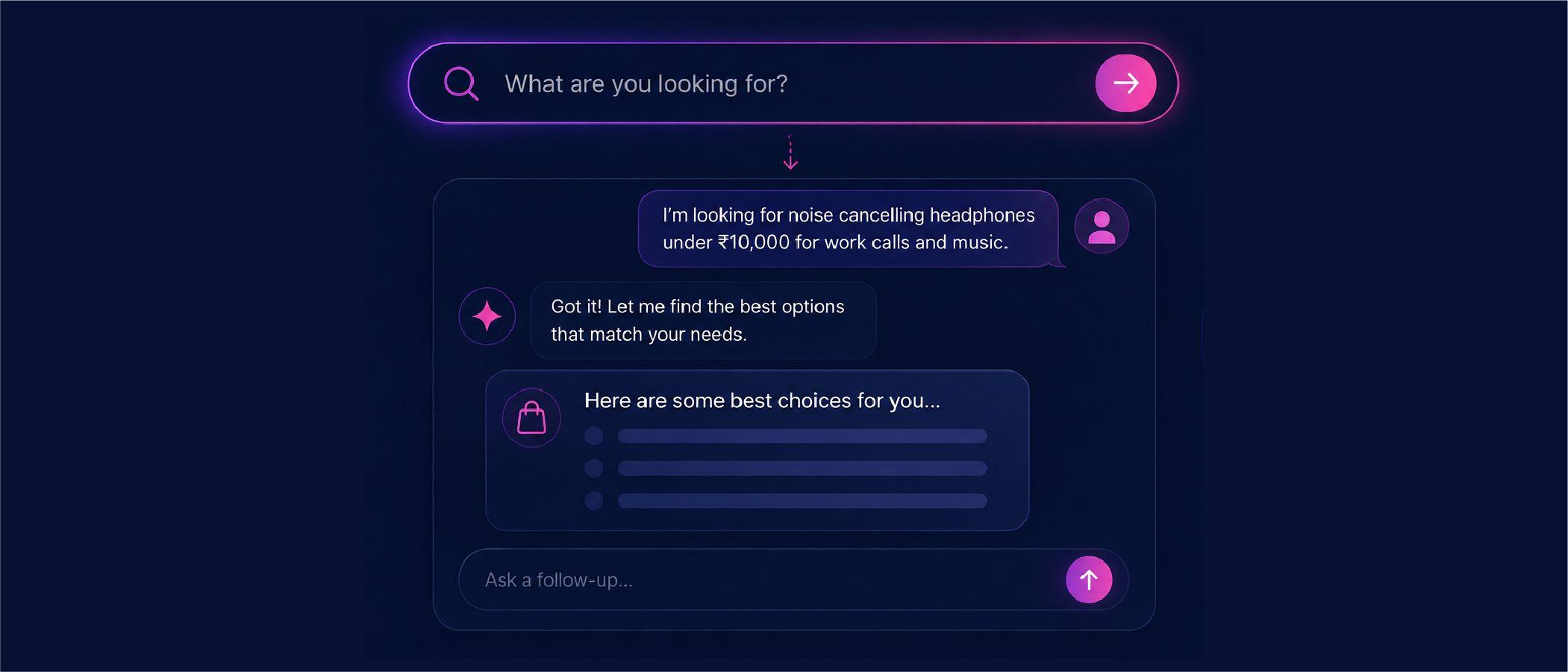

Ask ChatGPT which trail shoes suit wide feet, and it may name brands, link to their websites and pull prices from merchant data the brands may never have provided. For many shoppers, that answer is already the shortlist.
Launched in beta on November 10 2026, ChatGPT Business Hub gives businesses a free dashboard to verify their profiles, upload product feeds, and track how often ChatGPT cites their websites. Eligible US sellers can also publish a Business Agent to answer shopper questions inside ChatGPT.
For retailers, the ChatGPT Business Hub is a new way to reach ChatGPT’s 1.2 billion weekly users, something that businesses have been struggling with for the last couple of years. But visibility isn't guaranteed, published profiles cannot be removed later, and businesses are responsible for agent responses without access to the conversations behind them. [1]
Getting started is free. But retailers should understand what they're signing up for before jumping in.
What is ChatGPT Business Hub?
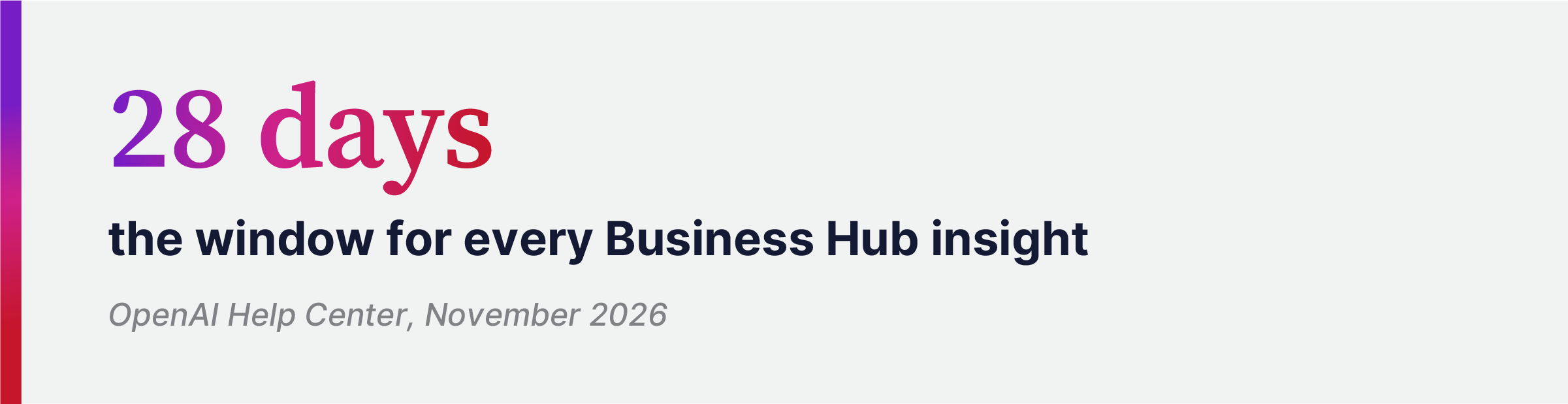
ChatGPT Business Hub is a dashboard in the ChatGPT sidebar where businesses manage how they appear on ChatGPT. Verified businesses can update their profile, add logos and policies, upload product feeds with pricing and availability, and track 28-day metrics such as mentions, website clicks and discovery topics.
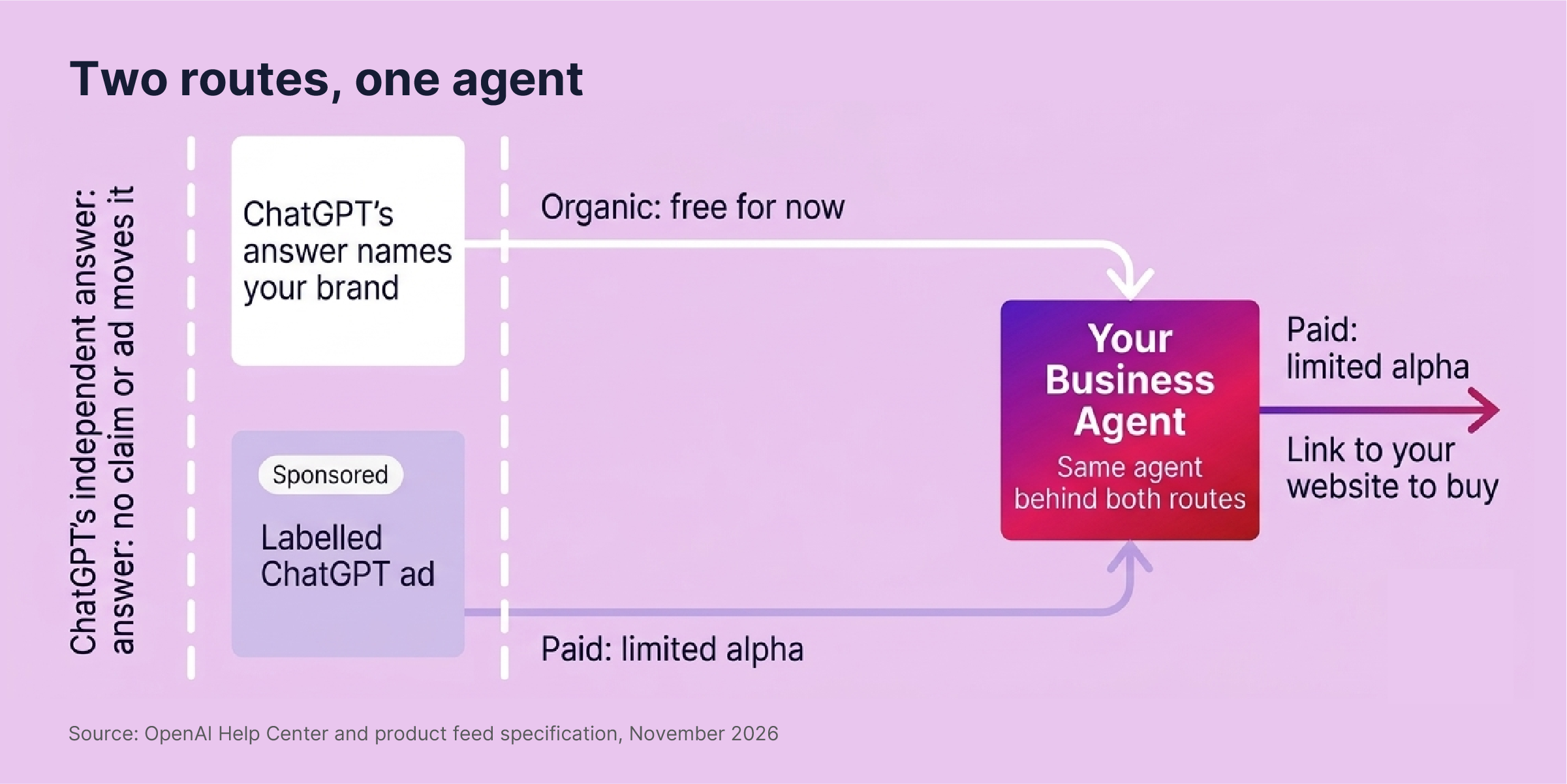
Eligible US businesses can also create a Business Agent, a dedicated chat powered by their product data and instructions. Shoppers can access it through the business profile or a ChatGPT ad.
Businesses can claim profiles wherever ChatGPT is available, but Business Agents are currently limited to the US. Shopify merchants can connect their stores directly, while others can upload product feeds.
Together, these features give businesses more ways to be discovered and engage with shoppers who increasingly use AI assistants for product research. [1] [2] [3]
Shoppers are forming their shortlist before they visit your site
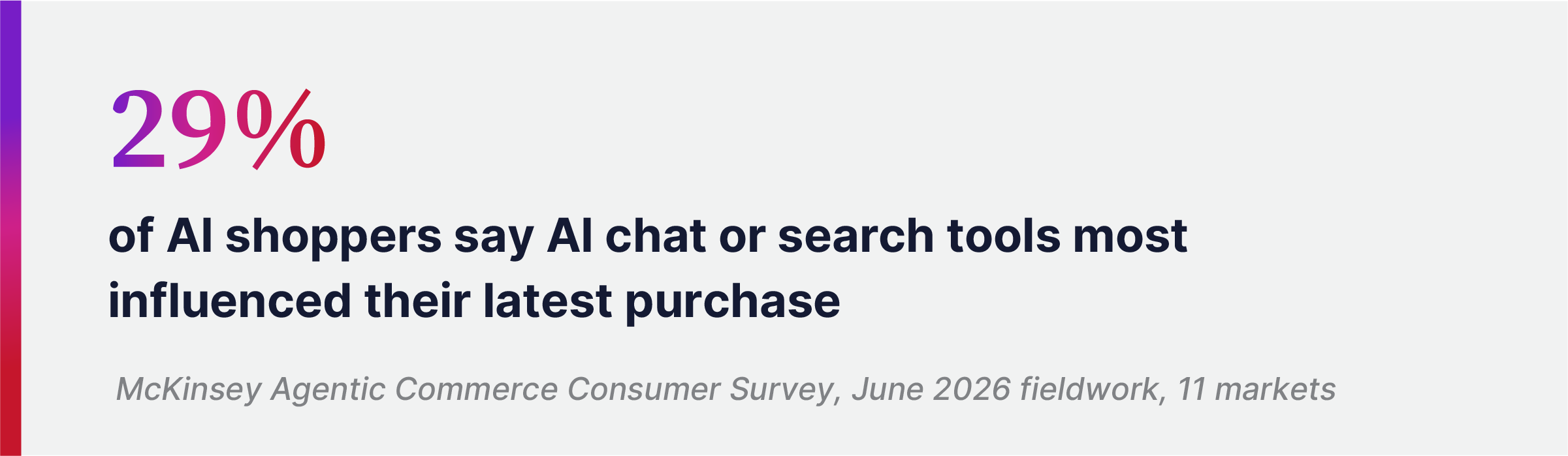
McKinsey's survey found that 29% of AI users said AI chat and search tools had the biggest influence on their latest purchase. That's more than search engines (9%) or retailers' own AI assistants (10%). More than half (56%) had used AI tools in the previous three months. [4]
And shoppers arriving from AI are more likely to buy. In September, AI-driven traffic to US retail sites converted 90% better than other traffic, according to Adobe. [5]
This is where the Business Agent comes in. It gives brands a voice while shoppers research and compare products. [6]
Claiming a business profile doesn’t automatically guarantee visibility
OpenAI clearly states that claiming a business profile doesn't guarantee better visibility or influence ChatGPT's recommendations. It also says advertising doesn't affect ChatGPT's independent answers. OpenAI's VP of Monetization, Benji Shomair, told Digiday that claiming a business shouldn't affect how often it appears. [2] [6]
So why claim? It helps keep business information accurate, making it easier for ChatGPT to recommend a brand when it's relevant. Being present doesn't mean being preferred. ChatGPT still decides when and where to mention a business.
Does ChatGPT show my business if I don't claim it?
Yes. ChatGPT can show your business even if you haven't claimed a profile. It pulls information from multiple sources, including third-party providers, and may create its own product titles, labels, and review summaries. Shopify products may also appear automatically through Shopify Catalog, with no extra work from merchants. [3], [7] [8]
Being a verified profile counts when ChatGPT ranks sellers
ChatGPT ranks merchants based on availability, price, quality, and whether they make or primarily sell the product. [8]
For brands selling direct, a verified profile and their own product feed help ChatGPT identify them as the maker. Retailers selling the same product may lose out on that advantage.
Structured product data matters too. Shopify reports that AI searches using its structured catalog convert at roughly twice the rate of searches relying on scraped or outdated data. [4]
ChatGPT may also show the first merchant's price, which isn't always the lowest. Delayed feed updates can mean shoppers see outdated prices. Getting control of your brand profile and product feed right matters.
A published profile cannot be taken down, so choose who claims it carefully
Claiming requires business verification through a phone, email, website DNS record (TXT record), or Shopify login, followed by an identity check through Persona. Once approved, the claimant becomes the admin and controls access for teammates and agencies.
If someone else has claimed the profile, you'll need to dispute ownership. OpenAI Support cannot delete or hide published profiles, making ownership a serious consideration. As search blogger Barry Schwartz noted at launch, businesses also risk having their profiles hijacked. [2] [9]
Hence, be careful about who claims your brand's profile. That person controls access to it, and businesses managing multiple brands will need to claim each profile separately.
Large retailers with many brands and stores come later
OpenAI doesn't yet offer central management for retailers with multiple brands and stores. Each brand must be claimed separately, and claiming the main brand doesn't cover its individual stores. Some location profiles also remain locked by default. Enterprise customers and advertisers need to work through their OpenAI representative, with more tools for larger organizations still to come. [2] [3]
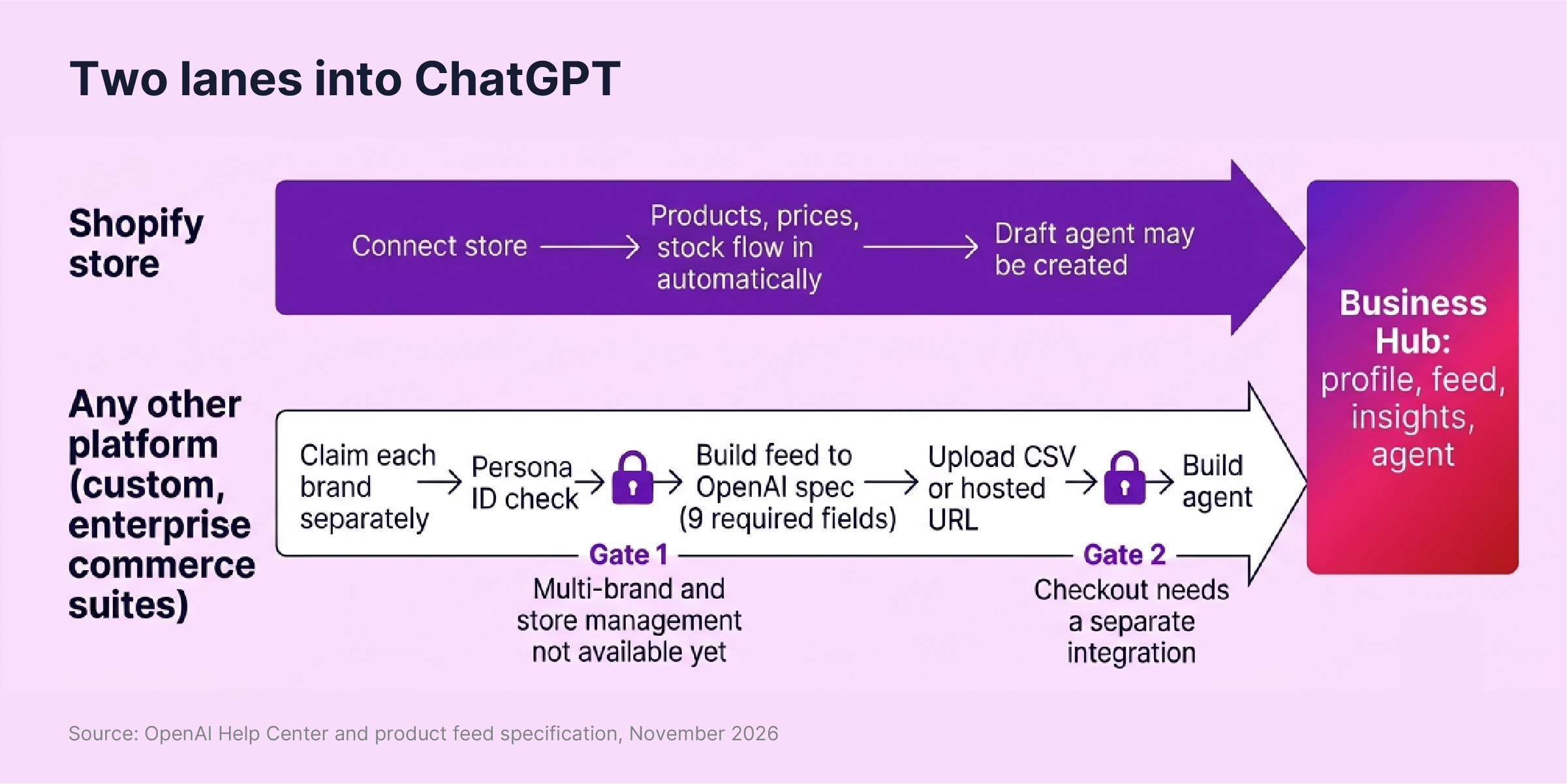
Shopify merchants have it easier. Their product details, prices and availability are shared automatically. Retailers using Salesforce Commerce Cloud, commercetools, Adobe Commerce or their own platforms must create a ChatGPT product feed that meets OpenAI's specifications. This requires nine fields, defaults to the US market and needs a separate integration for checkout. [10]
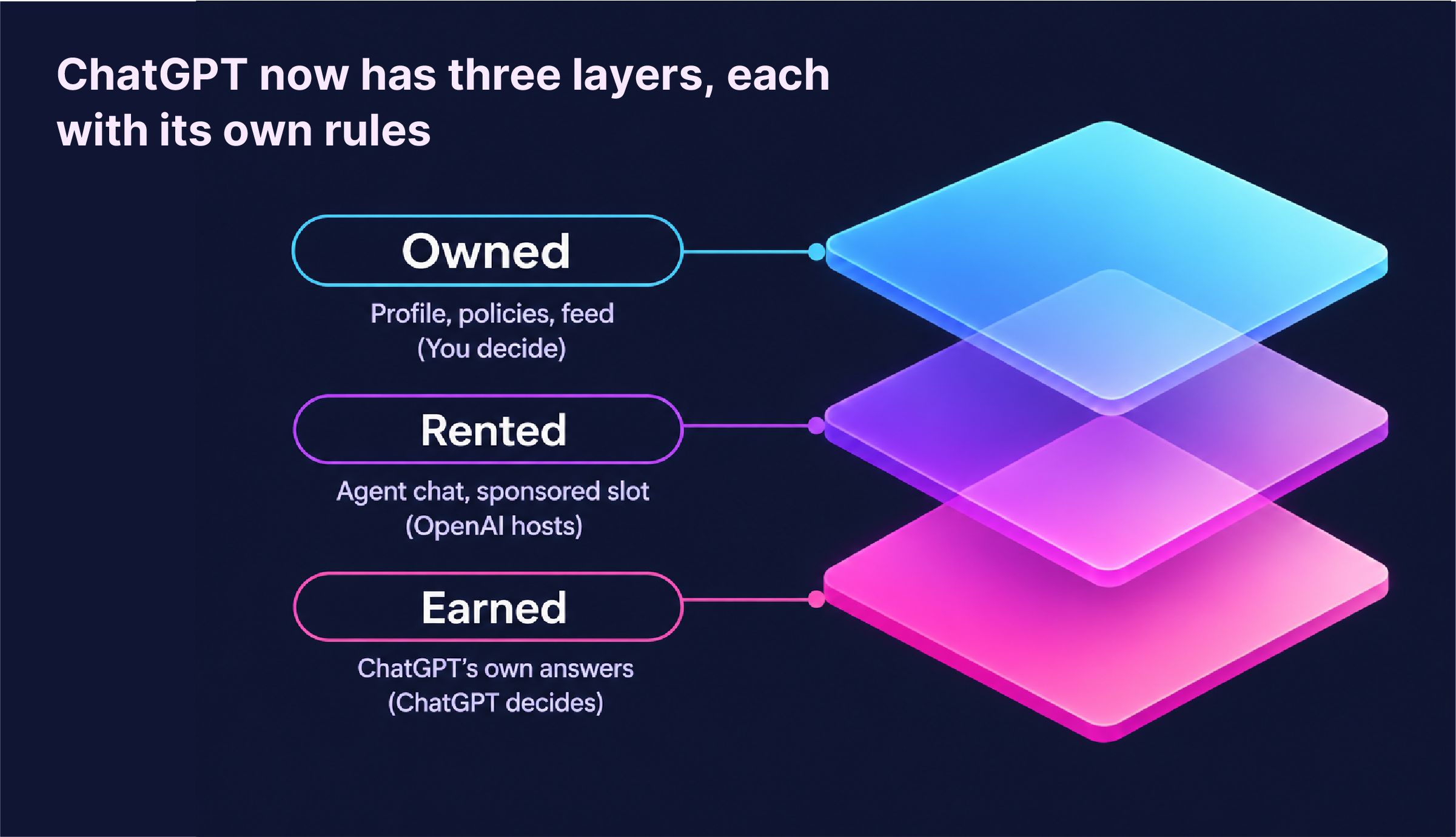
ChatGPT now has three different layers, each with its own rules
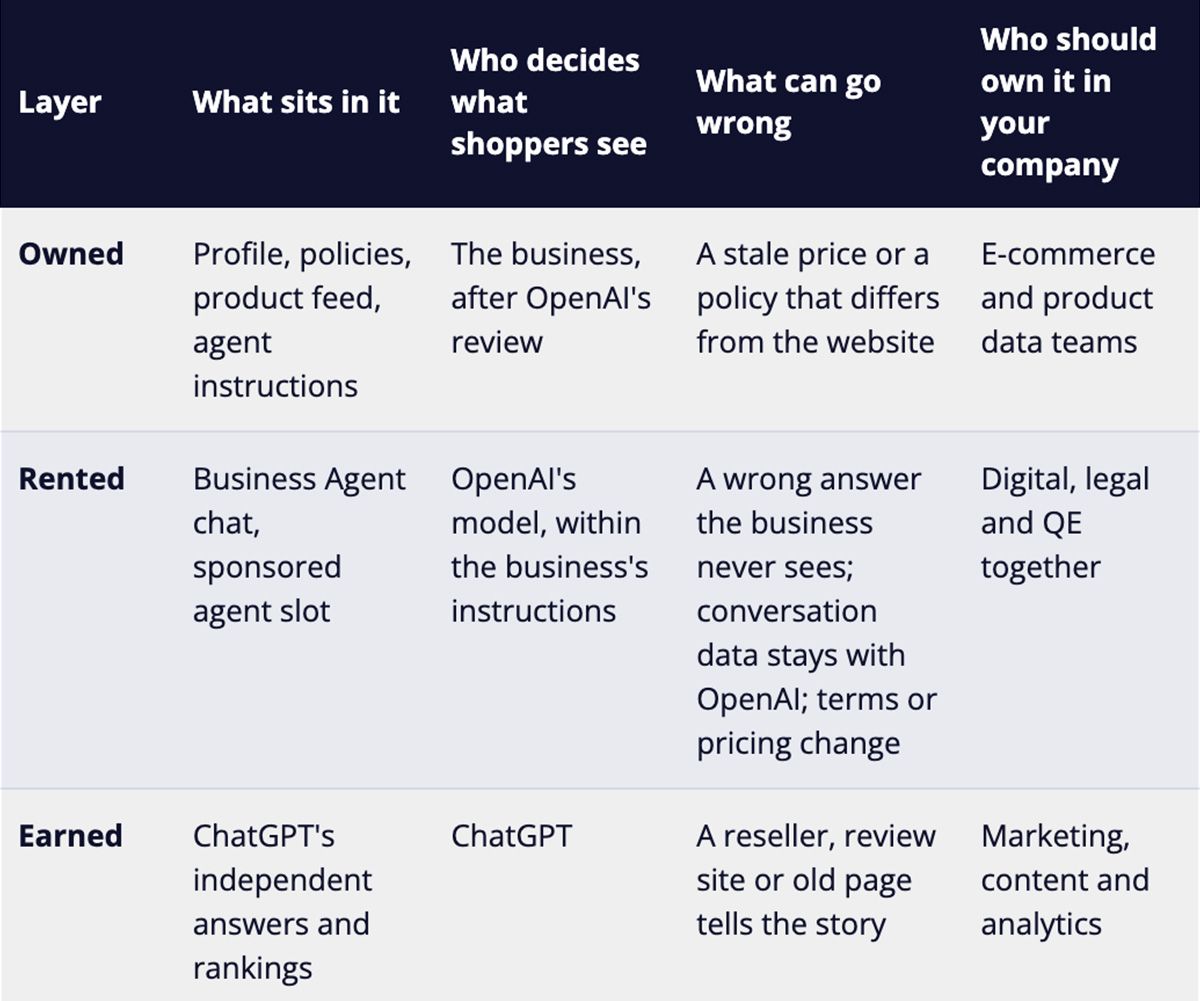
The owned layer is what a business supplies, from profile details and policies to the feed and the agent's instructions. OpenAI reviews all of it before it appears, and the business answers for all of it. [2]
The rented layer is the space OpenAI lets a business occupy: the Business Agent's chat and, for advertisers, the sponsored slot that points to it, hosted on OpenAI's surface, where OpenAI keeps the conversations, free "for now" and subject to suspension under its policy. [6] [11]
The earned layer is ChatGPT's own answer, written from the owned layer plus everything else the model reads, and OpenAI says neither claiming nor advertising moves it.
The ChatGPT Business Hub launch has changed the first two layers and left the third layer for the shoppers to make up their minds. The rented layer is the only place a brand has the power to control its agent.
Can a ChatGPT Business Agent take orders?
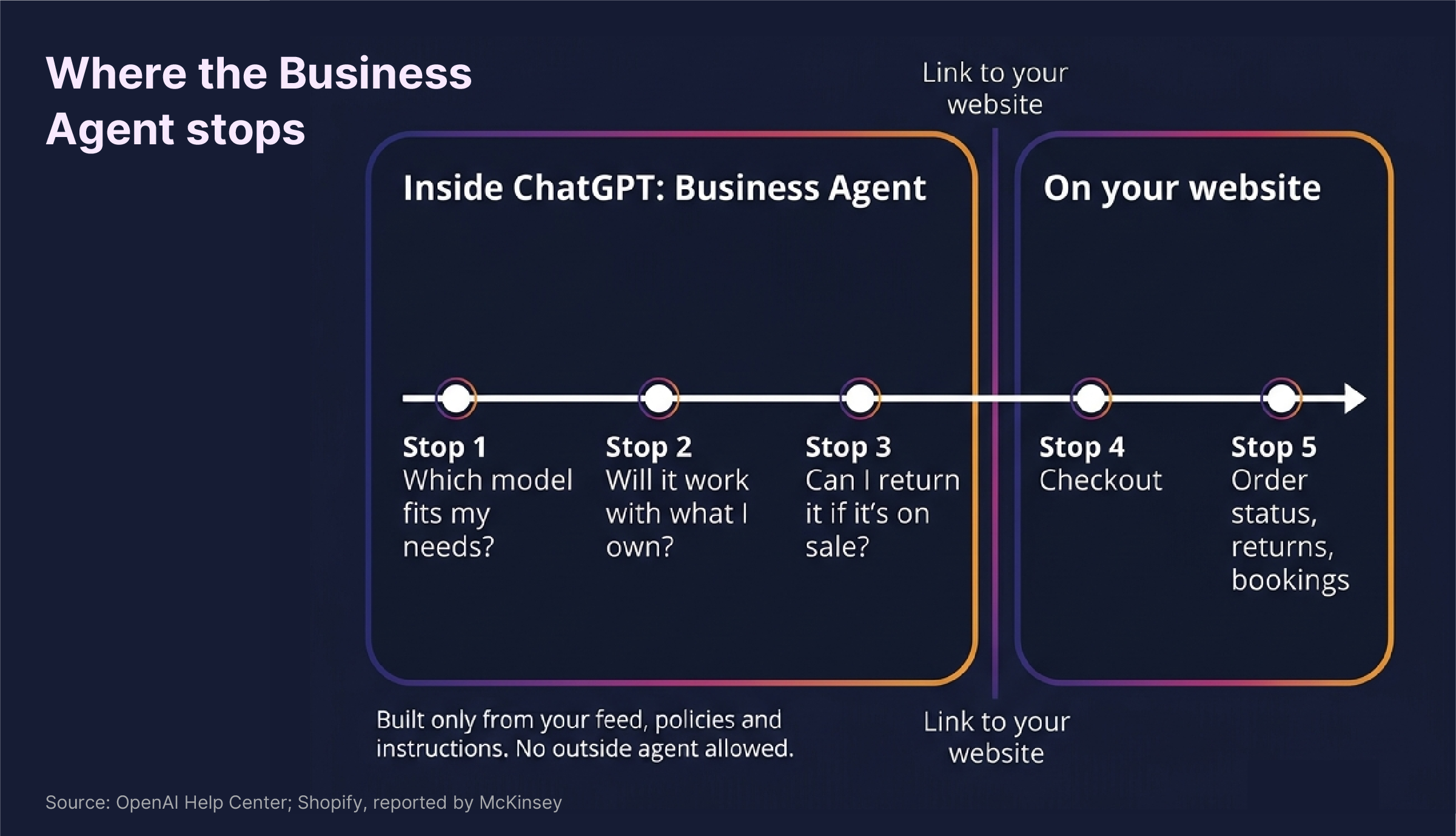
No. It answers product and policy questions but sends customers to the business's website to complete purchases. Businesses cannot plug in their own agents, and the Business Agent doesn't use data from their existing ChatGPT apps. [2] [6]
Its role is to help customers make informed decisions about sizing, compatibility and returns. Get those answers wrong, and you risk losing both the sale and the customer's trust.
Who is liable when a ChatGPT Business agent gets an answer wrong?
The business is responsible for the information its agent provides. OpenAI's policy makes this clear. Agents cannot make up prices, offers, availability, reviews or guarantees, hide fees, use pressure tactics or make high-stakes decisions without human review. They must also identify themselves as AI representing the business. [11]
But what happens when a business provides the correct information and the AI gets it wrong? OpenAI's policy doesn't clearly address this. In 2024, a Canadian tribunal held an airline responsible after its website chatbot gave a customer incorrect refund information. [12]
With ChatGPT, there's another complication: businesses don't get access to individual customer conversations with their agents, making it harder to know what went wrong. [2]
How do we see how often ChatGPT mentions my brand?
The Insights dashboard in Business Hub shows brand activity over the past 28 days, once your claim and Persona check are approved.
A ‘mention’ is counted only when ChatGPT links to your website, not when it simply names your brand. Website clicks track clicks on links, not actual visits or purchases. Discovery topics show themes from answers that cited your business, not individual prompts. [2]
Share of voice against competitors isn't available yet. Also, blank metrics don't necessarily mean zero activity. They may reflect activity below an unpublished reporting threshold.
ChatGPT's definitions also mean its numbers may differ from third-party AI visibility tools. [6] [13]
OpenAI's counts won’t match your analytics or your GEO tools
Most AI visibility tools track how often a brand appears in answers to prompts they create. OpenAI tracks brand website mentions in real conversations. So, the numbers won't match. Clicks won't match analytics sessions either. OpenAI says a click doesn't necessarily mean someone visited the site or converted. [2]
Farhad Divecha, CEO of Accuracast, told Digiday that wildly inaccurate third-party estimates could make brands reconsider paying for these tools. Sonata Insights analyst Debra Aho Williamson pointed out that ChatGPT is only one of several AI platforms. [6]
Both make valid points. Brands need a shared definition of an AI mention and an AI visit so marketing, analytics and agency teams are working with the same numbers. Discovery topics are the only OpenAI metric without an equivalent elsewhere.
Discovery topics show where ChatGPT already cites you, but not where you’re missing out
They group themes from ChatGPT answers that cite your website, but don't show where competitors appear instead. Compare them with your site search data and service logs to spot gaps in your product content. [2]
Before updating your profile, capture a baseline of ChatGPT answers to fixed buyer questions so you can measure the impact later. As consultant Hans van Gent advises, you need a starting point to track change. [14]
Brands may soon even be able to pay for a place in these conversations, at least in theory.
Can brands pay to appear in ChatGPT?
Yes. Brands can pay to appear alongside ChatGPT's answers, but not within them, according to OpenAI. ChatGPT ads are available on Free and Go plans, with more than 100,000 advertisers running campaigns as of October 21. [15]
Sponsored placements can also take shoppers directly to a brand's Business Agent. OpenAI calls this a limited alpha test, so it's still early days. [16]
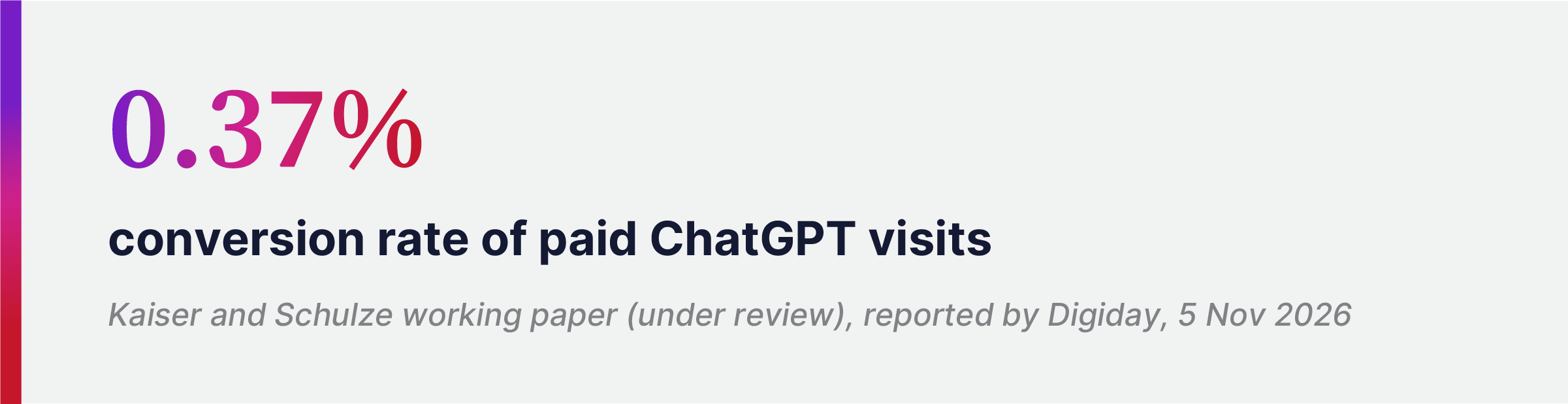
And does it work? Digiday reports that one study found paid ChatGPT traffic converted at 0.37%, compared with 1.17% for paid Google Search. The findings are still under review. [17]
Business Hub and agents are free for now, but that could change. Retailers may want to start setting them up while they can, alongside the tools they already use on Google. [6]
GSPANN'S TAKE
Claim your business profile today, but be extra careful on the business agent.
Here’s how you should approach the ChatGPT Business Hub:
- Claimed: claim every brand now, with IT adding the domain record and a named owner holding the admin seat. A published profile cannot be removed, and a disputed one takes identity checks to recover. [2]
- Findable: before the profile changes anything, log ChatGPT's answers to fifty to a hundred buyer questions per brand on product fit, price, delivery and returns, then read them against the discovery topics each month.
- Verifiable: generate the feed from the same PIM and price service that runs the website, refresh it at least daily, and match the delivery and return policies in the profile to the site word for word. Product content needs the same discipline, and a tool such as ContentHubGPT prepares it from approved product facts so that product pages, retailer listings, FAQs and the profile ChatGPT reads all answer a shopper's question the same way. [10]
- Explainable: publish the agent when it passes your test set, and hold regulated and high-consideration categories until OpenAI publishes the industry requirements its policy refers to. [11]
- Measurable: agree what an AI mention and an AI visit mean before the first monthly report, so OpenAI's counts, your analytics and your agency's tracker sit in one view.
None of these steps depends on trusting OpenAI's counts, which is fortunate, because few of them can be checked.
Most brands will claim their profile this month, because it costs nothing and the blue check is visible to shoppers. The harder part comes after. A brand's price, stock and return terms now have to be right in one more place, on a surface where it cannot read the conversations, and an agent it never wrote word for word speaks in its name. OpenAI has given brands a seat in the conversation that picks the shortlist, and what gets said from that seat is theirs to answer for. Your next lost sale may never appear in your website analytics.
Frequently Asked Questions About ChatGPT Business Hub
Is ChatGPT Business Hub free?
Yes, for now. At launch a business pays nothing to claim its profile, edit it, connect a product feed, view insights or publish a Business Agent, but OpenAI's VP of monetization, Benji Shomair, told Digiday that a paid model is not ruled out. Advertising is separate: a sponsored Business Agent is sold through ChatGPT Ads, and that format was still a limited alpha test in late October 2026.
Does claiming my business in ChatGPT improve my ranking?
No ranking gain is promised. OpenAI's help center says claiming "doesn't guarantee increased visibility or give you direct control over ChatGPT's independent recommendations," and that advertising does not influence its independent answers. What claiming does is give ChatGPT accurate first-party information, which OpenAI says can help it surface a business in more relevant conversations.
Can a ChatGPT Business Agent take orders, process returns or check order status?
No. At launch a Business Agent explains products and policies and links to the retailer's website, where the customer buys, returns or tracks an order. It is built from the business's product feed, policies and instructions, cannot be swapped for the retailer's own agent, and does not use data from any ChatGPT app the retailer already runs.
Can I delete my business profile from ChatGPT?
Only before it is published. OpenAI Support cannot delete, unpublish or hide a published profile, and ChatGPT may show information about a business whether or not anyone has claimed it. If someone else has claimed your business, the "Dispute ownership" option in Business Hub starts a Persona identity check to prove you represent it.
Can a retailer manage several brands or store locations in one Business Hub account?
Not yet. Each brand is claimed and managed separately. Claiming the main brand does not claim its stores, and location profiles under OpenAI's managed claim process stay locked by default. OpenAI says tools for organisations with more complex needs will follow, and it tells larger retailers to work through their OpenAI account contact.
What do ChatGPT Business Hub insights show?
Aggregated counts over the past 28 days. Mentions count only when ChatGPT references the business's website, website clicks do not confirm a visit or a purchase, and discovery topics group the themes of answers that cited the business. Businesses see no prompts, conversations or Business Agent chats, and the beta reports no share of voice against competitors.
All References
Ref 1: https://openai.com/index/introducing-businesses-chatgpt/
Ref 2: https://help.openai.com/en/articles/20001635-setting-up-your-business-on-chatgpt
Ref 3: https://openai.com/business/businesses-in-chatgpt/
Ref 5: https://business.adobe.com/blog/ai-traffic-higher-revenue-per-visit-retail-holiday
Ref 7: https://openai.com/policies/businesses-in-chatgpt/
Ref 8: https://help.openai.com/en/articles/11128490-shopping-with-chatgpt-search
Ref 9: https://www.seroundtable.com/chatgpt-business-hub-42505.html
Ref 10: https://developers.openai.com/commerce/specs/file-upload/products
Ref 11: https://openai.com/policies/business-agents-policy/
Ref 12: https://www.canlii.org/en/bc/bccrt/doc/2024/2024bccrt149/2024bccrt149.html
Ref 13: https://www.gspann.com/insights/blog/product-information-management-ai-agents
Ref 14: https://hansvangent.substack.com/p/chatgpt-business-hub
Ref 15: https://openai.com/index/chatgpt-ads-expands-26-new-countries/